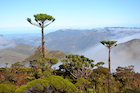
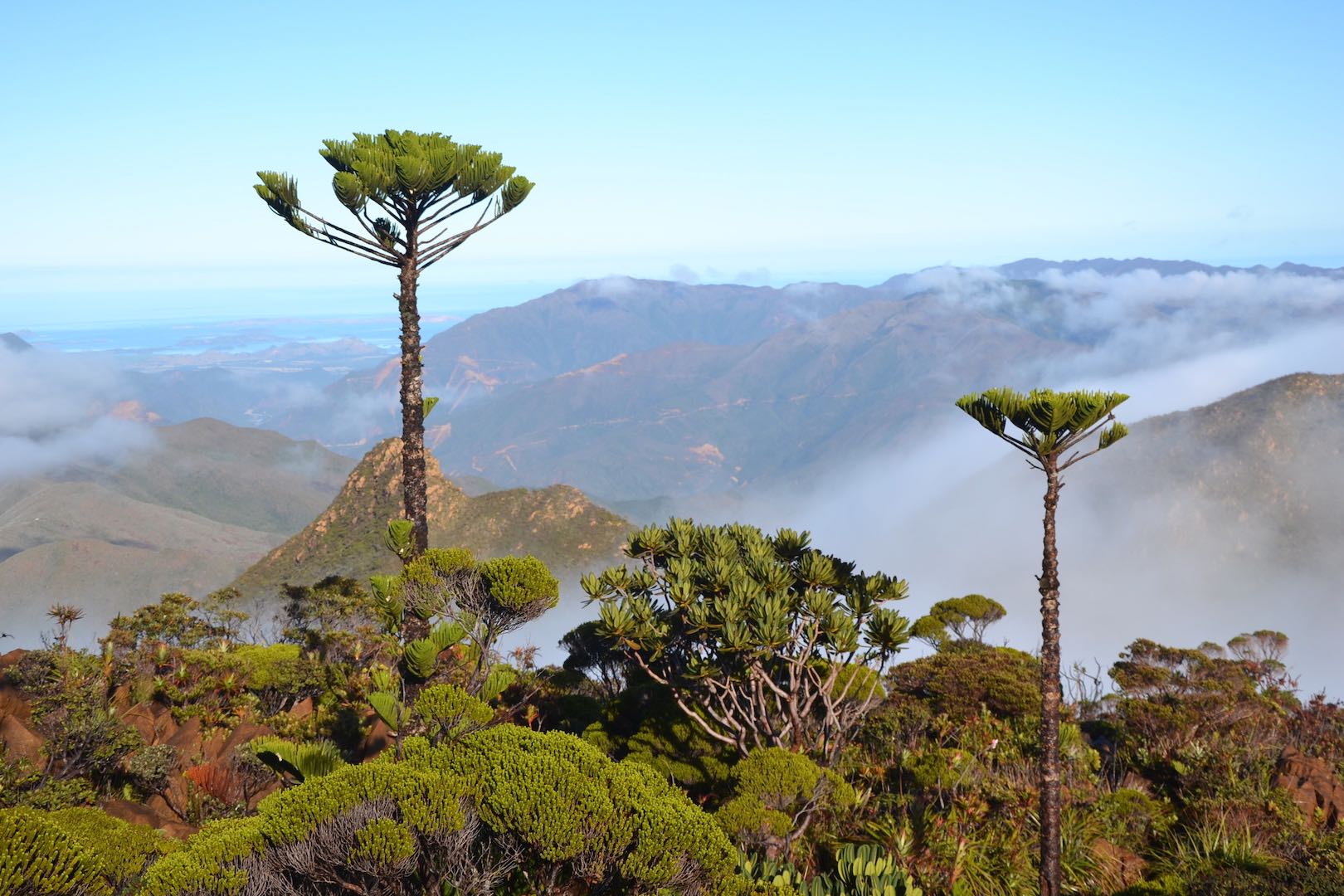
Trees in habitat, Mt Humboldt summit; iNaturalist observation 6153803 [V. Tanguy, 2015.07.25]
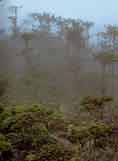
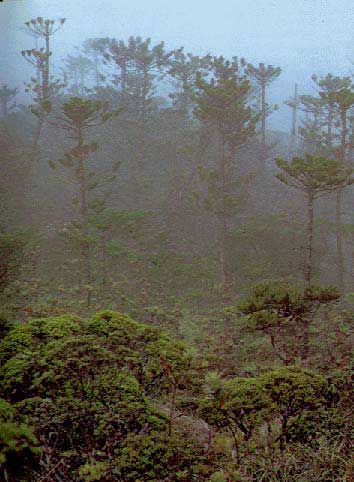
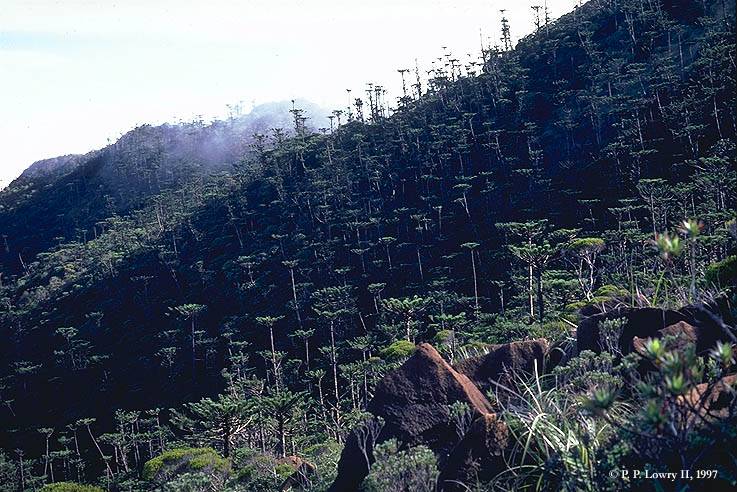
"An open stand of Araucaria humboldtensis dominant on maquis at near 1100 m. Fogs are common at this altitude" (Schmid 1981).
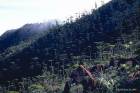
Stand of A. humboltensis in the mountains of New Caledonia (Lowry 1996).
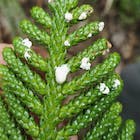
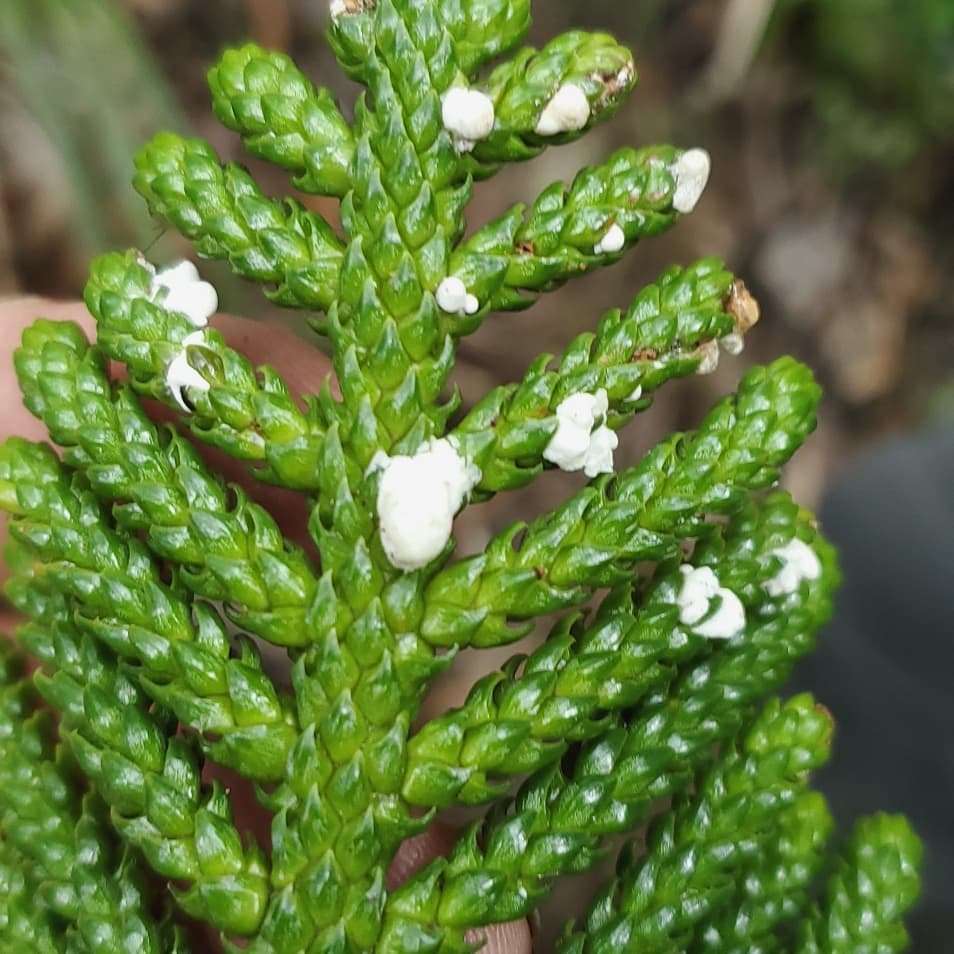
Resin exudate on foliage near the summit of Mt. Humboldt, New Caledonia [Adam Black, 2020.02.01, Facebook post].
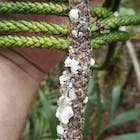
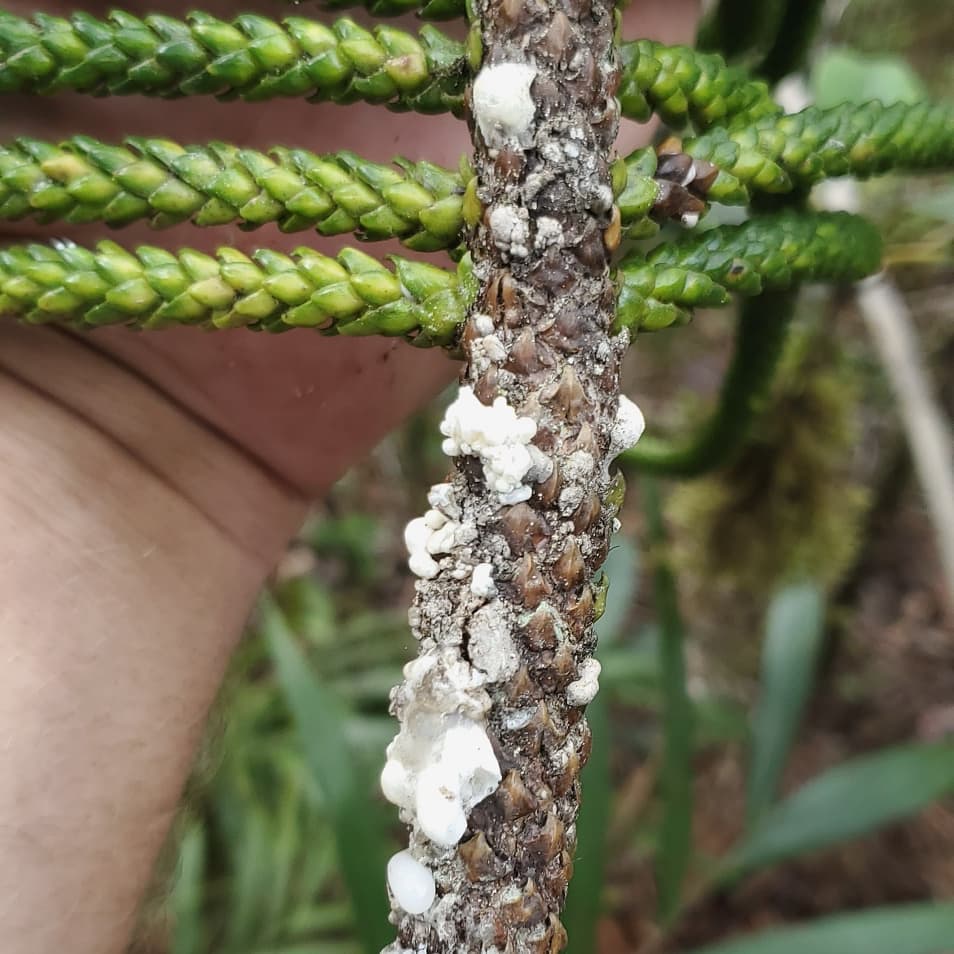
Resin exudate on a twig near the summit of Mt. Humboldt, New Caledonia [Adam Black, 2020.02.01, Facebook post].
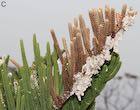
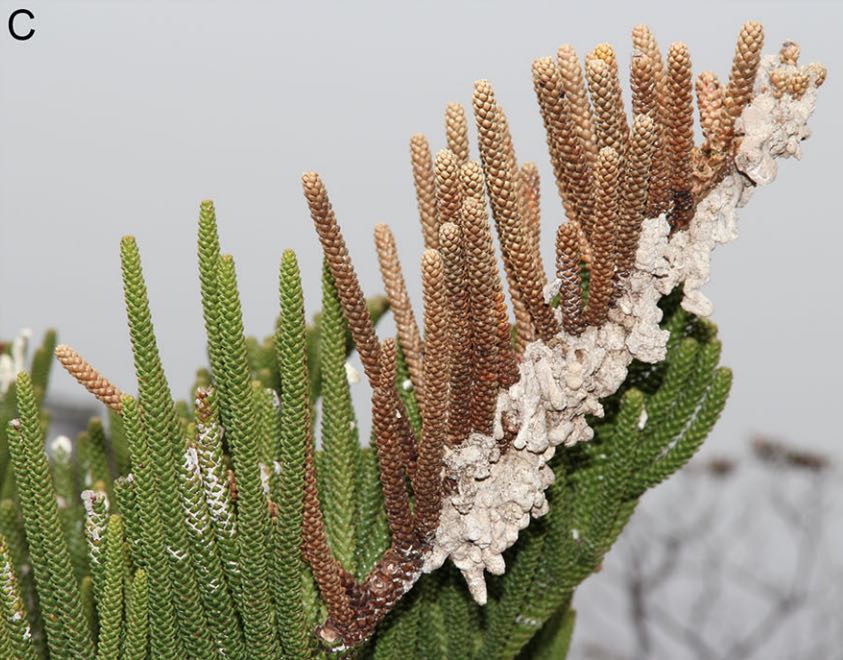
Massive resin outpouring and death of branch end after infestation by boring weevil (Figure 2c in Beimforde et al. 2017).

Araucaria humboldtensis
J.Buchholz 1949
Common names
Mt. Humboldt araucaria, L'Araucaria du Mont Humboldt [French].
Taxonomic notes
Syn.: Eutassa humboldtensis (J.T. Buchholz) de Laub. 2009. A molecular analysis places Araucaria humboldtensis into the clade of large-leaved species of New Caledonia, along with A. biramulata, A. laubenfelsii, A. montana, A. muelleri, and A. rulei, and a principal components analysis shows it as clearly distinct from a group containing all of the other species in the clade; this result, however, has not been explained (Gaudeul et al. 2012).
Description
"A tree 6-15 m tall, with a candelabra-like crown. Bark exfoliating in quadrangular scales or in thin strips, bright brown turning gray. Branches somewhat in one plane, in a V-like pattern, 8-10 mm. in diameter. Juvenile leaves scale-like, triangular, 2.5-4 mm. long by 2-3 mm. wide, apex incurved. Adult leaves scale-like, midrib prominent, keeled, ovate, apex acuminate and incurved, 5-6 mm. long by 4-5 mm. wide. Male cone cylindrical, to 6 cm. long by 15 mm. wide, twisted, microsporophylls triangular, pollen sacs 6. Female cone subglobose, 9 cm. long by 8 cm. wide; bracts erect to 6 mm. long. Seed to 3 cm. long with a broad nut and with broad wings. Germination epigeal" (Silba 1986).
Distribution and Ecology
S New Caledonia: Mt. Humboldt, Mt. Mou and Mt. des Sources, 750-1500 m (Silba 1986), on ultramafic substrates (Schmid 1981). it is the dominant tree near the summit of Mt. Humboldt (Beimforde et al. 2017).
This map shows herbarium records of Araucaria species native to New Caledonia. Letter corresponds to first letter of species epithet (A. goroensis coded as A. muelleri, see A. goroensis for discussion). Click on an icon for further information. Distribution data from GBIF (2020.03.30), edited to remove duplicates.
The IUCN reports that the species is facing a very high risk of extinction in the wild due to a limited and severely fragmented distribution combined with ongoing decline in extent of habitat, number of subpopulations, and number of mature individuals.
This species is subject to attack by two types of boring beetles (a cossonine weevil and a Cerambycid) that trigger extensive outpourings of resin. The resin itself forms the habitat of an ascomycete, Resinogalea humboldtensis, and also of another unidentified fungus. This remarkable circumstance "indicates that the beetle-induced resin outpourings must have been common and continuous enough to allow the evolution and continued existence of a unique ascomycete species specific to this unusual substrate." These beetles and fungi are endemic and may be unique to A. humboldtensis. Elsewhere among the conifers, endemic resinicolous fungi are only known in Sequoia and Sequoiadendron (Beimforde et al. 2017).
Remarkable Specimens
No data as of 2023.02.23.
Ethnobotany
No data as of 2023.02.23.
Observations
No data as of 2023.02.23.
Remarks
The epithet cites the type locality, Mont Humboldt.
Citations
Beimforde, Christina, Leyla J. Seyfullah, Vincent Perrichot, Kerstin Schmidt, Jouko Rikkinen, et al. 2017. Resin exudation and resinicolous communities on Araucaria humboldtensis in New Caledonia. Arthropod-Plant Interactions 11(4):495-505. DOI 10.1007/s11829-016-9475-3.
Buchholz, J. T. 1949. Additions to the coniferous flora of New Caledonia. Bull. Mus. Natl. Hist. Nat. (Paris), Sér. 2, 21(2):279–286. Available: Biodiversity Heritage Library, accessed 2020.02.10.
Gaudeul, M., G. Rouhan, M.F. Gardner, and P.M. Hollingsworth. 2012. AFLP markers provide insights into the evolutionary relationships and diversification of New Caledonian Araucaria species (Araucariaceae). American Journal of Botany 99(1):68-81.
See also
Association Endemia, a site devoted to New Caledonian species. Has excellent photos, a range map, and other information. In French.
The species account at Threatened Conifers of the World.
de Laubenfels (1972).

 Back to top