Callitris
Ventenat 1808
Common names
Australian cypress (Christiansen 2000), cypress pine (Wunderlin 1993); chinchilla, jinchila [Barunggam] (Power and Lorraine 2008), cooloola or kululu [unspecified Aboriginal language] (Brown 2000).
Taxonomic notes
A generally recognized, distinctive genus within the Cupressaceae, here treated in 20 species:
Syn: Frenela Mirbel 1825; Fresnelia Steudel; Leichardtia Sheph.; Pachylepis Brong.; Octoclinis F. Mueller 1858; Parolinia Endl. (Vidakovic 1991). Type: C. rhomboidea. No species mentioned when the genus originally described. For note on typification see Bullock (1957).
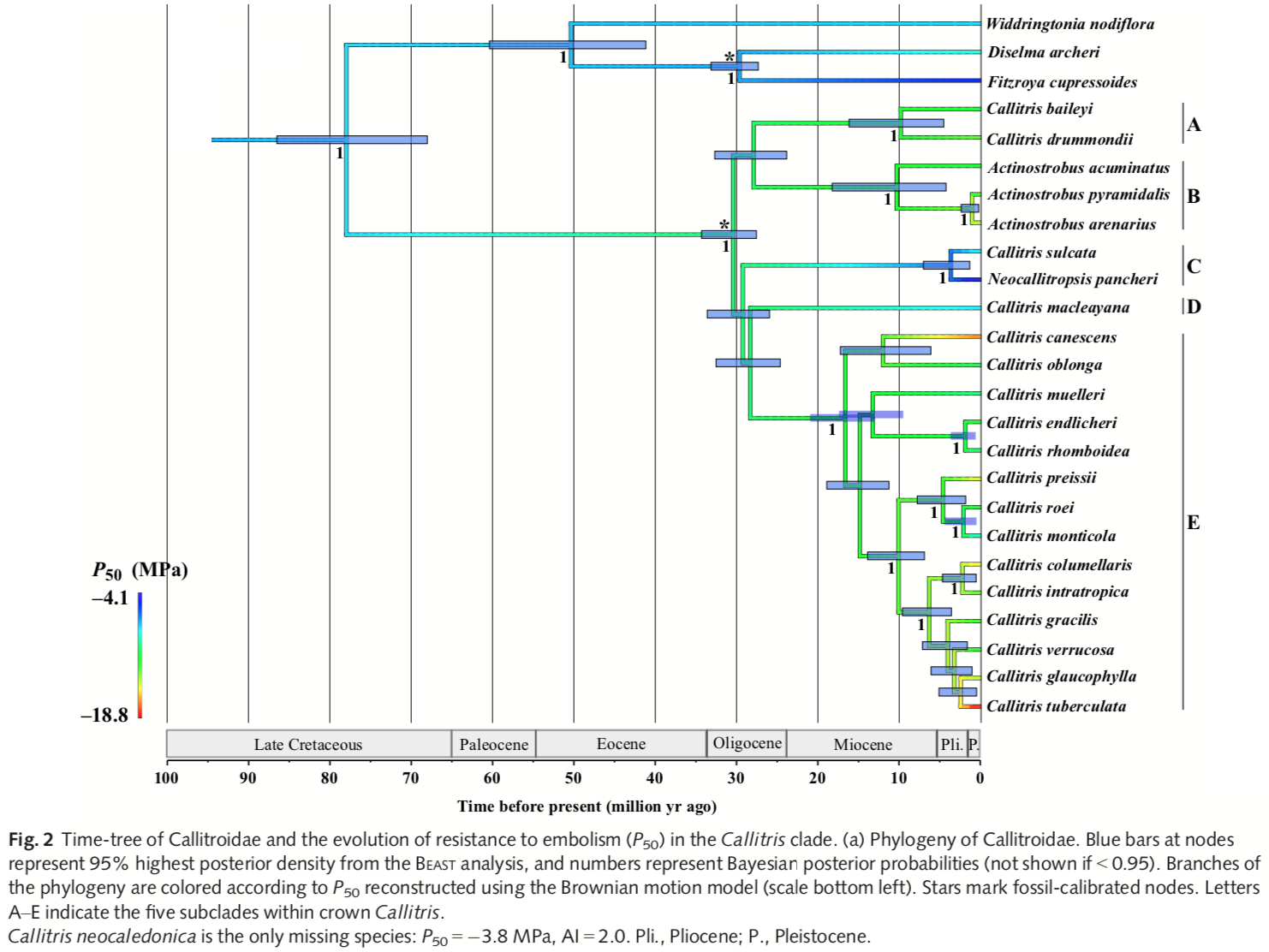
Gadek et al. (2000), in a molecular study, placed Callitris within a well-supported monophyletic clade along with Actinostrobus and Neocallitropsis. A molecular study by Pye et al. (2003), which unfortunately did not include all Callitris taxa, also placed Neocallitropsis within Callitris (sister to C. sulcata), with Callitris sister to Actinostrobus. Farjon (2005), in an unpublished morphological analysis, found Callitris monophyletic and sister to an Actinostrobus-Neocallitropsis clade. A detailed morphological analysis, considering 42 characters for all species in all three genera, found Callitris paraphyletic in a clade with Actinostrobus, sister to Neocallitropsis (Piggin and Bruhl 2010). However, several of the relationships in the cladograms proposed by Piggin and Bruhl are only weakly supported; in fact the only clade supported by a bootstrap percentage above 90% is that of Actinostrobus. Larter et al. (2017), using a new analysis of available GenBank sequences, produced substantially the same phylogenetic tree as Pye et al. (2003), with the added benefits of estimation of time since divergence. It thus appears that the genetic analyses have converged on a solution that is well supported by the available data; I have here reproduced the phylogenetic tree of Larter et al. (2017); the top three taxa are outgroups, and Callitris is subdivided into five clades labeled A through E. The analysis indicates that all five clades diverged in the early Oligocene, and relationships between them (which clade is sister to which) are unclear; however it is clear that the divergence between C. baileyi, C. drummondii and the Actinostrobus group happened much later, likewise the divergence between C. sulcata and Neocallitropsis, leading to the conclusion that both Actinostrobus and Neocallitropsis are best treated as infrageneric taxa of Callitris.
Description
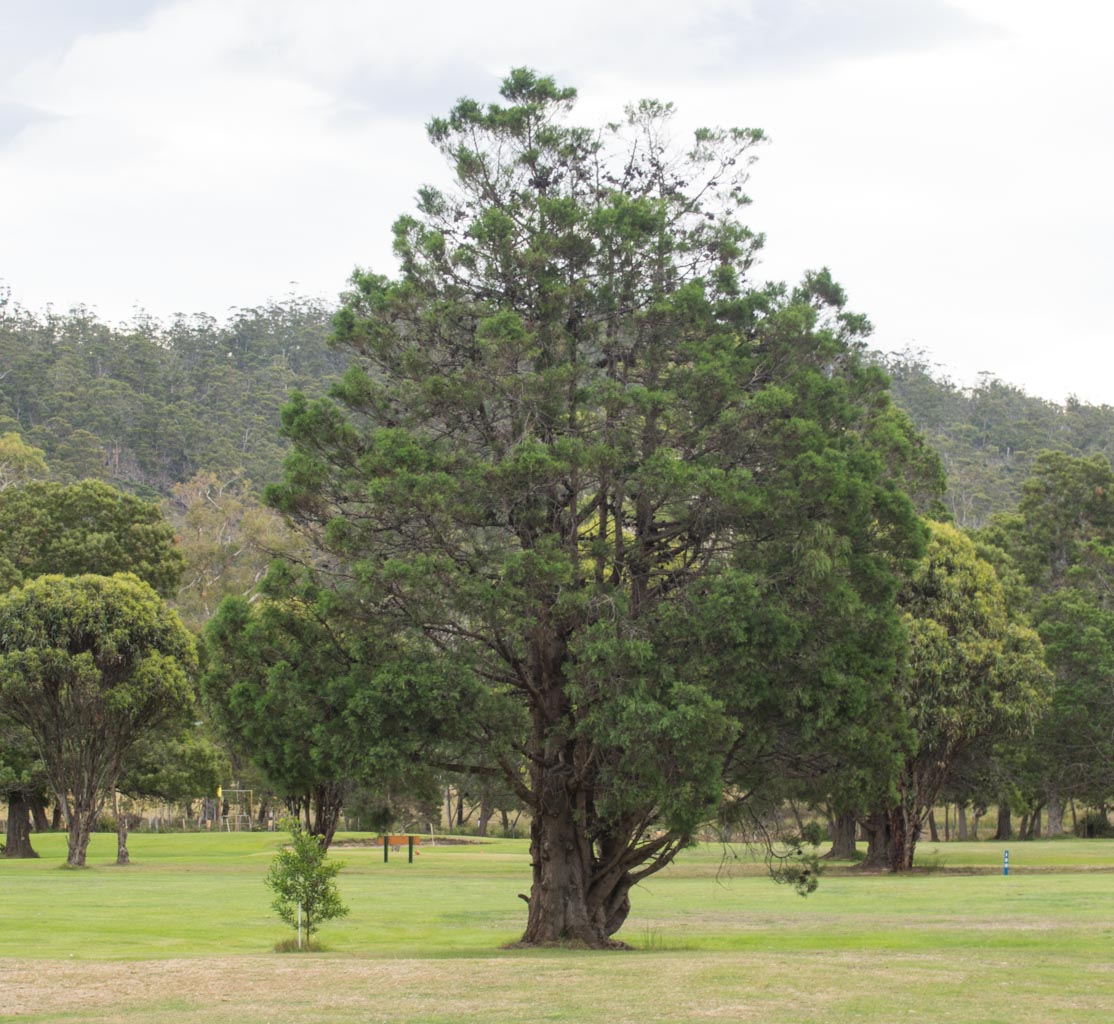
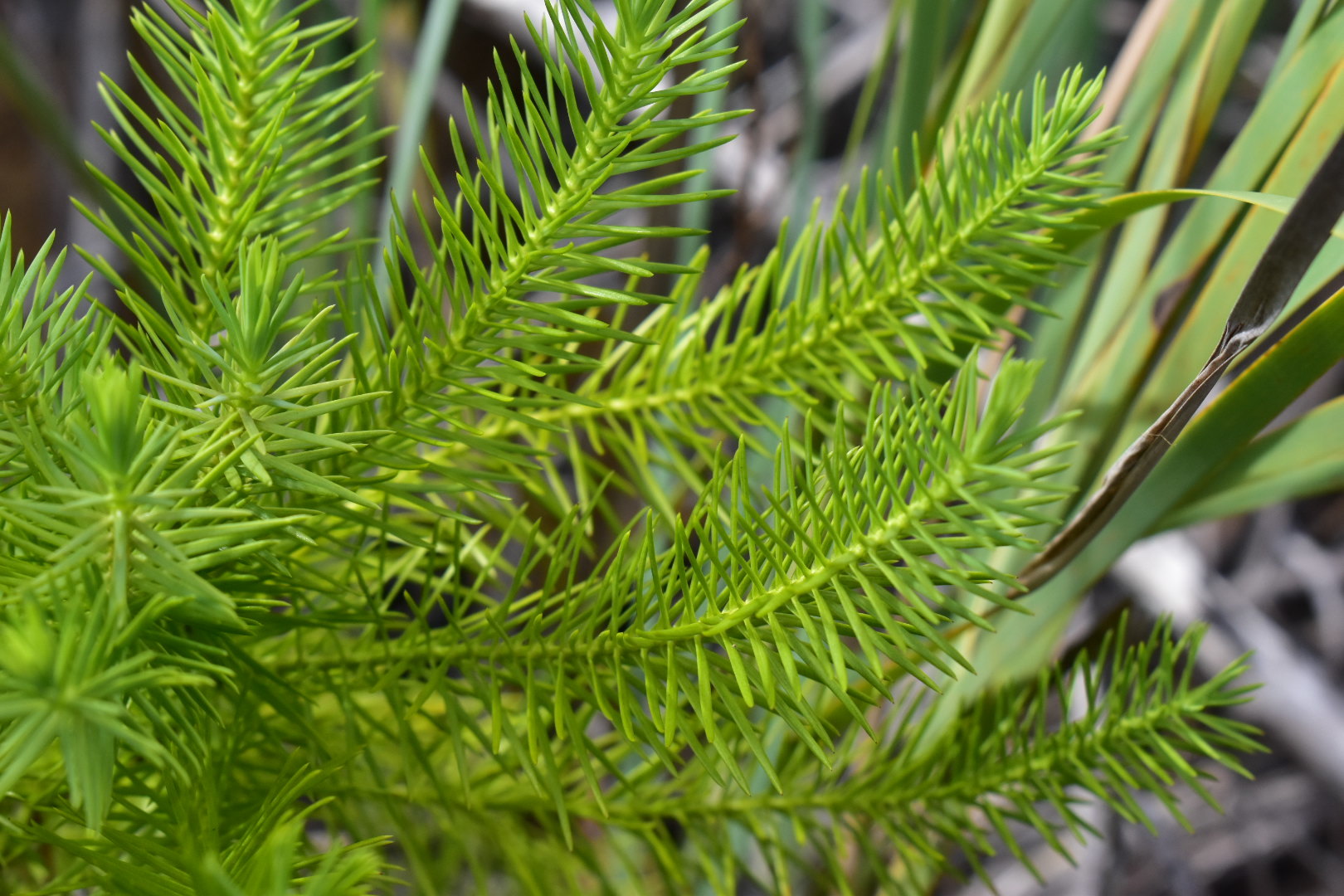
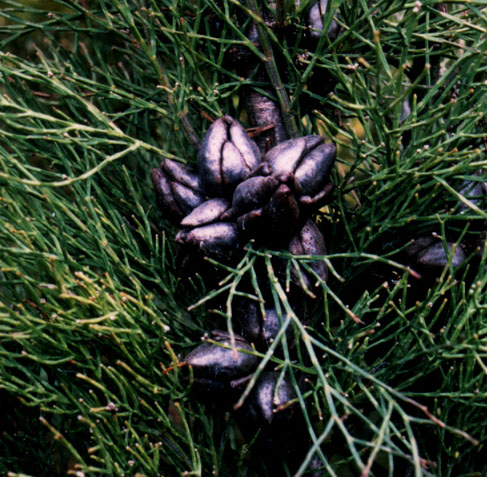
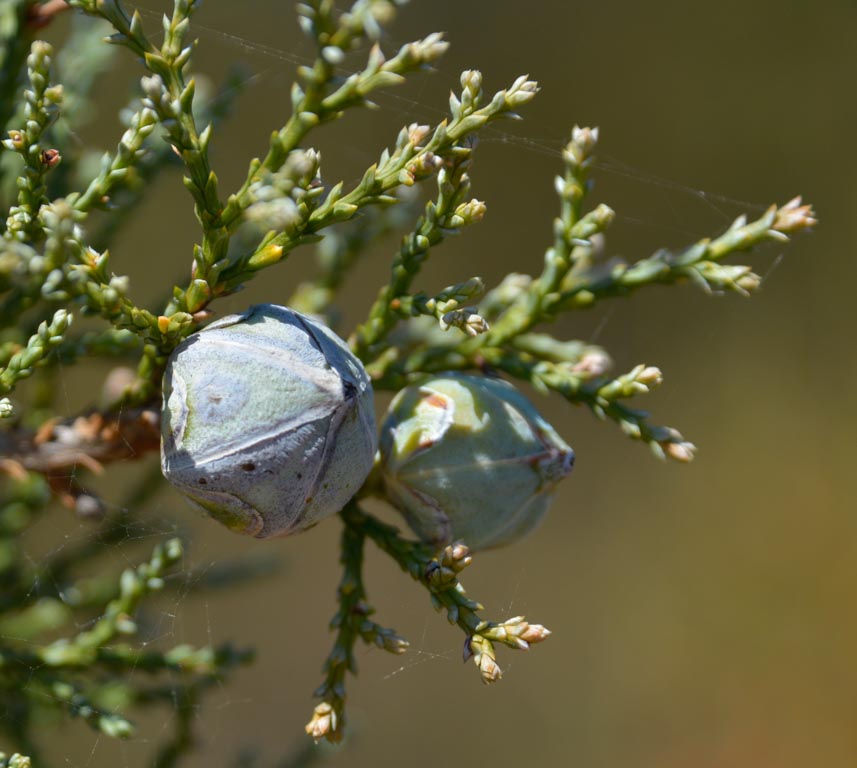
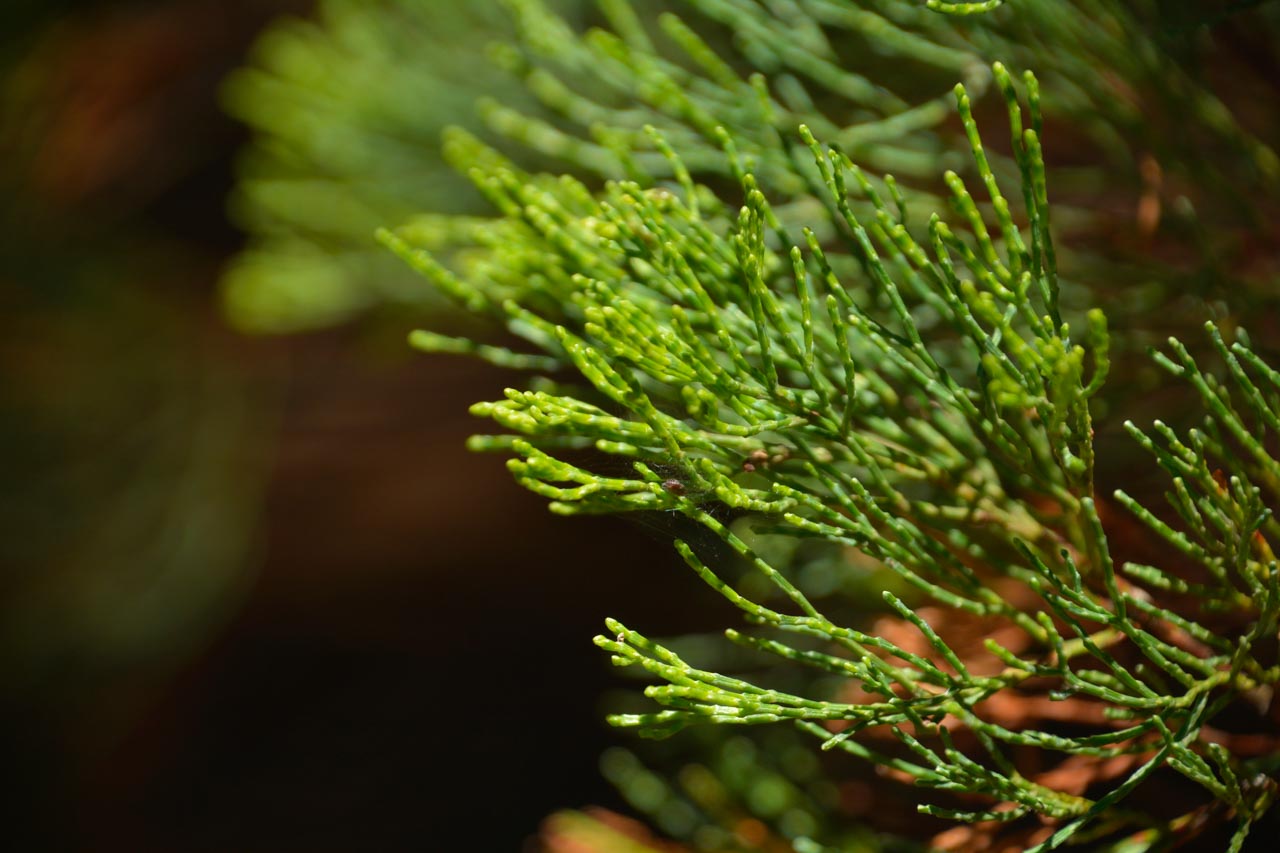
Monoecious (C. pancheri is dioecious) evergreen trees or shrubs. Branches erect, spreading or fastigiate. Bark persistent, hard and compact (fibrous in C. macleayana and C. pancheri). Branchlets appearing to consist of triangular or grooved-cylindrical joints owing to the decurrent leaf bases. Juvenile leaves in whorls of 3-4, triangular in cross-section, basally shortly decurrent below a spreading needle-like upper portion, in some species remaining on mature trees. Adult leaves needle-like or scale-like, in alternating whorls of 3, decurrent for much of their length; free tip triangular in section and often appressed; dorsal surface rounded or keeled. Male cones ovoid, obovoid, oblong or cylindrical, solitary, paired or clustered at the ends of the branchlets, comprising numerous alternating, trimerous whorls of imbricate scales; each with 2-6 abaxial microsporangia; pollen spherical, not saccate. Female cones solitary or clustered on short lateral branches, comprising 2 whorls of 3 fertile scales with a reduced internode, to form a 6-merous cone (rarely 8 in C. macleayana and C. oblonga); outer whorl of scales often smaller than the inner; fertile scales each with 1-8 erect ovules and subtended by an adnate sterile bract which may form a dorsal protuberance; 10-30 mm diam.; globose to ovoid. Mature cones are persistent or deciduous. Below each scale are 1-8 seeds, oblong, with 1-3 wings (Harden 1990, Vidakovic 1991, Hill 1998, Farjon 2005). For the 7 species studied (Mehra and Koshoo 1956), 2n=22.
Distribution and Ecology
Australia (all States) and New Caledonia; naturalized in USA: Florida (Harden 1990, Wunderlin 1993). Callitris is Australia's only arid region conifer genus, and in this is an ecological analogue of the northern hemisphere Juniperus. Both genera are, for the most part, scale-leaved shrubs and small trees that form dominant cover types in warm semiarid and arid environments. The following remarks primarily concern the Australian species. This table provides some distribution details:
| Species |
Common name | Occurrence |
| Callitris acuminata |
Moore cypress-pine | WA |
| Callitris arenaria |
Bruce cypress-pine | WA |
| Callitris baileyi |
Cypress-pine | NSW, QLD |
| Callitris canescens |
Scrubby cypress pine | SA, WA |
| Callitris columellaris |
Coast cypress pine | ACT, NSW, NT, QLD, SA, VIC, WA |
| Callitris drummondii |
Small cypress pine | WA |
| Callitris endlicheri |
Black cypress pine | NSW, QLD, VIC |
| Callitris macleayana |
Stringybark pine | NSW, QLD |
| Callitris monticola |
Steelhead | NSW, QLD |
| Callitris muelleri |
Cypress-pine | NSW |
| Callitris neocaledonica |
Cypress-pine | Southern New Caledonia |
| Callitris oblonga |
Pigmy cypress-pine | NSW, TAS |
| Callitris pancheri |
Pancher's cypress-pine | New Caledonia |
| Callitris preissii |
Rottnest Island pine | NSW, QLD, SA, VIC, WA |
| Callitris pyramidalis |
Swan River cypress | WA |
| Callitris rhomboidea |
Port Jackson pine | NSW, QLD, SA, TAS, VIC |
| Callitris roei |
Cypress-pine | WA |
| Callitris sulcata |
Cypress-pine | Southern New Caledonia |
| Callitris tuberculata |
Cypress-pine | WA |
| Callitris verrucosa |
Cypress-pine | NSW, SA, VIC |
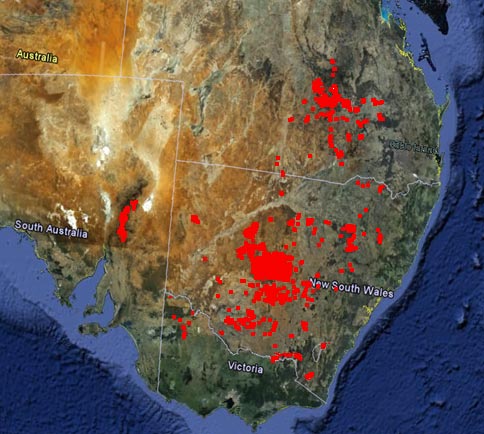
Although the genus is widely distributed, many of the species are of very narrow distribution, occurring in localized, disjunct stands. Callitris forest or woodland forms a dominant vegetation type only in a relatively restricted portion of South Australia, Victoria, New South Wales, and Queensland (see map at right); overall, it is a dominant vegetation type across approximately 23,000 square kilometers, a bit more than 1% of Australia's total forest cover; over half of these forests are within New South Wales. Climate in the range of Callitris features hot summers and mild to warm winters. Annual rainfall is variable, within the range (200-)400-600(-2000) mm (NLWRA 2001, National Forest Inventory 2005).
Stands are generally dominated by an herbaceous understory with few shrubs. Pure stands occasionally occur, but Callitris is generally associated with a mixture of tree species such as mulga (Acacia aneura), wilga (Geijera spp.), sugarwood (Myoporum spp.) and buloke or belah (Casuarina spp.). Associated shrub species include Eremophila, Dodonaea, chenopods (e.g. Atriplex, Maireana, Sclerolaena) and grasses (e.g. Triodia, Plectrachne, Aristida and Austrostipa). Extensive areas have been cleared for grazing. Large portions of the remaining forest and woodland are included in state forests and other crown reserves in Queensland and New South Wales, where silvicultural and fire management practices are used to foster Callitris in preference to other canopy trees (NLWRA 2001, National Forest Inventory 2005).
Fire is a very important environmental factor in most Australian forests. Callitris often grows with fire tolerant species, but does not survive intense fire; instead, it regenerates from seed. It preferentially occurs in areas protected from frequent fire by topography or slow rates of fuel accumulation (National Forest Inventory 2005).
Remarkable Specimens
C. macleayana grows up to 50 m in height and up to 1.5 m in diameter (Vidakovic 1991).
Few species have been investigated to determine maximum ages; C. columellaris, though, appears to achieve 400 years.
Ethnobotany
Callitris wood is often attractively marked, and for a softwood, is fairly hard and dense. It is known as the world's hardest coniferous timber (Christiansen 2000). Aboriginal Australians have used different species for diverse purposes. The wood has been used for firewood and torches, oars, spears, spear throwers, ceremonial objects, paddles and music sticks, and the bark is used to make rope. The resin has been used for glues. The cones, bark, leaves and ashes are used in medicines (Christiansen 2000, National Forest Inventory 2005).
Callitris is also an economically important source of softwood timber. It is exceptionally resistant to decay and termite attack and so is widely used in ground-contact applications such as fenceposts, timber posts, telephone poles and flooring. It is suitable for use in furniture. The commercial logging industry primarily relies upon Callitris columellaris, probably the most abundant species, supporting a harvest of about 250,000 m3/yr in New South Wales and Queensland (National Forest Inventory 2005).
Some species have been used in dendrochronology. See the species, as well as the summary papers by Banks (2001) and Searson and Pearson (2001).
Observations
See the species accounts.
Remarks
Named for the "Greek callos, beautiful, and treis, three, referring to the beauty of the plants and the three-whorled leaves and cone scales" (Wunderlin 1993).
Birds feed on the seeds, and cypress pine jewel beetle larvae feed on the branches and trunks (Grodecki et al. 1996).
Citations
Banks, J. and I. Pulsford. 2001. Dendrochronology of Australian cypress pines. P. 30-38 in Dargavel, J., Hart, D. and Libbis, B. (eds), Perfumed Pineries: Environmental histories of Australia's Cypress Pines. Canberra: Centre for Resource and Environmental Studies.
Brown, E. 2000. Cooloola Coast: Noosa to Fraser Island – the Aboriginal and settler histories of a lost society. St. Lucia, Qld: University of Queensland Press.
ISBN 0702231290.
Bullock, A.A. 1957. The typification of the generic name Callitris Vent. Taxon 6:227-228.
Christiansen, D.L. 2000. Australian cypress. INTAD. http://www.intad.asn.au/materials/wd_cypss.asp, accessed 2002.01.18, now defunct. This site has quite a variety of information on commercial uses of Callitris wood, lists common names for many of the species, and has several links to photographs.
Garden, J. 1957. A revision of the genus Callitris. Vent. Contr. New South Wales Natl. Herb 2(5): 363-392.
Grodecki, Andy, Sylvia Willie and Matt Deshon. 1996. Queensland tree selector. Online database; these data cited at http://ocean.fit.qut.edu.au/tsm/html/treetext.html, accessed 2002.01.18, now defunct.
Larter, M., S. Pfautsch, J.-C. Domec, S. Trueba, N. Nagalingum, and S. Delzon. 2017. Aridity drove the evolution of extreme embolism resistance and the radiation of conifer genus Callitris. New Phytologist 215:97-112.
Mehra, P.N. and T.N. Koshoo. 1956. J. Genet. 54: 181-185.
National Forest Inventory. 2005. Callitris forests. http://www.adl.brs.gov.au/brsShop/data/13197_callitris_profile.pdf, accessed 2012.11.23, now defunct.
[NLWRA] National Land and Water Resources Audit. 2001. Australian Native Vegetation Assessment 2001. http://www.anra.gov.au/topics/vegetation/pubs/native_vegetation/nat_veg_veggroups.html, accessed 2010.02.02, now defunct.
Piggin, J., and J.J. Bruhl. 2010. Phylogeny reconstruction of Callitris Vent. (Cupressaceae)
and its allies leads to inclusion of Actinostrobus within Callitris. Australian Systematic Botany 23:69-93.
Power, P.A. and B.T. Lorraine. 2008. Bardoo Mai and Other Indigenous Things. USA: Lulu.
Pye, M.G., P.A. Gadek, and K.J. Edwards. 2003. Divergence, diversity and species of the Australian Callitris (Cupressaceae) and allied genera: evidence from ITS sequence data. Australian Systematic Botany 16:505–514.
Searson, M. and S. Pearson. 2001. A breakthrough in dendroecology using Callitris. In Dargavel, J., Hart, D. and Libbis, B. (eds), Perfumed Pineries: Environmental histories of Australia's Cypress Pines. Canberra: Centre for Resource and Environmental Studies.
Ventenat, É.P. 1808. Decas Generum Novorum, aut parum Cognitorum. Parisiis: Typis E. Dufart (p. 10). Available: Hathi Trust, accessed 2012.11.25.
Wunderlin, Richard P. 1993. Cupressaceae. Flora of North America Editorial Committee (eds.): Flora of North America North of Mexico, Vol. 2. Oxford University Press. Available at the Flora of North America, accessed 2012.11.25.
See also
Adams, R. and D. Simmonds. 1987. A chemosystematic study of Callitris (Cupressaceae) in south-eastern Australia. Australia Forest Research 17(2):113-125.
Baker, R.T. and H.G. Smith. 1910. A research on the pines of Australia. NSW Technical Education Series No. 16. Sydney. (p.290-298) (accounts of both Actinostrobus and Callitris).
Blake, S. T. 1959. New or noteworthy plants, chiefly from Queensland, l. Proc. Roy. Soc. Queensland 70(6): 33-46.
Dargavel, John, Diane Hart and Brenda Libbis (eds.). 2001. Perfumed Pineries: Environmental history of Australia's Callitris forests. Canberra: Centre for Resource and Environmental Studies.
Farjon (2005) provides a detailed account (of both Actinostrobus, Callitris, and Neocallitropsis), with illustrations.
Hauenschild, Paul and Greg Smith. 1999. Cypress pine forests. Queensland Department of Natural Resources. Available online at http://www.nrm.qld.gov.au/resourcenet/fact_sheets/pdf/forest/F07.pdf, accessed 2002.01.18, now defunct. Provides a brief but wide-ranging introduction to the distribution, ecology and management of Callitris species native to Queensland.
Miquel, F.A.G. 1845. Cupressinae Richard. V.1, p.643-645 in J.G.C. Lehmann, Plantae Preissianae. Hamburg (Type description of Actinostrobus).
Moore, H.E. 1967. Further notes on conifer nomenclature. Baileya 15(1):26
Thompson, J. 1961. Cupressaceae. Contr. New South Wales Natl. Herb., Fl. Ser. 1/18: 46-55.


 Back to top