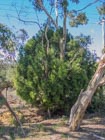
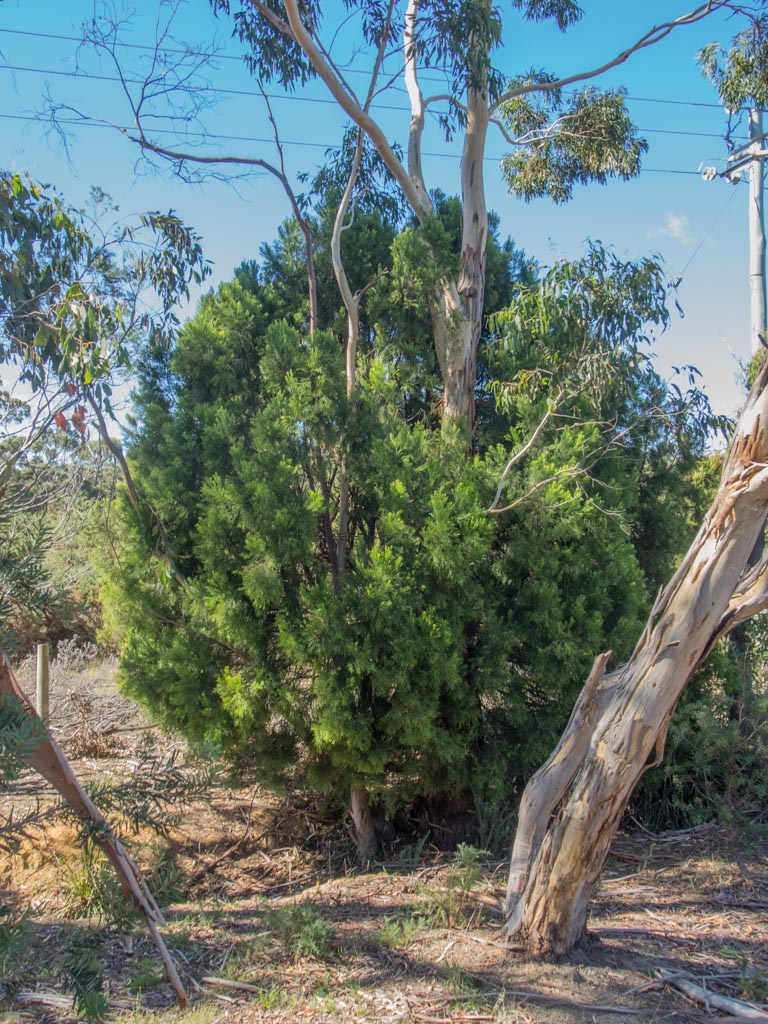
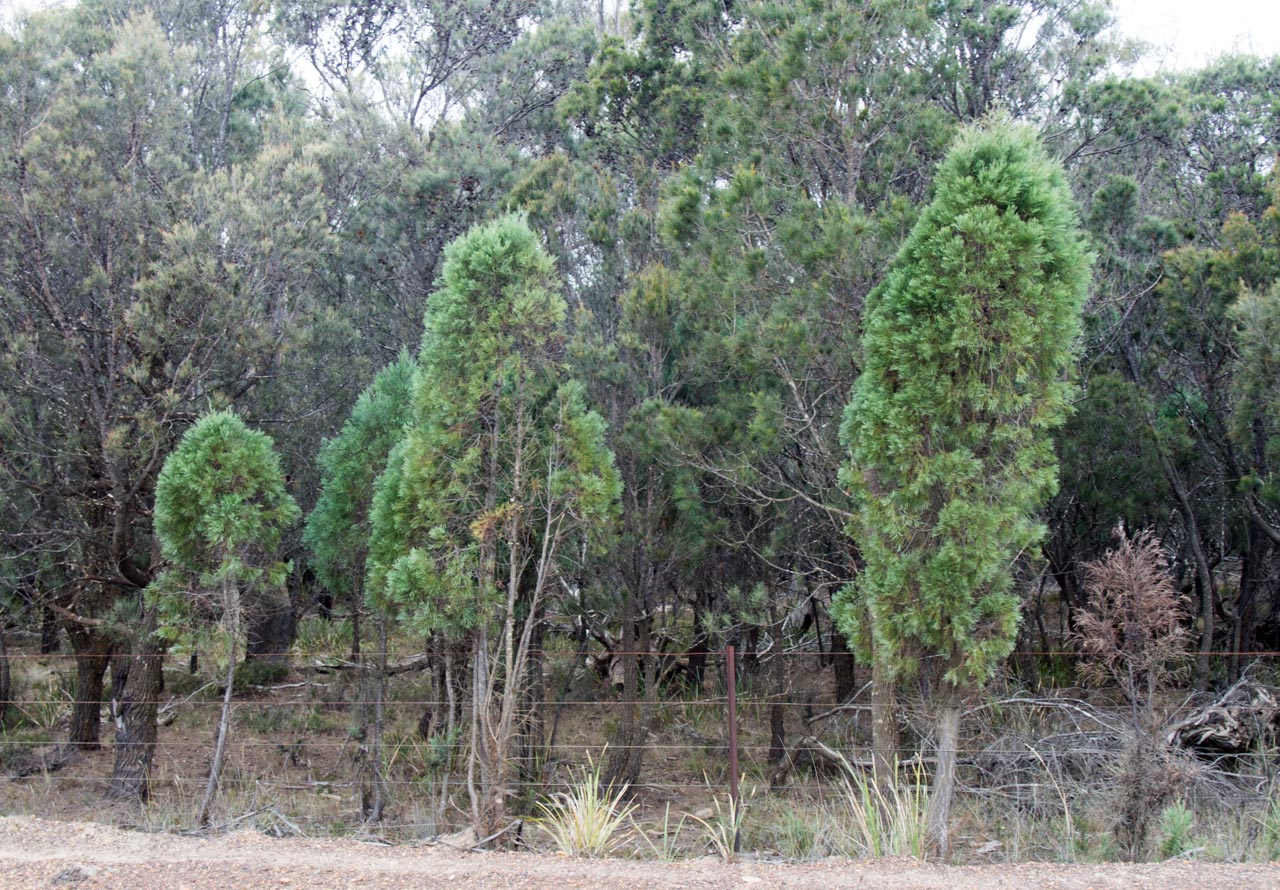
Mature tree in habitat, floodplain of Apsley River, Tasmania [C.J. Earle, 2015.03.05].
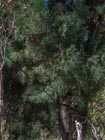
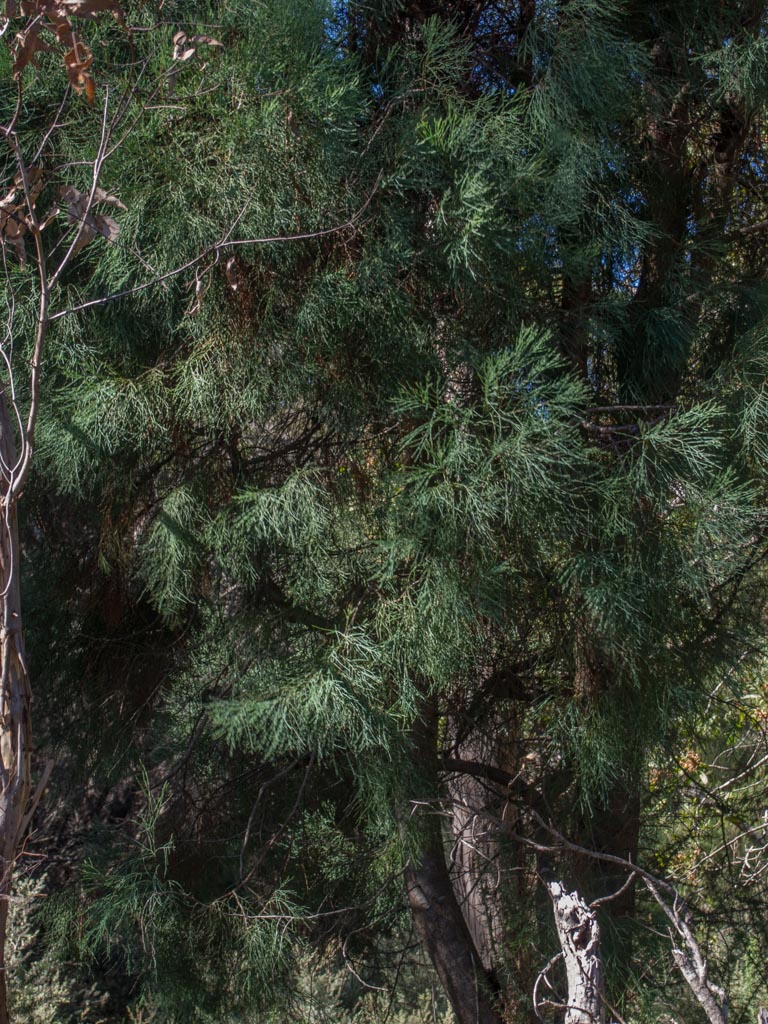
Foliage on another Apsley River tree, Tasmania [C.J. Earle, 2015.03.05].
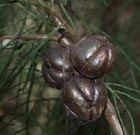
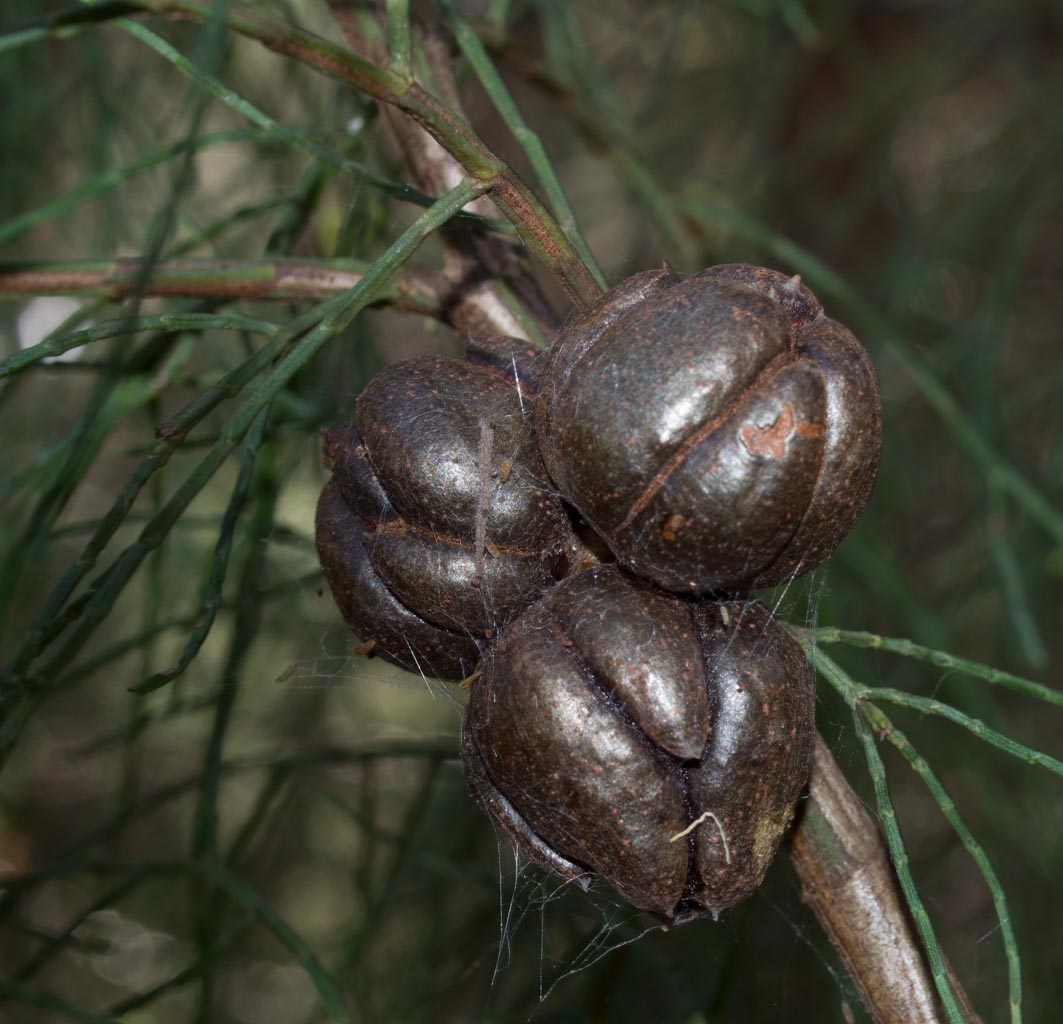
Nearly mature cones on an Apsley River tree, Tasmania [C.J. Earle, 2015.03.05].
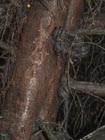
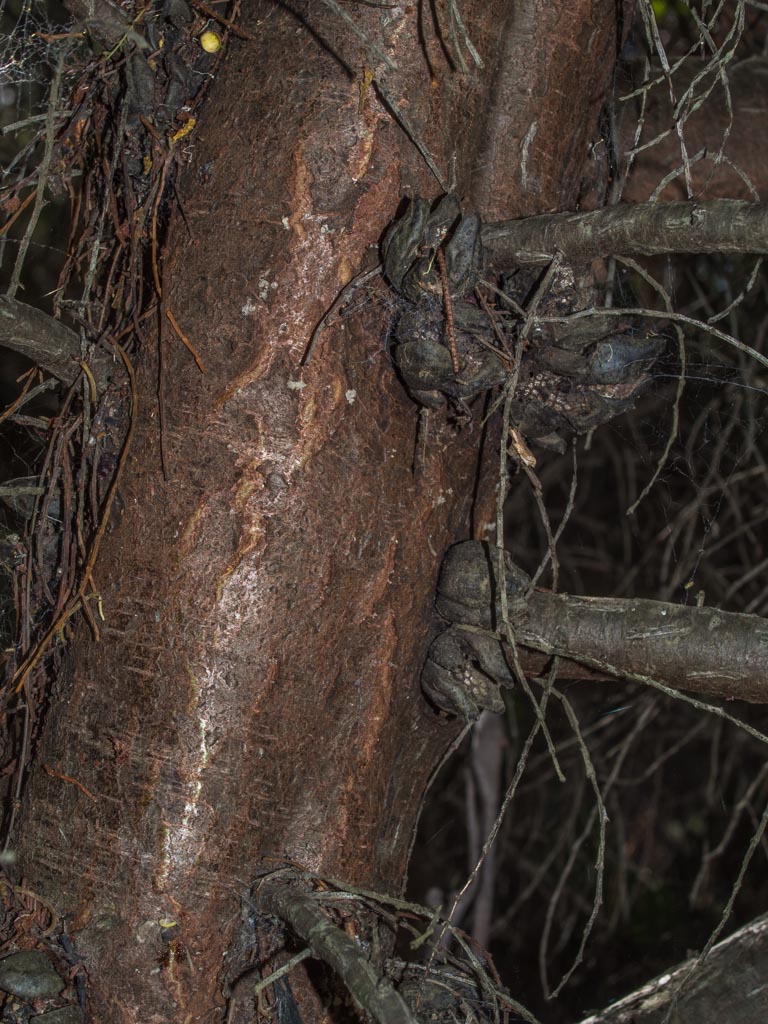
Bark, and some older serotinous cones on an Apsley River tree, Tasmania [C.J. Earle, 2015.03.05].
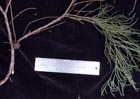
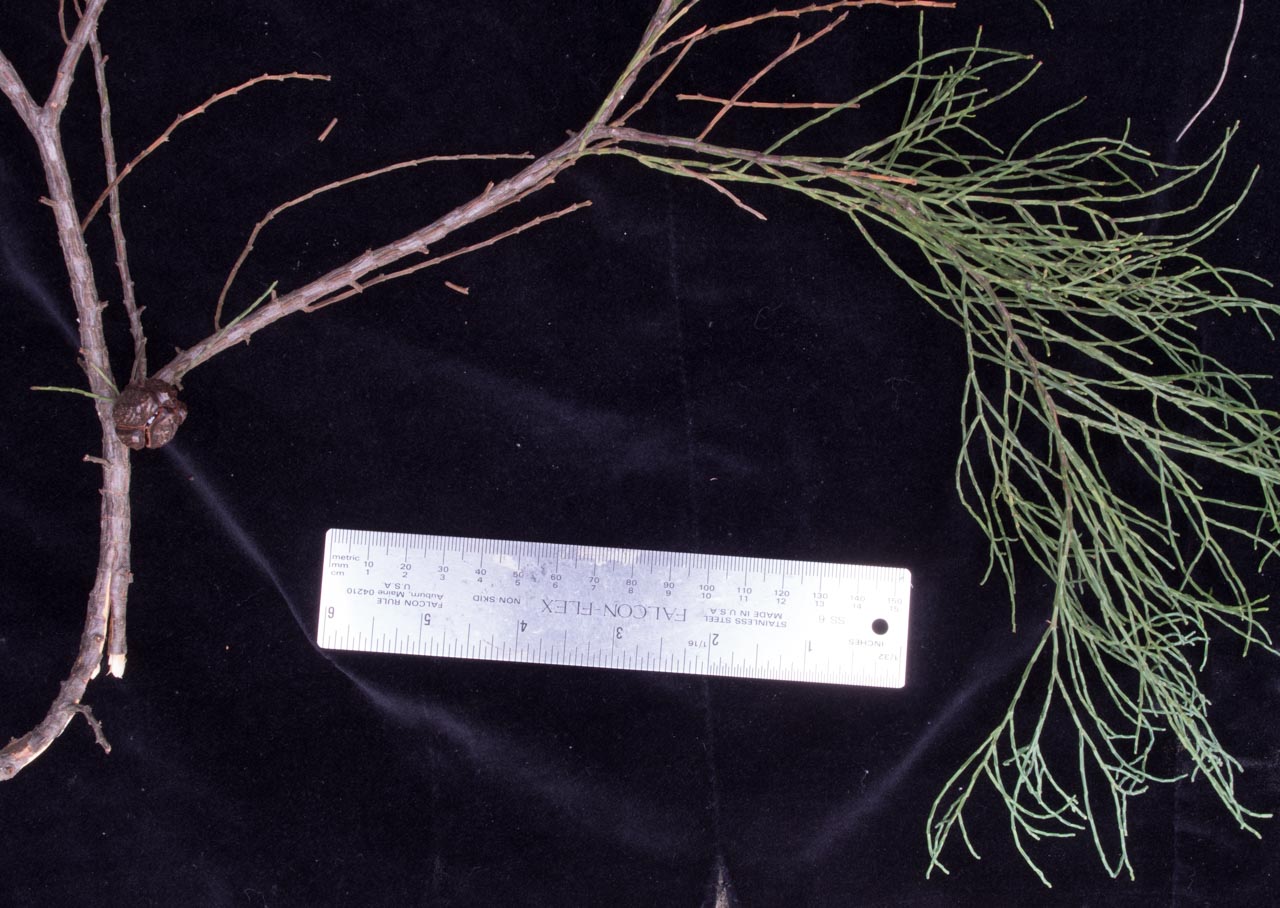
Twig with foliage and a nearly-mature cone, from a tree at the Friendly Beaches, Tasmania [C.J. Earle, 2015.03.07].
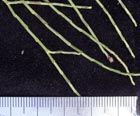
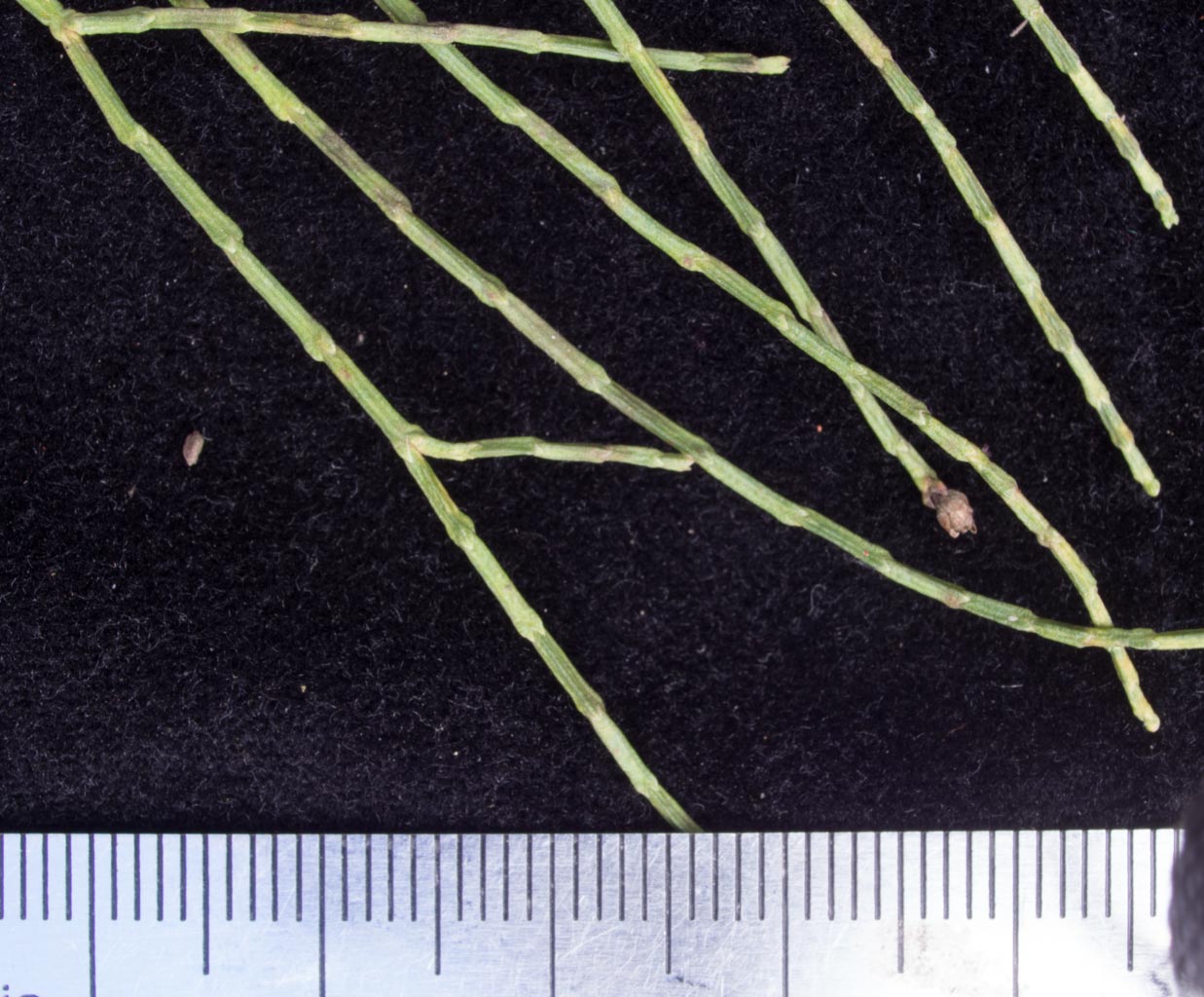
Foliage detail on the above specimen, showing an old pollen cone [C.J. Earle, 2015.03.07].
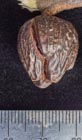
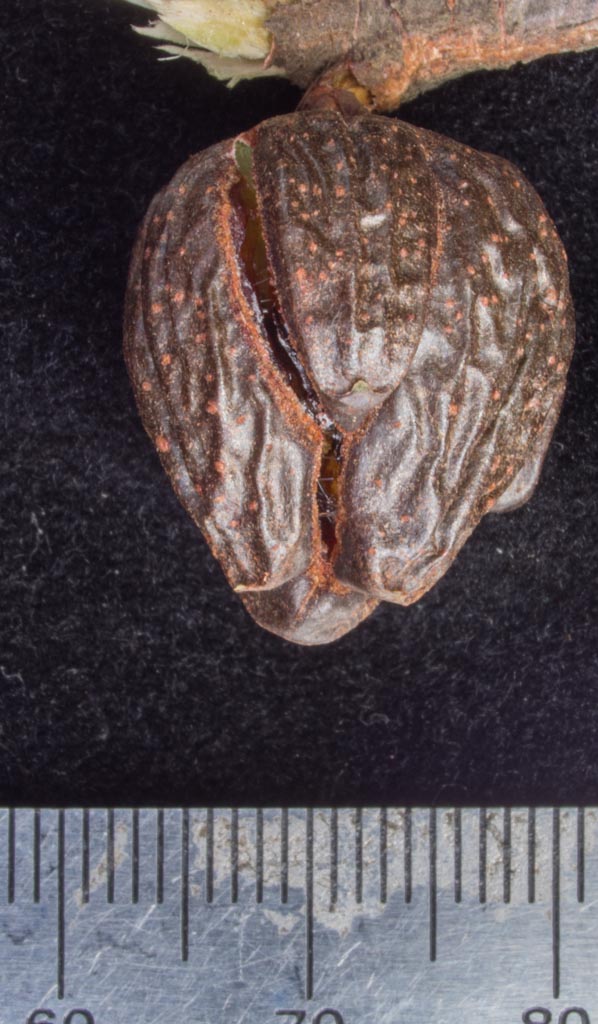
Detail of a nearly-mature cone, from a tree at the Friendly Beaches, Tasmania [C.J. Earle, 2015.03.07].
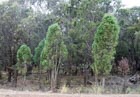
Saplings growing along a fenceline (probably responding to more light at the forest edge), NW of Swan-Rye River confluence, Tasmania [C.J. Earle, 2015.03.07].
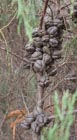
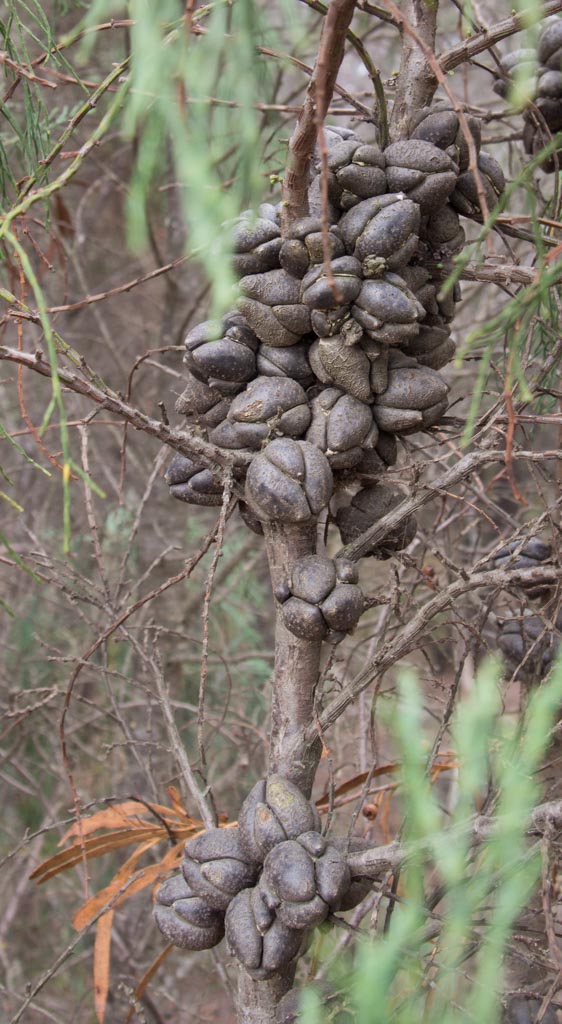
Serotinous cones tightly clustered on the step of a sapling, same location [C.J. Earle, 2015.03.07].
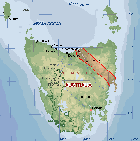
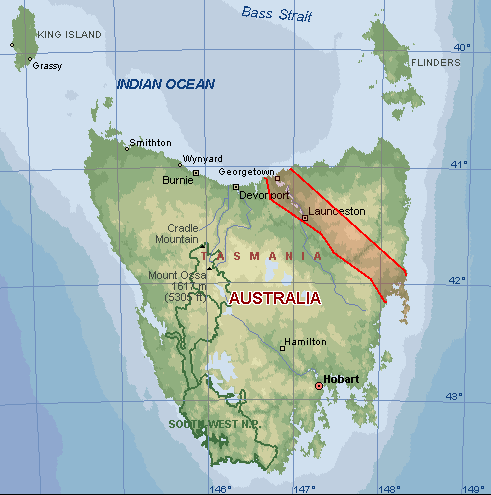
Distribution of Callitris oblonga (Bowman and Harris 1995). Basemap from Expedia Maps. You can also create a highly detailed map, and access specimen data, using the "search" function at the Australia Virtual Herbarium.

Callitris oblonga
A. Rich. et Rich. 1826
Common names
Pigmy cypress-pine, dwarf cypress-pine, river-pine, Tasmanian cypress-pine (Farjon 2005).
Taxonomic notes
Syn: C. fructicosa, C. gunni (Silba 1986).
Description
Small tree, leaves usually 4-5 mm long, cones solitary or in dense clusters on the branches; sessile or on short fruiting branchlets, remaining after maturity; ovoid, 12-15 mm in diameter × 15-20 mm long. Cone scales thick, tapering above to an apex usually thickened by a short dorsal point, the alternate scales very much reduced; columella short, often 3-lobed (Harden 1990).
Distribution and Ecology
Australia: NSW & Tasmania. "Usually grows in sand near banks of streams; scattered along the escarpment, rare in N.S.W." (Harden 1990). Hardy to Zone 9 (cold hardiness limit between -6.6°C and -1.1°C) (Bannister and Neuner 2001).
A dominant species in the Eucalyptus ovata - Callitris oblonga (Black Gum) forest, a Tasmanian riparian/floodplain vegetation type that has a Eucalyptus canopy, typically of E. ovata, but in some areas of E. viminalis or E. amygdalina; with a midlevel of Callitris oblonga and a shrub-rich understory in which Bursaria spinosa, Melaleuca gibbosa and Acacia dealbata are common components (TSSC 2011)
C. oblonga is well adapted to disturbance by both flood and fire. The cones do not open on maturity, and instead are retained until the branch supporting them dies, at which time the seeds are released. The species therefore requires disturbance resulting in the damage or death of trees to regenerate (Zacharek 2000, cited in TSSC 2011). In the event of fire, large amounts of seed are released and result in recruitment near the parent plant. In the event of flood, seeds can be redistributed by water, resulting in recruitment downstream. There has also been some research showing that the species may be able to regenerate vegetatively (Harris and Kirkpatrick 1991, cited in TSSC 2011) and thereby to establish new plants downstream in the aftermath of a flood. Floods are infrequent enough to allow seedlings to grow to maturity before the next flood event (TSSC 2011).
"Many patches of E. ovata - C. oblonga forest have been heavily invaded by gorse (Ulex europaeus). By increasing the frequency of fires, and out-competing C. oblonga seedlings, gorse can have a significant impact on C. oblonga, and potentially bring about its local extinction. Gorse is very difficult to control and is unlikely to be eliminated from the ecological community in the medium-term future" (TSSC 2011).
Remarkable Specimens
No data as of 2023.03.03.
Ethnobotany
Observations
The TSSC cites good examples in Tasmania on the upper Apsley River in the Douglas Apsley National Park and on the South Esk River at Trevallyn State Reserve. I found the species easily accessible in three locations. One is along Grange Road, which is just south of the junction between the A3 and B34 highways. The second is where the Coles Bay Road crosses the Apsley River; this is a good spot to see the species in riparian habitat and the area also has a substantial gorse infestation. The third was along the road to the Friendly Beaches camping area.
Remarks
Citations
Harris, S. and J.B. Kirkpatrick. 1991. The distributions, dynamics and ecological differentiation of Callitris species in Tasmania. Australian Journal of Botany 39:187-202.
Richard, L.C.M. 1826. Commentatio botanica de Conifereis et Cycadeis. Stuttgart: J.G. Cotta.
TSSC (Threatened Species Scientific Committee). 2011. Eucalyptus ovata - Callitris oblonga (Black Gum) forest. www.environment.gov.au/biodiversity/threatened/communities/e-ovata.html, accessed 2012.11.23.
Zacharek, A. 2000. Community Recovery Plan Eucalyptus ovata - Callitris oblonga Forest. Department of Primary Industries, Water and Environment, Tasmania.
See also
The species account at Threatened Conifers of the World.
Anon. 1996. South Esk Pine success. [reports on a project to re-establish the nationally vulnerable tree on a private property on the east coast of Tasmania] Threatened Species Network (Tasmania) Bulletin no. 8:2.
Askey-Doran, M.J. 1994. Callitris spp. aff. oblonga Apsley River Community Recovery Plan. Project No. 376 ; Endangered Species Program (Australia), Wildlife Report (Tasmania Parks and Wildlife Service, 94/5). Hobart: Tasmania Department of Environment and Land Management.
Farjon (2005) provides a detailed account, with illustrations.
Harris, S. and J.B. Kirkpatrick. 1991. The distribution, dynamics and ecological differentiation of Callitris species in Tasmania. Australian Journal of Botany 39(3):187-202.
Kirkpatrick, J.B., M.J. Brown and A. Moscal. 1980. Callitris oblonga. P.20-21 in J.B. Kirkpatrick, M.J. Brown and A. Moscal, Threatened Plants of the Tasmanian Central East Coast. Hobart: Tasmanian Conservation Trust.
Nadolny, C. and J. Benson. 1993. The Biology and Management of the Pigmy Cypress Pine (Callitris oblonga) in New South Wales. Species Management Report No. 7. Sydney: New South Wales National Parks and Wildlife Service.

 Back to top