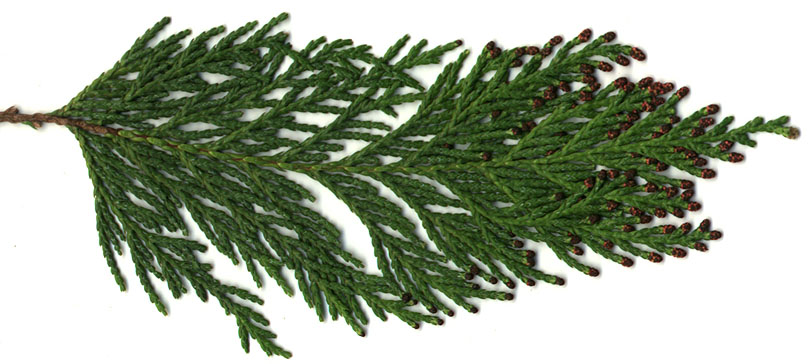
Foliage from an ornamental, Seattle (USA) [C.J. Earle, 1999.03].

Foliage from an ornamental, Seattle (USA) [C.J. Earle, 1999.03].
Chamaecyparis pisifera
サワラ sawara [Japanese]; sawara false-cypress, sawara cypress.
Closely allied to Ch. formosensis; q.v. for differences.
Evergreen trees to 21 m tall and 60 cm dbh with straight trunk and open, narrow, pyramidal crown. Bark reddish-brown, fibrous, shreddy, peeling in long thin strips. Juvenile leaves acicular, 6 mm long, spreading in 4 rows, blue-green, whitish beneath. Mature leaves 3 mm long, scalelike, sharp-pointed, overlapping, opposite in 4 rows, top pair flattened, side pair keeled, shiny green above, whitish-green beneath. the scales 8-10, each scale smoothly rounded and minutely mucronate Female cones resembling a wrinkled green pea in size and shape (hence pisifera): globose, 5-8 mm in diameter, green, turning dark brown, short-stalked, usually composed of 10 scales; scales strongly depressed when dry with a tiny point in the center, the apical pair of scales fused. There are 1-2 broad-winged seeds beneath each scale (Little 1980, Frankis 1999).
Japan: moist soils in the humid temperate zone (Little 1980). Hardy to Zone 6 (cold hardiness limit between -23.2°C and -17.8°C) (Bannister and Neuner 2001).
No data as of 2023.03.03.
One of the 'Five sacred Trees of Kiso' in Japan, the others being Ch. obtusa, Thuja standishii, Thujopsis dolabrata and Sciadopitys verticillata (Dallimore et al. 1967).
Widely planted as an ornamental; several numerous cultivars, with the juvenile-foliaged 'Squarrosa' and semi-juvenile 'Plumosa' and similar derivatives abundantly planted (Frankis 1999).
In Japan, an important timber species (Little 1980).
The epithet pisifera means "pear-shaped", perhaps referring to the seeds.
Frankis, M.P. Personal observations, email 1999.02.03.
This page co-edited with M.P. Frankis, 1999.02.
Elwes and Henry 1906-1913 at the Biodiversity Heritage Library (as Cupressus pisifera). This series of volumes, privately printed, provides some of the most engaging descriptions of conifers ever published. Although they only treat species cultivated in the U.K. and Ireland, and the taxonomy is a bit dated, still these accounts are thorough, treating such topics as species description, range, varieties, exceptionally old or tall specimens, remarkable trees, and cultivation. Despite being over a century old, they are generally accurate, and are illustrated with some remarkable photographs and lithographs.
Farjon (2005) provides a detailed account, with illustrations.
Last Modified 2023-03-03
 Back to top