
Thuja plicata [C.J. Earle, 1987.04.04].
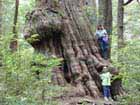
Thuja plicata [C.J. Earle, 2002.06.15].

Thuja occidentalis [C.J. Earle, 2003.07.16].
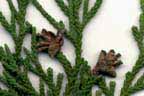
Thuja standishii [C.J. Earle, 2001.02].
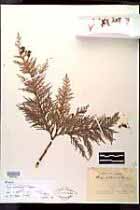
Herbarium sheet for Thuja sutchuenensis

Thuja plicata [C.J. Earle, 1987.04.04].
Thuja plicata [C.J. Earle, 2002.06.15].
Thuja occidentalis [C.J. Earle, 2003.07.16].
Thuja standishii [C.J. Earle, 2001.02].
Herbarium sheet for Thuja sutchuenensis
Thuja
Arborvitae, thuya, cédre (Chambers 1993), ya bai shu (Chinese; Fu et al. 1999).
A generally-accepted genus of five species:
Both morphological and molecular data show its close alliance to Thujopsis and Chamaecyparis.
Evergreen, monoecious trees or shrubs. Branchlets in fan-shaped, flattened sprays. Leaves 4-ranked, scalelike, base decurrent only on leading branchlets, dimorphic along branchlets: facial pairs obovate-rhombic; lateral pairs boat-shaped, ridged abaxially, less than 4 mm, overlapping facial pairs, without conspicuous, white stomatal bands abaxially. Pollen cones with (4-)6-10(-16) microsporophylls, each with 2-4 pollen sacs. Seed cones maturing and opening first year, terminal, solitary, cone scales in 4-6 pairs, decussate, flat, only middle, larger 2 or 3 pairs fertile, each fertile scale bearing 1 or 2 seeds; free bract apex a very short mucro. Seeds 1-3 per scale, lenticular, with 2 lateral, narrow wings. Cotyledons 2 x = 11" (Chambers 1993, Fu et al. 1999). The following key is provided by Fu et al. (1999) and Xiang et al. (2002):
| 1a. | Leaves obtuse at apex, rarely subacute. | |
| 2a. | Facial leaves without a gland; young branchlets not glaucous | T. sutchuenensis |
| 2b. | Facial leaves with a gland; young branchlets ± glaucous | T. koraiensis |
| 1b. | Leaves subacute to acuminate at apex. | |
| 3a. | Leaves acuminate at apex; lateral leaves longer than facial leaves, apex straight | T. plicata |
| 3b. | Leaves acute or subacute at apex, lateral leaves slightly shorter than or as long as facial leaves, apex incurved. | |
| 4a. | Facial leaves with a conspicuous abaxial gland | T. occidentalis |
| 4b. | Facial leaves without a gland | T. standishii |
North America, E Asia (Chambers 1993).
The largest trees are recorded in western redcedar, Thuja plicata, which is far larger than the other species. Few or no age data exist for the three Asian species. Of the two North American species, Thuja occidentalis has the greater demonstrated age at 1653 years, but Thuja plicata almost certainly attains much greater ages, likely 2000 to 3000 years. All of the largest trees, however, have lost most of their tree-ring record to severe heartwood decay.
The common name arborvitae is Latin for "tree of life" (17th cent.) because resins of these trees were used medicinally in western Europe. Effects include increasing blood pressure and reducing fever. The wood is reddish, light, and durable. Some of the larger species are valuable timber trees. The smaller species are cultivated in gardens and as wind screens for more tender plants.
Thuja plicata is extraordinarily significant to native peoples in its home range. The other species are less so.
Dendrochronological research has used Thuja plicata and, especially, Thuja occidentalis. Thuja standishii has been investigated as well. See the species accounts for details.
See the species accounts.
'Thuya'; was a Greek name for some evergreen, resinous trees (Chambers 1993).
Xiang Qiaoping, Farjon, Aljos, Li Zhenyu, Fu Likuo and Liu Zhengyu. 2002. Thuja sutchuenensis: a rediscovered species of the Cupressaceae. Botanical Journal of the Linnaean Society 139(3):305-310. LINK (accessed 2012.10.20). ABSTRACT: After more than a century, the only conifer species listed as being extinct in the wild (EW) by IUCN-SSC has been rediscovered in the Dabashan Mountains of central China. The history, taxonomy, ecology and conservation of Thuja sutchuenensis are described, and illustrations, based on both the earliest and latest collection of botanical material of this tree, are provided. The taxonomic context of this rare species is discussed.
Last Modified 2023-03-03
 Back to top