Conservation Status

Ginkgo biloba
L. (1771)
Common names
Ginkgo, maidenhair tree, yin hing 银杏 yin xing [Chinese], イチョウ ichou [Japanese], 은행나무 [Korean]. Variant spellings include ginko and gingo.
Taxonomic notes
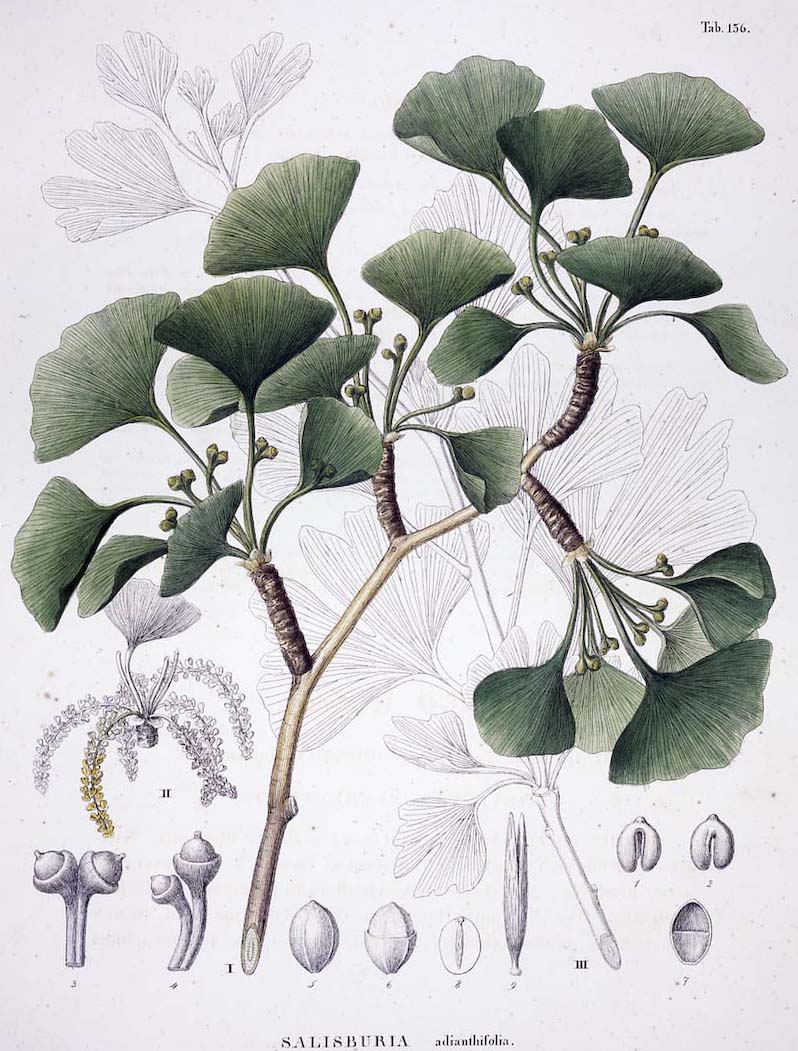
Syn.: Salisburia adiantifolia.
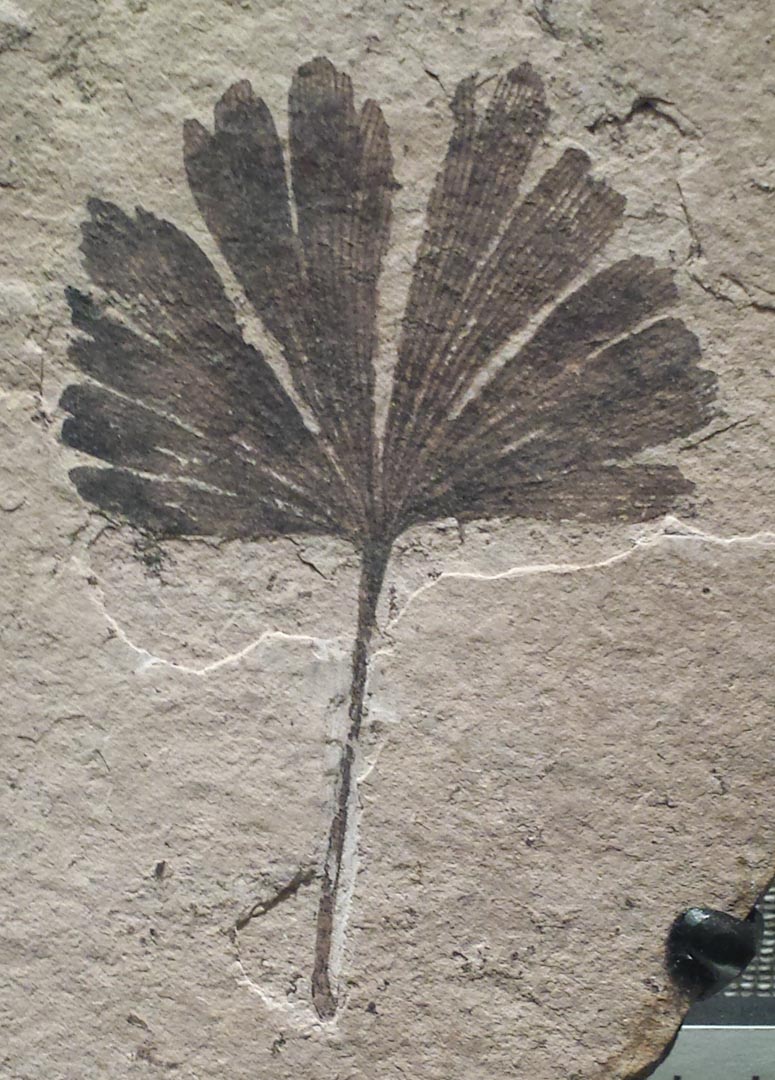
This is one of the most relict species on earth, alone in its subclass (Ginkgoidae Engler 1897), order (Gingkgoales Gorozh. 1904), family (Ginkgoaceae Engler 1897), and genus (Ginkgo Linnaeus 1771). Its origins are as old as those of any gymnosperm (the conifers, cycads, ginkgophyta, and perhaps the gnetophytes having radiated from the Cordaitales in the Permian), and the genus Ginkgo itself is the oldest of any seed plant, dating to the early Jurassic, approximately 200 million years ago (Tralau 1968).
Description
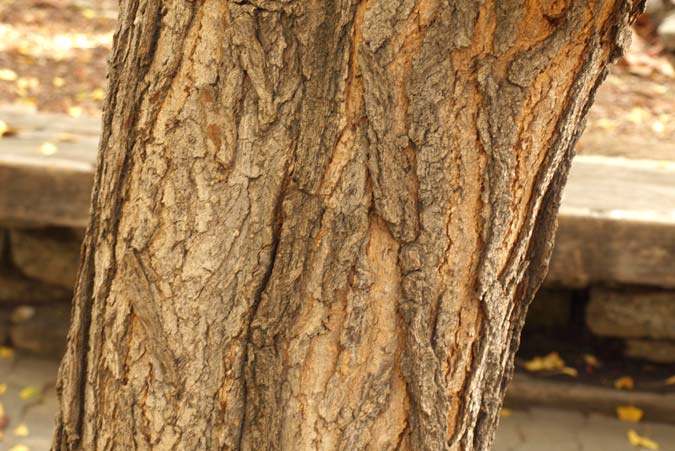
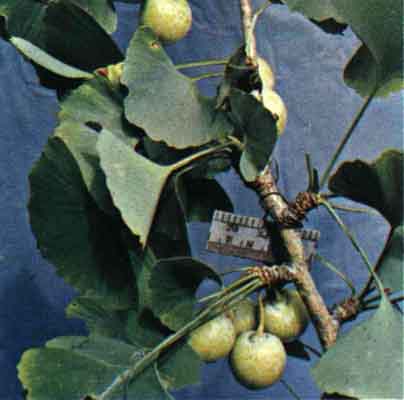
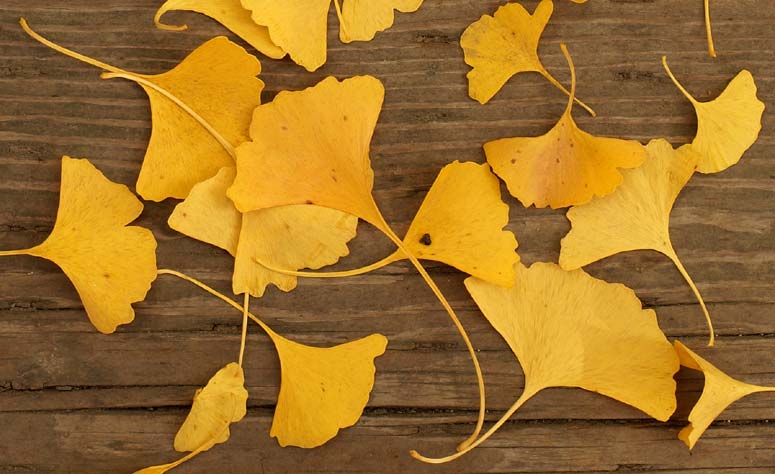
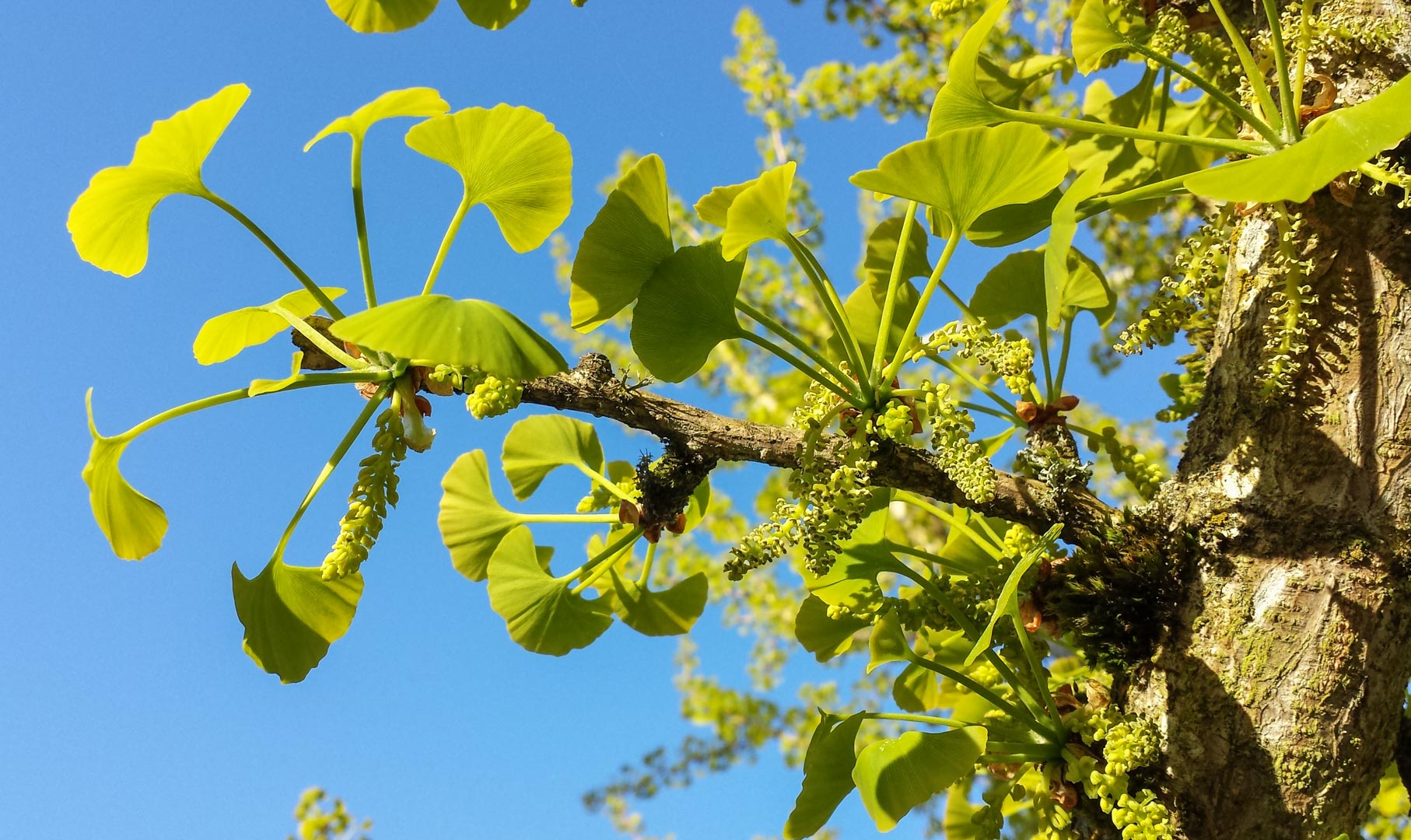
Dioecious deciduous tree, usually with a single straight trunk, up to 30 m tall and 100 cm dbh; crown ovoid to obovoid, tending to be asymmetric, primary branches ascending at ca. 45° from trunk. Bark gray, with short, irregular furrows. Branchlets gray, faintly striate, bearing stubby short shoots at regular intervals, each thick, knoblike or to 3 cm, bearing a cluster of leaves. Buds brown, globose, scales imbricate, margins scarious. Leaves slightly leathery, fan-shaped, with a pattern of radiating veins (not seen in any other tree), usually 2-10 × 2-12 cm, mostly 1.5 times wider than long, light green, stomata on lower side, turning golden and falling each winter. Pollen cones borne on short shoots, catkin-like; bracts absent; pollen spherical. Seeds also on short shoots, maturing in one year, obovoid to ellipsoid, yellow to orange, 2.3-2.7 × 1.9-2.3 cm, mostly 1.1-1.2 times longer than broad, glaucous, rugose, with apical scar, maturing in single season, usually 1 per peduncle, the outer coating softening and giving off a foul odor (which is why female plants are rarely seen). 2n = 24 (Whetstone 1993 and pers. obs.).
Very simply: the leaves do not resemble those of any other tree. See photo at right.
Distribution and Ecology
After long years of debate whether Ginkgo was extinct in the wild and persisted only in cultivation, the matter was largely resolved in the early 21st Century with field studies of populations in the Dalou Mountains of Guizhou that concluded "current species composition of Ginkgo forests in the Dalou Mountains agrees closely with floristic assemblages from fossil records bearing G. biloba. Current populations are found in habitats similar to those of fossil Ginkgo, which, as today, favored rock crevices. Female to male ratios are 3:2. Estimated ages for many of the trees show that Ginkgo was present in this area prior to human settlement and indigenous peoples of this area are unlikely to have planted Ginkgo because of traditional beliefs. Our results agree with existing genetic studies that show that these mountains were glacial refugia for G. biloba" (Tang et al. 2012). The Dalou population occurs in an area with a subtropical monsoonal climate, with mean annual precipitation of 1270–1400 mm, of which 80% occurs in from June to September. Mean annual temperature is about 14°C with a mean monthly minimum temperature as low as 1.8°C in January and maxima as high as 25.1°C in July. The mean annual relative humidity is 80%. The Ginkgo trees occur in a structurally complex mixed forest that includes many canopy tree species, among them the conifers Cunninghamia lanceolata and Taxus sumatrana. The population is all-aged, including many seedlings and saplings as well as mature trees, the latter having dbh values of up to 369 cm (Tang et al. 2012).
The species is also reported to occur naturally at Dahongshan in Hubei, Tianmushan in Zhejing, Wuchuan in Guizhou, and Jinfoshan near Chongqing, Sichuan, although these localities have not been evaluated using the rigorous methods employed by Tang et al. (2012) and some or all of these populations may be introduced or naturalized. For instance, Del Tredici et al. (1992) report on the population in the remote mountain valleys in China's Zhejiang province, where a stand has been preserved as the 1018 ha Tianmushan Reserve. This area has supported human activities for approximately 1500 years and it is thus plausible, given the long history of ginkgo as an ornamental species in the area, that its persistence at this site has been facilitated by human actions. Regardless of its origin, the "population is biologically significant by virtue of its long survival in a semi-natural state under conditions of intense interspecific competition. Many of the trees [grow] on disturbance-generated microsites, such as stream banks, steep rocky slopes, and the edges of exposed cliffs. [Many] individuals are multitrunked, consisting of at least two trunks greater than 10 cm in diameter at breast height. Most of these secondary trunks originated from root-like 'basal chichi,' that are produced at the base of trees that have experienced damage from soil erosion or other factors. No Ginkgos less than 5 cm in basal diameter were found in the mature forests of Tian Mu Shan" (Del Tredici et al. 1992).
The great majority of ginkgoes live as ornamentals. In this role the species is nearly cosmopolitan, planted in temperate and subtropical areas around the globe (Whetstone 1993). Hardy to Zone 4 (cold hardiness limit between -34.3°C and -28.9°C) (Bannister and Neuner 2001).
Remarkable Specimens
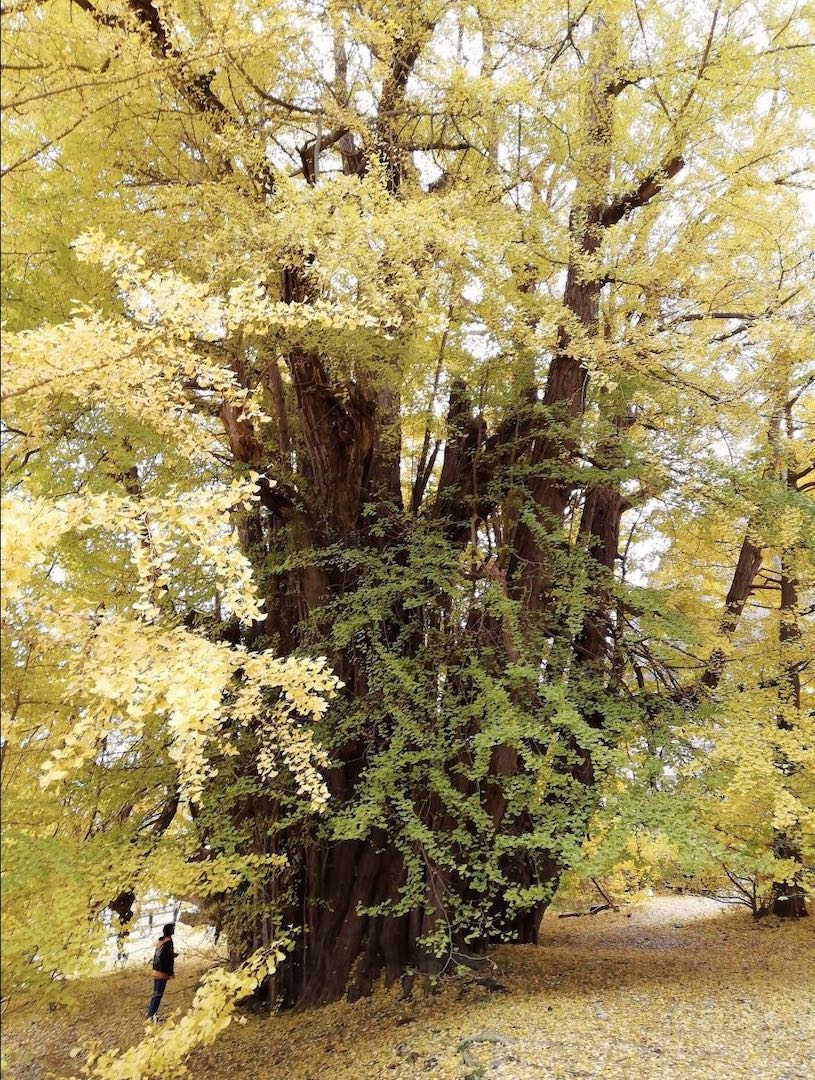
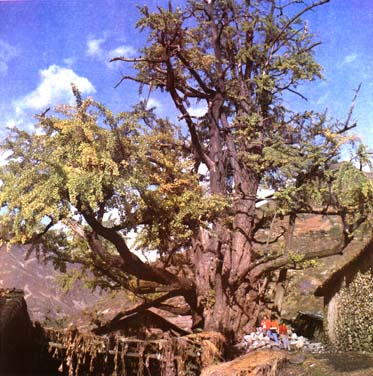
The largest known specimen in habitat is 369 cm dbh (Tang et al. 2012). A tree in Lijiawan, Guizhou, China is 40 m tall with a dbh of 471 cm, and another at Dabao in Gansu is 60 m tall with a 286 cm dbh (Jinxing et al. 1996). One at Yongmun-san temple in South Korea is 36 m tall with a 457 cm dbh (Carder 1995). The largest ginkgo, also the fourth largest tree in Japan is the Kitakanegasawa Ichou, located in Kitakanegasawa aza shiomigata, Fukaura town, Nishitsugaru county, Aomori prefecture. It has a girth of 2,200 cm, and is also one of the most picturesque ginkgos in the country (Ministry of the Environment 2001, Monumental Trees 2021). The largest in North America may be a tree planted in 1789 at Pierce Arboretum (now part of Longwood Gardens) in Kennett Square, PA. By 1968 that tree was 32.0 m tall and about 396 cm dbh (Ewan, 1969).
There do not appear to be any hard data on tree ages. Tang et al. (2012) assert ages of up to 878 years, but this estimate was not crossdated and appears to be based on extrapolation (increment borers are not made that can sample a 369 cm dbh tree, for which they assert this great age) and could be a substantial overestimate. Temple trees are commonly claimed to be over 1,000 years old, on the basis of no more than wishful thinking. A tree at Dinglin Temple in Shandong, China was claimed to be 2,711 years old in 1996, but without supporting data (Jinxing et al. 1996).
Ethnobotany
"The unusual shape of the crown, natural resistance to disease, and yellow leaf color in fall make this a favorite street and park tree. Ovulate trees produce an abundance of seeds, which have a particularly obnoxious odor; the planting of ovulate ginkgoes is often discouraged for this reason. Seeds (canned with fleshy outer coat removed) are sold in ethnic markets as "silver almonds" or "white nuts," the gametophyte and embryo being edible. Oils from the outer coat are known to cause dermatitis in some humans" (Whetstone 1993).
An online review of modern and traditional medical uses of the Ginkgo is provided by Foster (1998).
Observations
Nearly every arboretum or botanical garden in a temperate or subtropical climate will contain specimens. It is also very commonly planted as a street tree, due to its high tolerance for air pollution. One of the oldest and largest in the West is at the Royal Botanical Gardens, Kew (UK). The supreme specimens, though, are to be found on temple grounds in China, Korea and Japan.
Remarks
The name ginkgo is derived from the Chinese 银杏 yin xing, "silver apricot", in reference to appearance of the seed (Whetstone 1993). The epithet "biloba" means "two-lobed", referring to the shape of the leaves (Linné 1771).
Ginkgo differs from all other seed plants except the Cycadales in having a distinct mode of fertilization by motile or free swimming sperm. Fertilization is usually by wind pollination (Silba 1986).
Engelbert Kaempfer, during his tenure as a physician with the Dutch East India Company at Deshima from 1690 to 1692, provided the western world with its first description of the ginkgo. By 1730, it was in cultivation in the botanical garden at Utrecht (Folsom 2003). The illustration at right is from the first installment of Siebold and Zuccarini's Flora Japonica, issued in 1835. Philipp Franz von Siebold visited Japan from 1823-1829 as a doctor and scientist in the employ of the Dutch East India Company. During this time he collected thousands of plant and animal specimens, many of new species that were later named for him. Among the conifers, he is commemorated by Tsuga sieboldii.
"Pollination March-April; seeds shed August-November.
"In North America, ginkgo seeds minus the fleshy outer coat have been found beneath various species of trees up to 150 m from the nearest seed-producing ginkgo. The dispersal agents were almost certainly birds, possibly crows. A cache of ginkgo seeds, in association with scats of raccoons [Procyon lotor], was found in a tree crotch about 50 m from the nearest source of the seeds. Apparent animal dispersal of ginkgo requires further study" (Whetstone 1993).
Ginkgo has a vesicular-arbuscular mycorrhiza; one symbiote is Glomus epigaeum (Fontana 1985).
Citations
Carder, A. C. 1995. Forest giants of the world: past and present. Fitzhenry and Whiteside. 208 pp.
Del Tredici, P., Ling Hsieh and Yang Guang. 1992. The Ginkgos of Tian Mu Shan. Conservation Biology 6(2):202-209.
Engler in Engler et Prantl, Nat. Pflanzenfam. Nachtr. II.-IV: 19. 1897.
Ewan, J. (ed.). 1969. A Short History of Botany in the United States. New York: Hafner Publishing Company, 174pp.
Folsom, J. (ed.). 2003. Plant Trivia TimeLine. PlantEd, Huntington Botanical Gardens, 1151 Oxford Road, San Marino, CA 91108-1299.
Fontana, A. 1985. Vesicular-arbuscular mycorrhizas of Ginkgo biloba L. in natural and controlled conditions. New Phytologist 99(3):441-447.
Foster, Steven. 1998. Ginkgo. Published online at http://www.stevenfoster.com/education/monograph/ginkgo.html, accessed 27-Jan-1999.
Jinxing, L., H. Yushi, and W. Xianpu. 1996. Old Ginkgo trees in China. Pages 32-37 in: International Dendrology Society Yearbook 1995.
Linné [Linnaeus], Carl von. 1771. Mantissa Plantarum Altera: 313. Available: Biodiversity Heritage Library, accessed 2021.12.22.
Liu (1970).
Ma Shitu. 1985. The Rare Plants and Flowers of Western Sichuan. 1985. Sichuan People's Press.
Ministry of the Environment. 2001. Big trees survey. http://www.biodic.go.jp/english/kiso/13/13_kyoju_e.html, accessed 2009.11.08.
Tang, C.Q., Y. Yang, M. Ohsawa, S.-R. Yi, A. Momohara, W.-H. Su, H.-C. Wang, Z.-Y. Zhang, M.-C. Peng, and Z.-L. Wu. 2012. Evidence for the persistence of wild Ginkgo biloba (Ginkgoaceae) populations in the Dalou Mountains, southwestern China. American Journal of Botany 99(8):1408-1414.
Tralau, H. 1968. Evolutionary trends in the genus Ginkgo. Lethaia 1:63–101.
Whetstone, R. David. 1993. Ginkgo, in the Flora of North America online.
See also
Elwes and Henry 1906-1913 at the Biodiversity Heritage Library (Photos). This series of volumes, privately printed, provides some of the most engaging descriptions of conifers ever published. Although they only treat species cultivated in the U.K. and Ireland, and the taxonomy is a bit dated, still these accounts are thorough, treating such topics as species description, range, varieties, exceptionally old or tall specimens, remarkable trees, and cultivation. Despite being over a century old, they are generally accurate, and are illustrated with some remarkable photographs and lithographs.
Hori, T., R.W. Ridge, W. Tulecke, J. Tremouillaux-Guiller, H. Tobe and P. Del Tredici (eds.). 1997. Ginkgo Biloba - A Global Treasure. Tokyo: Springer-Verlag. Contains about 30 articles by various authors on all aspects of Ginkgo and its use.
Jalalpour, J., M. Malkin, P. Poon, L. Rehrmann and J. Yu. 1997. Introduction to the Ginkgoales. Web page hosted by the Museum of Paleontology at the University of California, Berkeley. URL= http://www.ucmp.berkeley.edu/seedplants/ginkgoales/ginkgo.html, accessed 29-Jun-1999.
Liu (1970).
van Beek, Teris A. (ed.). 2000. Ginkgo Biloba. Amsterdam: Harwood Academic Publ. Contains about 30 articles by various authors on all aspects of Ginkgo and its use.


 Back to top