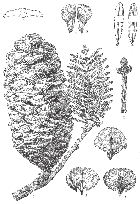
Line drawing; for full size image go to the Flora of China (Wu and Raven 1999).


Keteleeria fortunei
Syn: K. cyclolepis; K. oblonga (Silba 1986); Abies fortunei A. Murray; Abietia fortunei Kent. (Dallimore et al. 1967).
Trees, 24 m tall, with habit resembling Cedrus libani. Bark corky. Branches horizontal and spreading. Branchlets orange-red, slender, with scattered hairs. Buds ovoid, rounded at the apex, with numerous keeled scales. Leaves of young trees linear, stiff, 2.5-3 cm long, with spiny tips. Leaves of mature trees 12-31 mm, rounded or shortly pointed at the apex. Cones cylindrical, 10-18 × 3-5 cm (or 7.5 cm wide when expanded), on stout, hairy peduncles about 2.5 cm long, purple or brownish when mature; scales larger and broader at the apex than K. davidiana, the widest part (about 3 cm) being above the middle, the upper margin rounded and slightly toothed. Seeds about 2 cm long with a 3 cm wing, both seed and wing larger than in K. davidiana, bright glossy brown in colour, the seed greyish beneath (Dallimore et al. 1967).
China (Fujian, Guangdong, Guangxi, Guizhou, Hunan, Jiangxi, Yunnan, Zhejiang); Hong Kong; Viet Nam (WCMC 1998). In S China, found in mountains near Fuzhou, where it was seen by Fortune in 1844, who distributed seeds (Dallimore et al. 1967). Hardy to Zone 9 (cold hardiness limit between -6.6°C and -1.1°C) (Bannister and Neuner 2001).
I have no data for trees in habitat. An ornamental tree at the Melbourne Botanical Garden was measured at 103.0 cm dbh and 15.6 m tall (R. Van Pelt email 2009.04.14).
Carrière, E.A. 1866. Rev. Hort. 37: 449.
World Conservation Monitoring Centre - Trees [WCMC]. 1998. Database at http://www.wcmc.org.uk/cgi-bin/SaCGI.cgi/trees.exe, accessed 1998.10.01, now defunct.
Elwes and Henry 1906-1913 at the Biodiversity Heritage Library. This series of volumes, privately printed, provides some of the most engaging descriptions of conifers ever published. Although they only treat species cultivated in the U.K. and Ireland, and the taxonomy is a bit dated, still these accounts are thorough, treating such topics as species description, range, varieties, exceptionally old or tall specimens, remarkable trees, and cultivation. Despite being over a century old, they are generally accurate, and are illustrated with some remarkable photographs and lithographs.
Last Modified 2023-02-26
 Back to top