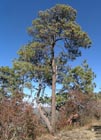
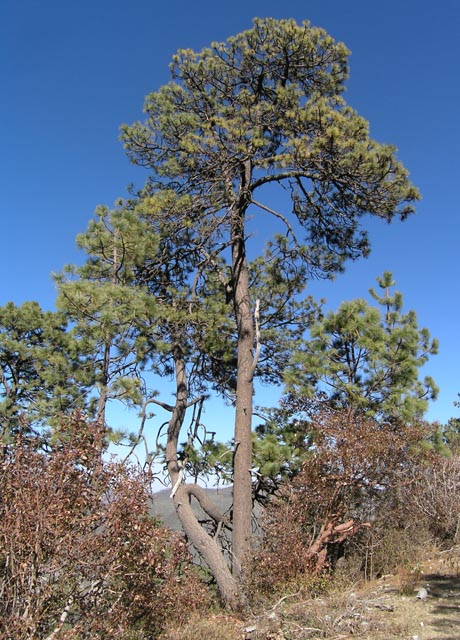
Tree, approx. 10 m tall, on Cerro Potosí (at 24.893°N, 100.218°W) [C.J. Earle, 2007.02.19].
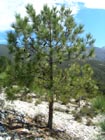
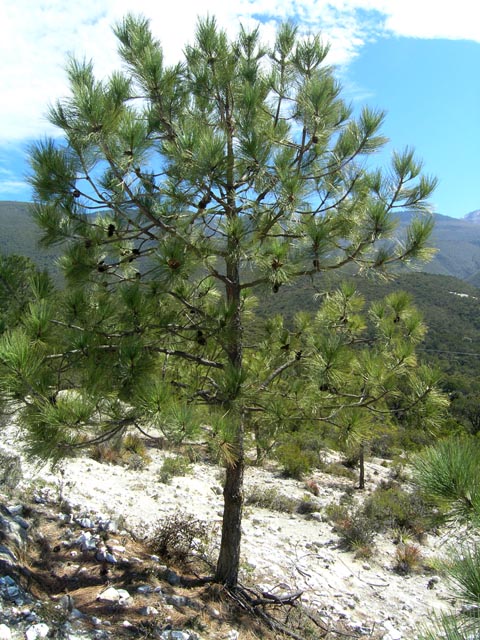
Tree, 5 m tall [C.J. Earle, 2007.02.18].
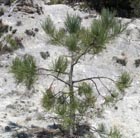
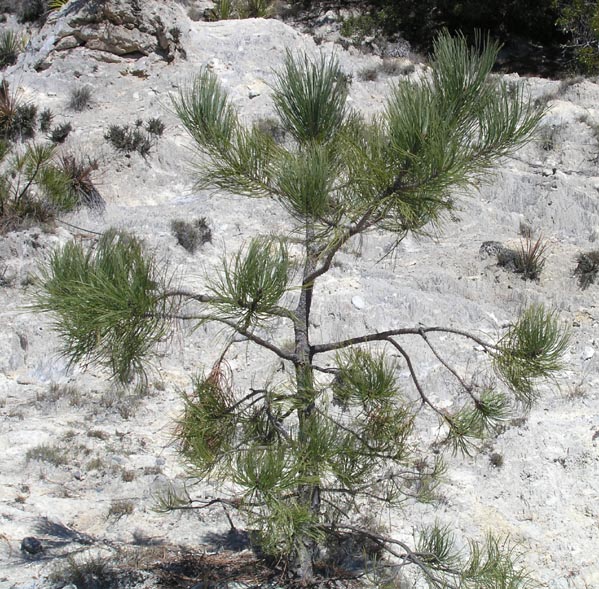
Sapling, 1.5 m tall [C.J. Earle, 2007.02.18].
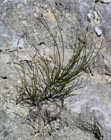
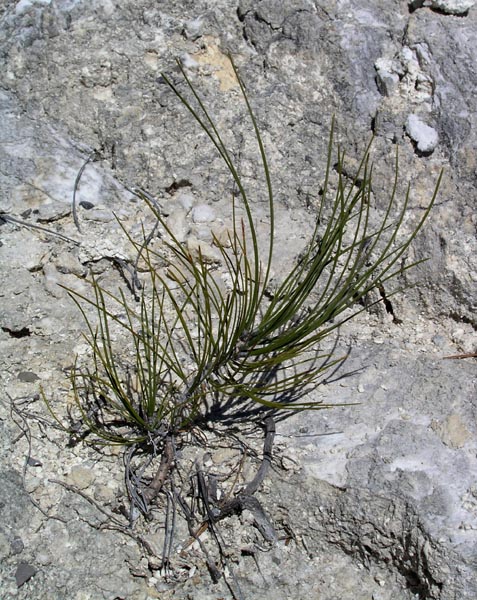
Seedling, 15 cm tall [C.J. Earle, 2007.02.18].
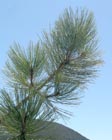
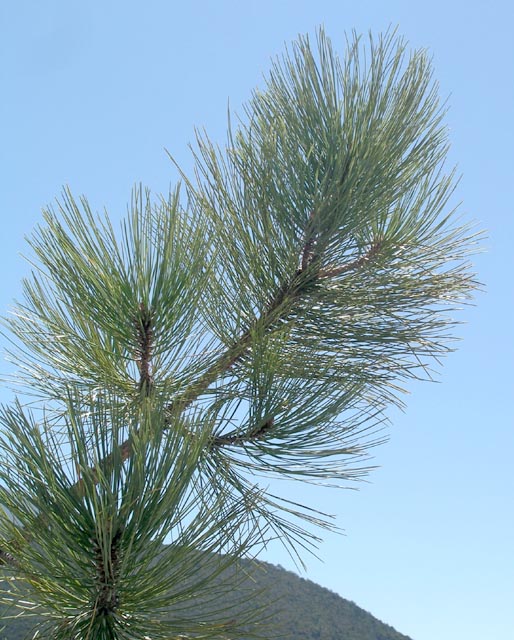
Foliar units; needles approx. 20 cm long [C.J. Earle, 2007.02.18].

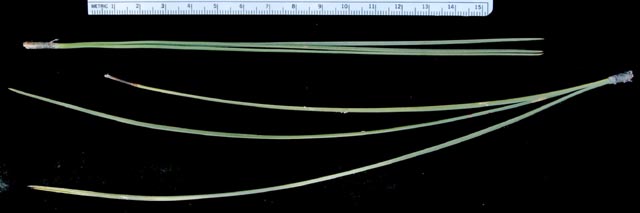
Fascicles [C.J. Earle, 2007.02.18].
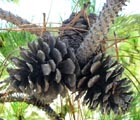
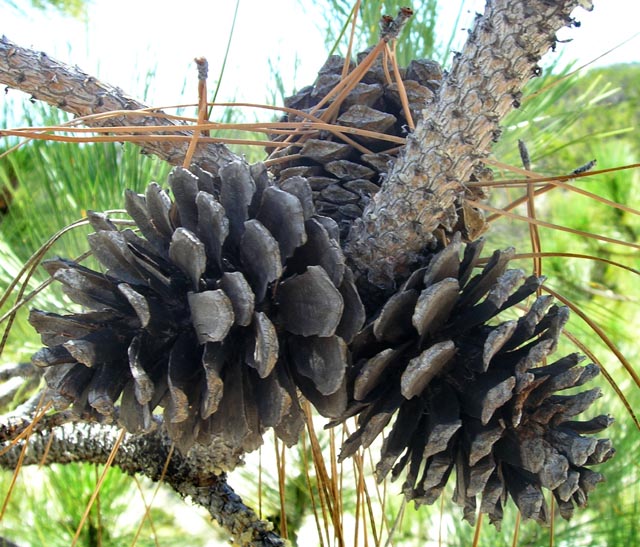
Mature cones in situ [C.J. Earle, 2007.02.18].
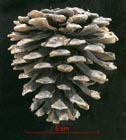
Mature cone [C.J. Earle, 2007.02.18].
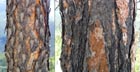
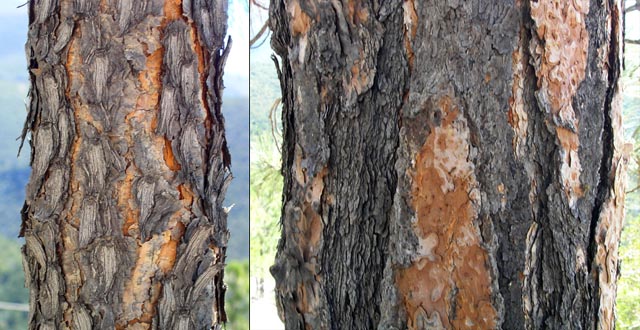
Bark on 30 cm and 15 cm diameter trunks [C.J. Earle, 2007.02.18].
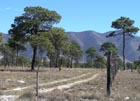
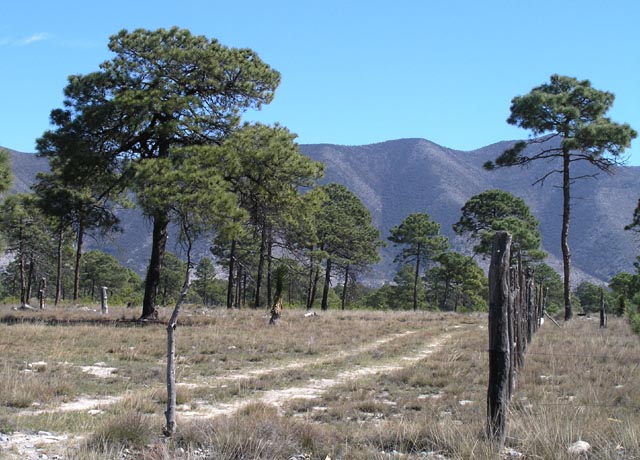
Parkland stand at elev. 1774 m, Nuevo León (24.708°N, 100.034°W) [C.J. Earle, 2007.02.19].
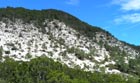
Stand developed on gypsum amid Pinus cembroides developed on carbonate soils. Stand in the southern Sierra Peña Nevada at about 23.8°N, 99.9°W [C.J. Earle, 2007.02.18].

Pinus arizonica var. stormiae
Martínez 1945
Common names
Pino real, pino blanco [Spanish] (Perry 1991).
Taxonomic notes
See the "Taxonomic notes" for Pinus ponderosa. Several molecular studies, most notably Willyard et al. (2021a, 2021b), have clearly established that this taxon is at best a distant relative of P. arizonica and warrants treatment at species rank. However, it has not yet been so described. There is one, equally incorrect synonym: Pinus ponderosa D. Douglas ex P. Lawson var. stormiae (Martínez) Silba 1990 (Farjon and Styles 1997).
Description
Trees to 35 m tall with a straight, massive trunk up to 120 cm in diameter. Crown open, pyramidal in young trees, becaming round-topped; branches thick and spreading, the first-order branches drooping and the others ascending. Bark on young trees dark brown, rough and scaly, with age becoming 4-5 cm thick, deeply furrowed, divided into large irregular plates separating into thin closely appressed light cinnamon-brown scales. Twigs first orange-brown, pruinose, later turning dark gray-brown, with decurrent leaf bract scales. Needles tufted at the ends of the branches, in fascicles of 3-4(-5) needles, 14-25 cm long, 1.4-1.8 mm thick, rigid, dark green, with 8-12 lines of stomata on the abaxial (outer) side; margins finely serrate; resin canals 6-10, medial, and with two distinct vascular bundles; fascicle sheaths brown, persistent, initially to 30 mm long but wearing shorter, turning dark gray; needles falling after 2-3 seasons. Cotyledons 7-9. Seed cones ovoid to conical, symmetrical, 6-9 cm long, borne in groups of 1-3 on short, stout peduncles, light red-brown at maturity, with hard, stiff scales 12-14 mm wide, the apex margin rounded and smoothed with apophyses raised and with a transverse keel; armed with slender recurved spines. Cones open at maturity and are soon deciduous, leaving the peduncle and a few basal cone scales attached to the branchlet. Pollen cones borne in dense clusters at the ends of new shoots, 15-20×5 mm, yellow to yellow-brown. Seeds dark brown, 6 mm long, oval, slightly compressed towards the apex, with a thick coat; seed wings articulate, 20-25×8-9 mm, with about 28,000 seeds/kg. Wood light, soft, brittle, light red or yellow, with thick pale yellow or white sapwood (Sargent 1922, Perry 1991, Farjon and Styles 1997).
Distribution and Ecology
Mexico: Coahuila, Nuevo León, southwest Tamaulipas (Miquihuana) and parts of San Luis Potosí (Perry 1991); United States: Texas (Perry 1991, Willyard et al. 2021a). It is probably most abundant in southern Nuevo León. Occurs at 1,500-3,000 m elevation, commonly with Quercus, Juniperus, or other pines, particularly P. cembroides and P. pseudostrobus (Farjon and Styles 1997). In Nuevo León I observed that on gypsum-derived soils in was the only tree (photo at right), whereas adjacent carbonate substrates were dominated by P. cembroides but supported a variety of conifers, including P. arizonica var. stormiae.
Distribution data. Pinus arizonica (undifferentiated) shown in red, var. arizonica shown in orange, var. stormiae shown in blue, and P. cooperi shown in yellow. Data sources (click on data points to view) include my observations, Farjon & Styles (1997), and downloads from GBIF (2014) and SEINet (2014).
Remarkable Specimens
Ethnobotany
Observations
Have seen it in the Sierra Peña Nevada of southern Nuevo León, and in extensive stands on the plains south of and at mid-elevations on Cerro Potosí, also in Nuevo León. Within its range it is a common and conspicuous pine.
Remarks
The epithet honors Marian Isabel Storm (1892-1975), an American writer and botanist who emigrated to Mexico in the 1930s. Along with Pinus douglasiana, this makes two independent American women that Martínez honored by naming pines for them.
This species is one of many principal hosts for the dwarf mistletoe Arceuthobium vaginatum subsp. vaginatum, and is also a principal host for A. vaginatum subsp. cryptopodum (Hawksworth and Wiens 1996).
Citations
Willyard, Ann, David S. Gernandt, Blake Cooper, Connor Douglas, Kristen Finch, Hassan Karemera, Erik Lindberg, Stephen K. Langer, Julia Lefler, Paula Marquardt, Dakota L. Pouncey, and Frank Telewski. 2021a. Phylogenomics in the hard pines (Pinus subsection Ponderosae; Pinaceae) confirms paraphyly in Pinus ponderosa, and places Pinus jeffreyi with the California big cone pines. Systematic Botany 46:538–561.
Willyard, A., Gernandt, D.S., López-Reyes, A., and Potter, K.M. 2021b. Mitochondrial phylogeography of the ponderosa pines: widespread gene capture, interspecific sharing, and two unique lineages. Tree Genetics & Genomes 17(6):47. doi:10.1007/s11295-021-01529-4.
See also
The species account at Threatened Conifers of the World.



 Back to top