Pinus flexilis
E. James 1823
Common names
Limber pine, limbertwig, Rocky Mountain pine (Peattie 1950), pino [Spanish] (Perry 1991), pin blanc de l'ouest [French] (Kral 1993).
Taxonomic notes
Section Strobus. Syn: Apinus flexilis (E. James) Rydberg (Kral 1993). One variety, Pinus flexilis var. reflexa Engelmann 1879 (syn: P. reflexa (Engelmann) Engelmann 1882; P. ayacahuite var. strobiformis Lemmon 1892; P. ayacahuite var. reflexa (Engelmann) Voss 1907; P. flexilis subsp. reflexa (Engelmann) Murray 1982 (Farjon and Styles 1997). P. flexilis and P. strobiformis form a cline, showing continuous variation in ecological, morphological and molecular characters, a subject detailed in the "Taxonomic notes" section of P. strobiformis. Briefly, intermediate populations occur from southern Colorado to the northern Sierra Madre, and trees in this transitional area can reasonably be called Pinus reflexa (Engelmann) Engelmann, or may be referred to a variety or subspecies of P. flexilis or P. strobiformis. The cline becomes more complex in Mexico, with distinctions between populations of the Sierra Madre Occidental and Oriental, as well as of the Transverse Volcanic Plateau.
This cline has been the subject of much debate since the days of Engelmann and Lemmon. Among the more recent authorities, Farjon and Styles (1997) describe P. flexilis and P. strobiformis as forming a polymorphic cline, while Perry (1991) describes them as distinct taxa with introgression in their shared range. My own interpretation, after review of the relevant literature (cited above, plus Frankis [2008], Moreno-Letelier and Piñero [2009], and Bisbee [2014]) is that these taxa likely arose in the New World, probably from a subtropical Mexican progenitor, and that the cline has been subject to frequent migrations and mixing associated with glacial-interglacial transitions throughout the Pleistocene. Substantial further paleontological and molecular study is likely to be needed before anyone can confirm or deny that hypothesis.
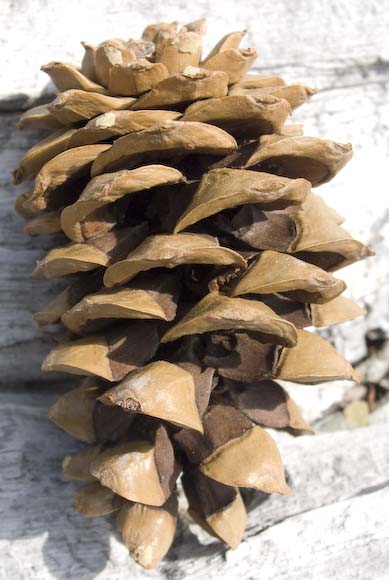
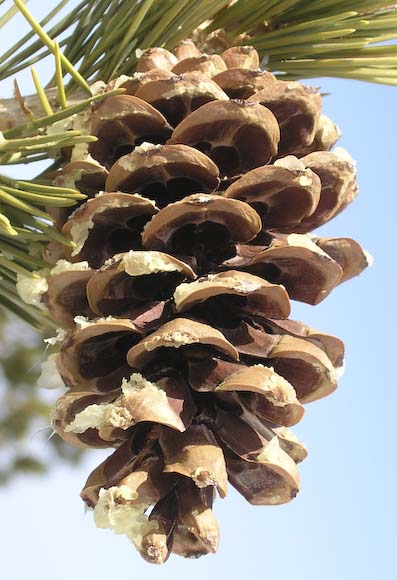
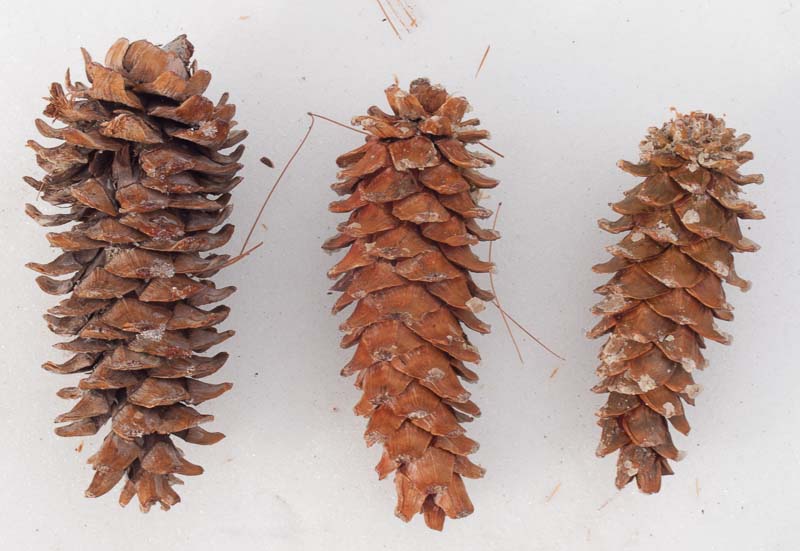
Three photographs presented here show cones of limber pine in northeast Oregon, in extreme southern California, and in southern Arizona. All cones appeared representative of their local populations.
Description
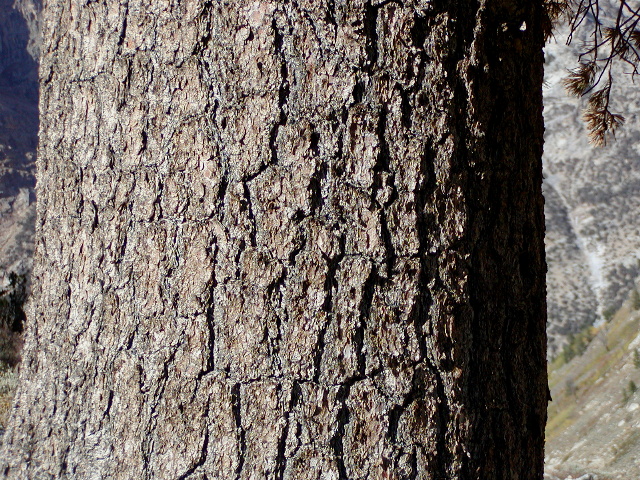
Trees 12–15(–26) m tall; 60–90(–200) cm diameter, straight to contorted; crown conic, becoming rounded; growth form may be substantially altered near timberline (krummholz form occurs) or on very dry sites. Bark light grey, nearly smooth, becoming dark brown and cross-checked in age into scaly plates and ridges. Branches spreading to ascending, often persistent to trunk base; twigs pale red-brown, puberulous (rarely glabrous), slightly resinous, aging gray, tough and flexible, smooth. Buds ovoid, light red-brown, 0.9–1 cm, resinous; lower scales ciliolate along margins. Needles 5 per fascicle, spreading to upcurved and ascending, persisting 5–6 years, 3–7 cm × 1–1.5 mm, pliant, dark green, abaxial surface with less conspicuous stomatal bands than adaxial surfaces, adaxial surfaces with strong, pale stomatal bands, margins finely serrulate, apex conic-acute to acuminate; sheath 1–1.5(–2) cm, shed early. Staminate cones broadly ellipsoid-cylindric, ca. 15 mm, pale red or yellow. Ovulate cones maturing in 2 years, shedding seeds and falling soon thereafter, spreading, symmetric, lance-ovoid before opening, cylindro-ovoid when open, 7–15 cm long, yellow-brown, resinous, sessile to short-stalked, apophyses much thickened, strongly cross-keeled, umbo terminal, depressed. Seeds irregularly obovoid; body 10–15 mm, brown, sometimes mottled darker, wingless or nearly so. 2n=24 (Little 1980, Kral 1993).
In the absence of cones, P. flexilis strongly resembles P. albicaulis, the whitebark pine. See the P. albicaulis page for a detailed discussion of how to distinguish the two species.
Distribution and Ecology
The type variety occurs in the Rocky Mountains and Intermountain Ranges from Canada: SE British Columbia and SW Alberta, S through USA: Oregon, Idaho, Montana, North Dakota, South Dakota, Nebraska, Wyoming, Colorado, Utah and Nevada to N New Mexico and W through N Arizona to S California at (1000)1500-3700 m, preferring dry, rocky slopes and ridges of high mountains up to timberline, often occurring in pure stands (Little 1980, Kral 1993). See also Thompson et al. (1999). Hardy to Zone 3 (cold hardiness limit between -39.9°C and -34.4°C) (Bannister and Neuner 2001).
Var. reflexa occurs in USA: Colorado, Arizona, New Mexico and W Texas (possibly Utah), and in Mexico: Chihuahua, Coahuila, Nuevo León (Frankis 2008, Bisbee 2014).
Distribution data including polygons provided by USGS (1999) and my personal observations through 2017.
The hardest land that supports a pinyon-juniper forest is the high plains of eastern Montana, where you can find a Pinus flexilis–Juniperus scopulorum forest clinging to the sandstone cliffs and washes of the Missouri breaks. West of there, all down the spine of the high Rocky Mountains from Alberta to New Mexico, this species comes into its own as a tree of the high mountains. On exposed and rocky sites it will sometimes descend to the lower treeline, but usually it is a tree of the passes and summits, sharing its habitat with other subalpine species such as Abies lasiocarpa var. bifolia and Picea engelmannii. It occupies similar sites in the Wallowa Mountains of Oregon, where it thrives best on limestone substrates (much like its southern cousin P. longaeva); and also west across the high plateaux of Utah and the high mountains of the Basin and Range province, where it occupies picturesque sites that receive most of their precipitation with the winter snows. It even holds to this niche in the diverse subalpine forests of the Sierra Nevada, where it reigns east of the range crest and on high summits of the Inyo, Panamint, White and other desert ranges, often mingling there with P. monophylla. In more limited portions of its range, I have also found it with a variety of other conifers, including Abies concolor, Juniperus communis, Picea pungens, Pinus albicaulis, Pinus longaeva, Pinus jeffreyi, Pinus ponderosa, and Pseudotsuga menziesii.
Remarkable Specimens
The largest known specimen since 1968, height 18.6 m, dbh 244 cm, crown spread 14.6 m (photo at right). It grows on a ridge S of Snowbird, Utah (American Forests 2021, accessed 2021.12.17). There is also a very large specimen in Oregon, the Dielman Monarch (photo at right), measuring 205 cm DBH, 9.34 m tall, and with a crown spread of 8.2 m (Dielman 2009). Some very large trees reportedly occur in California, Nevada and Colorado as well, but I don't have the numbers.
The oldest tree on record is at Site ERE in New Mexico, collected by Swetnam and Harlan, which yielded crossdated ages of up to 1,670 years; and a crossdated age of 1659 years was found for specimen KET3996 from Ketchum, Idaho collected by Schulman in 1956 (Brown 1996). Given that crossdated tree ages are always underestimates due to the near-impossibility of sampling the tree's seedling growth years, either of these trees could have been the older, particularly since KET3996 was sampled about 30 years before the ERE tree. During a 1994 visit to Craters of the Moon National Monument, I believe I located KET3996; it was dead, and had been for some time. I saw it again in 2014, and based on the deterioration of the log during that time, I suspect it had been dead for more than 20 years when I first saw it.
Some very old trees have been reported elsewhere in the range of the species. The oldest known from California is specimen 323121, collected in 1970 on the north slope of Mt. San Gorgonio in southern California by R. Tosh. It has a continuous tree-ring record from 465 to 1970 (1505 years) (source: https://www.ncdc.noaa.gov/paleo/study/5122, accessed 2015.10.14). Aerial photos from 2013 show the site appears not to have since burned, so the tree may well still be alive. Collections containing trees over 1,000 years old have also been reported from Nevada, Colorado, Utah, Wyoming, Montana, and Alberta, and there is a narrative report (unsupported by physical evidence or corroboration) of a sample with 2,030 rings from Oregon (Johnson 2004, p. 69).
Ethnobotany
There is some evidence that the seeds were used as a food source by certain Great Basin tribes, such as the Northern Shoshone. Numerous grinding stones at Alta Toquima Village, a high elevation prehistoric site in central Nevada, also suggest use of pine nuts as food, with limber pine the likely source (Lanner 1996). The sole occurrence of the species in North Dakota is thought to have been established by an aboriginal group.
I have observed that miners, sheepherders, and other rural residents in its range (ca. 1850-1950) used it for cabins, fencing, mine timbers, and doubtless, firewood. Muir (1894) wrote that "Throughout Utah and Nevada it is one of the principal timber-trees, great quantities being cut every year for the mines. The famous White Pine Mining District, White Pine City, and the White Pine Mountains have derived their names from it." Young and Budy (1987) reported that "Limber pine was the most valuable timber tree of the central Great Basin, because it was large and more widespread than the bristlecones. It was the only tree of the region that was sawed into lumber." However, the wood is too contorted and resinous, and the trees generally too small (though one wonders what stands were exterminated in the historical period) to warrant commercial exploitation in the modern age. Still, it is a popular bonsai subject, and is occasionally used for craftwood.
Limber pine is an important species in dendrochronology due to its longevity and widespread occurrence in the arid U.S. Many chronologies have been developed and used in climate reconstructions.
Observations
The most memorable stands I have seen have been:
- Craters of the Moon National Monument in Idaho, which has numerous groves of trees that, due to the harsh environment (growing on mostly barren lava in a cold desert climate), tend to be very picturesque. You'll see what looks like evidence of logging there; many ancient limber pines in the Monument were cut by the National Park Service in the early 1960s in a poorly conceived attempt to eradicate a mistletoe infestation.
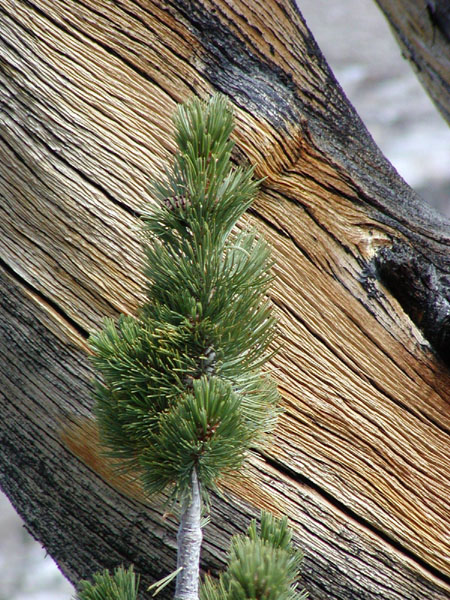
- The timberline grove along the trail up Borah Peak, Idaho. This site is a particularly worthy objective for photographers, as it contains many ancient and extremely gnarled trees. These limbers resemble the extremely ancient and gnarled form typically associated with Pinus longaeva.
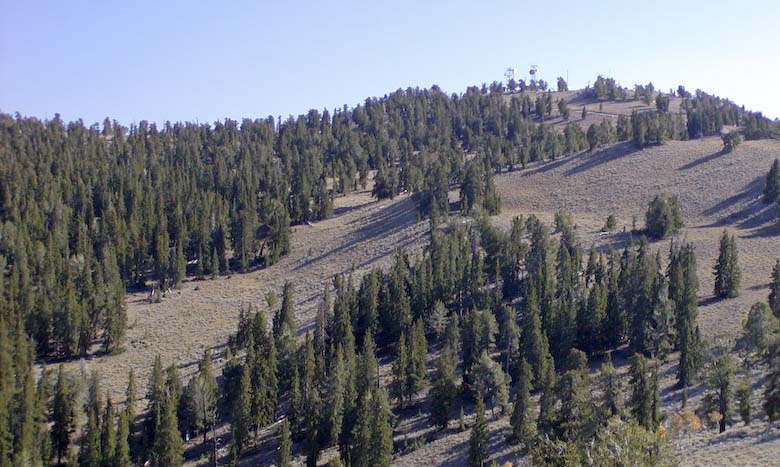
- The forest near the summit of Cave Mountain, southeast of Ely, Nevada. A steep road passable for light trucks and sturdy sedans climbs to a communications complex on the summit of this peak and affords access to an extensive stand of P. flexilis and P. longaeva. The east-facing slopes of the peak support a closed-canopy stand of very large P. flexilis, the only closed-canopy stand of this species that I have seen, and in it grow the largest trees of this species known from Nevada.
- Along the hiker's trails up Thomas and Lamoille Canyons in the Ruby Mountains of Nevada, where it grows with P. albicaulis. It is interesting to see how these very similar white pines share the habitat in the Ruby Mountains. Limber pine generally occurs at somewhat lower elevations. Where the two species co-occur, limber pine typically occupies relatively rocky granitic substrates, while whitebark pine is usually found in areas with deep soils. Below the elevation limit of whitebark, limber pine moves onto deep soils, often in mountain mahogany (Cercocarpus ledifolius) woodlands. Above the elevation limit of limber, whitebark pine occurs on some extremely rocky sites.
Remarks
Both the epithet flexilis and the common name "limber" refer to the tough, flexible twigs. The seeds are an important food source for rodents and certain birds (Little 1980).
The fresh-cut wood has the odor of turpentine (Kral 1993).
White pine blister rust (Cronartium ribicola), an introduced fungal disease, has afflicted this and certain other white pines (Elias 1987). It is also one of the primary hosts for the dwarf mistletoe Arceuthobium cyanocarpum (Hawksworth and Wiens 1996), and mistletoe infestation is a locally significant cause of limber pine mortality (Mathiasen and Hawksworth 1990).
Stop a moment and listen to the whistle of the mountain wind it its short, stubby, thick needles. They are lifting their voices in a tale of their life that is all fierce endurance. The sort of winter wind that would get into the headlines of newspapers if it blew down below, blows here for days and weeks, raising the voices of the Pines to a high sustained keening note. Snows that would stop all traffic on our roads and streets weigh down its branches. But they do not break, for this a Limber Pine whose long boughs and twigs can bend and bend without snapping. A tree better adapted to endure timberline conditions does not exist. — Donald Culross Peattie
Citations
American Forests 1996. The 1996-1997 National Register of Big Trees. Washington, DC: American Forests.
Bisbee, Jeff. 2014. Cone morphology of the Pinus flexilis-strobiformis complex and related species of the western United States and Mexico. Bulletin of the Cupressus Conservation Project 3:3-33.
James, Edwin. 1823. Account of an Expedition from Pittsburgh to the Rocky Mountains, Performed in the Years 1819, 1820., V.2, pp. 224-225. Available http://content.wisconsinhistory.org/u?/aj,17167, accessed 2011.05.20.
Johnson Jr., Charles G. 2004. Alpine and subalpine vegetation of the Wallowa, Seven Devils and Blue Mountains. Report R6-NR-ECOL-TP-O3-O4. USDA Forest Service, Pacific Northwest Region.326pp.
Mathiasen, R. L., and F. G. Hawksworth. 1990. Distribution of limber pine dwarf mistletoe in Nevada. Great Basin Naturalist 50(1): 91–92.
Young, J. A., and J. D. Budy. 1987. Energy crisis in 19th century Great Basin woodlands. In Proceedings - pinyon-juniper conference; 1986 January 13-16; Reno, NV. Edited by R. L. Everett. U.S. Department of Agriculture, Forest Service, Intermountain Research Station, Ogden, UT. doi:10.2737/INT-GTR-215.
See also
Burns and Honkala (1990).
Elwes and Henry 1906-1913 at the Biodiversity Heritage Library. This series of volumes, privately printed, provides some of the most engaging descriptions of conifers ever published. Although they only treat species cultivated in the U.K. and Ireland, and the taxonomy is a bit dated, still these accounts are thorough, treating such topics as species description, range, varieties, exceptionally old or tall specimens, remarkable trees, and cultivation. Despite being over a century old, they are generally accurate, and are illustrated with some remarkable photographs and lithographs.
Johnson, Kathleen A. 2001. Pinus flexilis. In: Fire Effects Information System, [Online]. U.S. Department of Agriculture, Forest Service, Rocky Mountain Research Station, Fire Sciences Laboratory (Producer). Available: https://www.fs.fed.us/database/feis/plants/tree/pinfle/all.html, accessed 2021.09.27.
Kendall, Katherine C. 1995. Limber pine. In Status and Trends of the Nation's Biological Resources. U.S. Geological Survey.
Lanner (1983).
Schoettle, A. W. and S. G. Rochelle. 2000. Morphological variation of Pinus flexilis (Pinaceae), a bird-dispersed pine, across a range of elevations. American Journal of Botany 87:1797-1806. Available: http://www.amjbot.org/cgi/content/full/87/12/1797, accessed 2008.01.07.





 Back to top