
(not evaluated)
Pinus ponderosa subsp. benthamiana
(Hartw.) Silba 2009
Common names
Pacific ponderosa pine.
Taxonomic notes
Synonymy (mostly from Callaham 2013):
- Pinus benthamiana Hartweg 1847;
- P. beardsleyi A. Murray 1855;
- P. craigana A. Murray 1855;
- P. ponderosa Dougl. ex Laws. var. benthamiana (Hartweg) Vasey 1876
- P. ponderosa Dougl. ex Laws. var. beardsleyi (A. Murray) A. Kellogg 1882;
- P. ponderosa Dougl. ex Laws. var. benthamiana (Hartweg) Lemmon 1888;
- P. ponderosa Dougl. ex Laws. var. nigricans Lemmon 1889;
- P. ponderosa Dougl. ex Laws. var. pacifica Haller 2011;
- P. ponderosa Dougl. ex Laws. subsp. critchfieldiana Callaham 2013;
- P. ponderosa Dougl. ex Laws. var. willamettensis (undescribed, but referred to in the popular media).
P. ponderosa subsp. benthamiana includes populations formerly assigned to Pinus benthamiana Hartweg (1847) from the Sierra Nevada and west of the Cascade crest in California, Oregon and Washington. Haplotype data (see "Taxonomic notes" for P. ponderosa; Potter et al. 2013) indicate these populations are most strongly and consistently allied with a haplotype that is predominant in populations in the Puget Trough, the Willamette Valley, and the Klamath-Siskiyou region. Along the Sierra Nevada, this haplotype is present along with a second haplotype that predominates in eastern Oregon and generally seems to be associated with populations of drier, colder, more continental environments. A variant haplotype found south of San Francisco Bay is differentiated by a single mutation from the Puget-Willamette-Klamath haplotype.
Hartweg (1847) collected the type specimen on August 24, 1846 in "the mountains" within a day's ride of Santa Cruz, California; a few days earlier he had also collected the type of Hesperocyparis macrocarpa.
There is still substantial uncertainty about what is going on west of the Cascade Crest in Washington and Oregon. The haplotype analysis by Potter et al. (2013) included only one sample from Fort Lewis, Washington, and one from Eugene, Oregon. The Fort Lewis sample had the subsp. ponderosa variety haplotype and the Eugene sample had the subsp. benthamiana haplotype, which agrees with assignment of these specimens based on morphology. It is recognized, in the Willamette Valley of Oregon, that trees from Eugene and points south are good benthamiana, typically found on drier upland sites; but that trees from north of Eugene are ecologically distinct, often associated with wetter sites than are normal for any other ponderosa subspecies, and they can even be found as an early seral species on alluvial islands in the Willamette River. It has been proposed to assign these trees to a new and as yet undescribed variety willamettensis (see, e.g., materials at https://www.westernforestry.org/wvppca/ accessed 2019.06.02), but no formal description has yet been published and no one has demonstrated that these trees comprise a distinct taxon. I have seen these trees in the field, though, and they key out as normal benthamiana; they are simply adapted to an unusual habitat. Thus var. willamettensis is synonymous with subsp. benthamiana.
Description
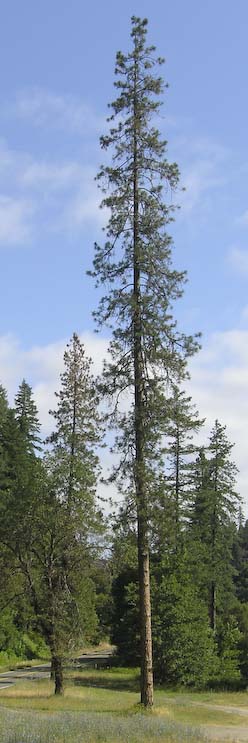
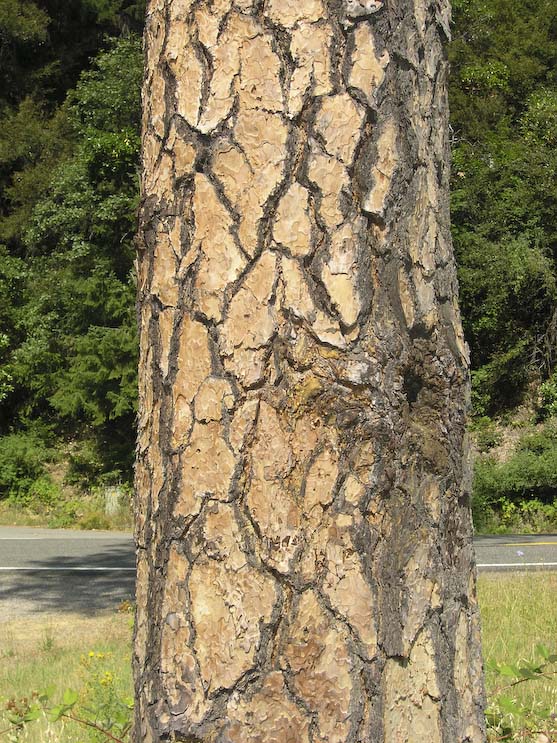
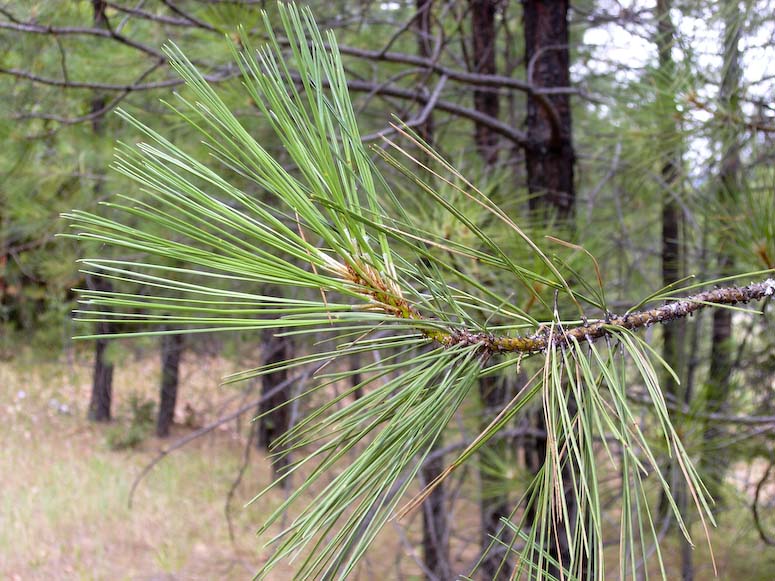
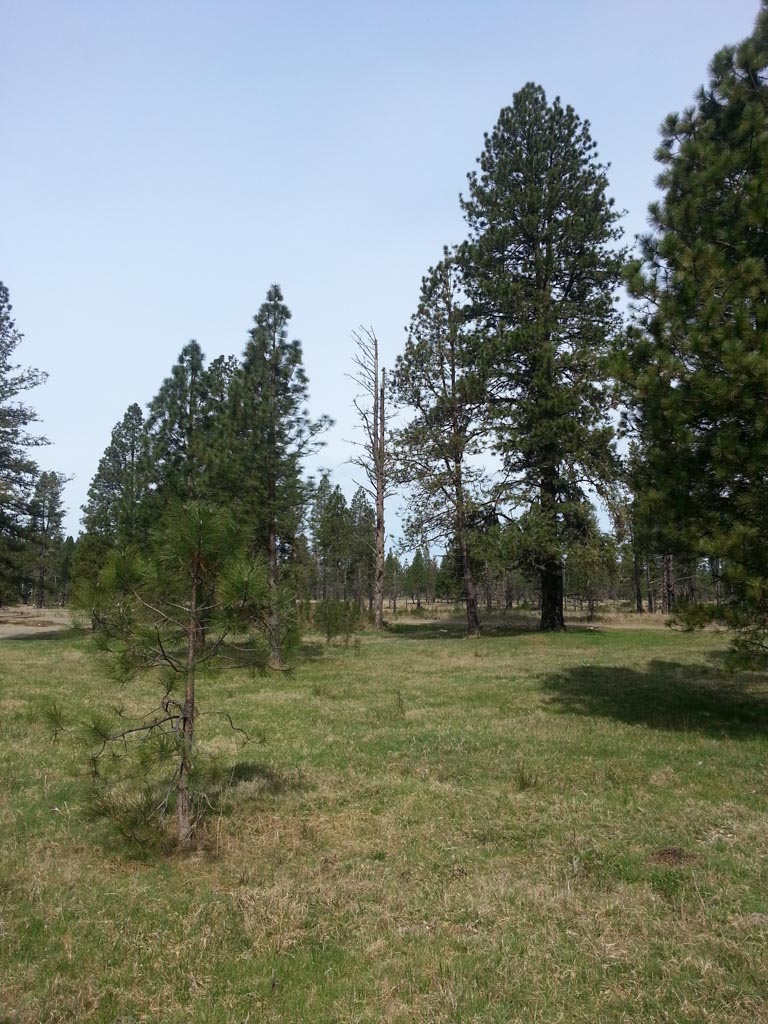
Evergreen monoecious trees to 60 (-83) m tall and 150 (-280) cm] DBH. Stem usually straight and robust; branches thick and persistent; usually one whorl per year; average 4.4 branches in a whorl; branches inserted at an average angle of 56° from apex of the stem of young trees. Bark on mature trees vertically fissured, dark brown or dark gray to black; on old trees becoming pale yellow to orange, thick, with broad plates separated by shallow fissures. Xylem resin odor (discernible in bark crevices warmed by the sun) usually like vanilla, turpentine, or lemon rind. Needles finely serrate, sharp-tipped, finely lined with stomata on all faces, 15-24 cm × 1.5-2 mm, dark green to blue-green, paler and shorter at higher elevations and under xeric conditions; generally not glaucous, but becoming glaucous at higher elevations and with the onset of winter; flexible and in fascicles of three; remaining green on stem an average of 4 years, remaining green longer at higher elevations; persisting on branch only a few years, giving a tufted appearance to branches; enclosed at the base by sheaths of papery bracts that are, in the first year, 10-15% of needle length but that weather away to leave a thick, dark brown to black sheath 4-8 mm long on the oldest fascicles. Vegetative buds covered with loosely appressed ovate acute scales that are conspicuously fringed with short brown hairlike projections; scales dark reddish-brown, dotted with resin during summer, sometimes covered with resin during winter. Vegetative shoots green or brownish green and sticky, elongating once each year. Pollen cones borne in clusters of 5-30, dark red to reddish purple, long-cylindrical, 40-90 mm long. Seed cones in first year 15 to 25 mm long, on stalks half as long; red on emergence, turning greenish brown, with short, appressed, mucronate scales; prickles usually erect; when mature, symmetrical and straight to slightly curved, average 100 mm long, long-ovoid; color during second summer typically green; subsessile; deciduous during the first winter after ripening, with a very short stalk and a few basal scales usually persisting temporarily on branch after the cone falls. Seed cone scales average 159, slightly concave, usually rounded at apex; apophysis yellow to brown, lustrous, slightly elevated along a transverse keel; umbo salient and forming base of a stout, persistent prickle usually directed outward, but occasionally slightly reflexed; adaxial surface slightly concave and dull tawny to red brown; abaxial surface dark brown, purplish, or blackish. Seeds dark brown or speckled; acute-ovoid; width about two-thirds of length, averaging 4-5 x 6-8 mm. Seed wings average 4.3 times length of seed, average length 25 mm, thin, semitransparent, pale brown, sometimes darkly streaked with brown, widest at or slightly below midpoint, apex rounded (Callaham 2013, Kral 1993, and my observations). See P. ponderosa for a table detailing differences from the other taxa commonly called "ponderosa pine".
Distribution and Ecology
USA: Oregon west of the Cascade crest; California, particularly in the Sierra Nevada but also in a few areas in the Coast Ranges. Habitat montane, dry, open forests at 0-2300 m (Kral 1993).
Distribution data for the various taxa that have been called "Pinus ponderosa", i.e. P. arizonica, P. brachyptera, P. ponderosa, and P. scopulorum, including subspecies and varieties. Data downloaded on 2021.12.15 from the Consortium of California Herbaria, the Consortium of Midwest Herbaria, and the Consortium of Pacific Northwest Herbaria, limited to geolocated records with coordinate uncertainty less than 10 km. Note that there are probably some misidentifications; for instance, P. scopulorum is unlikely to be found in the North Cascades. Most records include a link to the original herbarium record.
The IUCN does not recognize this taxon as distinct from subsp. ponderosa or subsp. washoensis. However, it is still probably accurate to assess subsp. benthamiana as "least concern" under IUCN criteria due to its extensive area of occupancy and the limited scope of its threats.
Remarkable Specimens
The largest volume, 152.9 m3, is found in a tree discovered in 2014 in Eldorado National Forest, California (Michael Taylor e-mail 2014.08.14). Other notable trees include:
- The Lovitt tree, which grows at an undisclosed location in California, and has a volume of 143.5 m3, a 253 cm dbh, and is 72.2 meters tall (Michael Taylor email 2009.10.17).
- The Calaveras Giant in Stanislaus National Forest, California, has a volume of 143.3 m3 (Michael Taylor e-mail 2014.08.14).
- The Mokelumne Giant in California has a volume of 140.4 m3 and a dbh of 265 cm (Michael Taylor e-mail 2014.08.14).
- The Clark's Creek Giant grows in California, has a volume of 131.7 m3, and is 59.4 meters tall. I don't have the precise dbh, but it is about 280 cm (Michael Taylor email 2009.10.17).
- The Collins Pine near Almanor, California has a volume of 122.5 m3 and a dbh of 254.8 cm, and is 44.8 m tall (Kennedy 2015, reporting 2015 measurements by Michael Taylor).
- The Grizzly Meadow Monarch, which grows along the West Fork Chiquito Creek in Sierra National Forest, California. Its volume is 126.2 m3, and it is 222 cm dbh and 68.0 meters tall (Van Pelt 2000).
- A tree on Eagle Creek in the Trinity Alps of California is 78.9 m tall (Michael Taylor e-mail 2014.08.14).
See the P. ponderosa account regarding the tallest trees, which are probably (but not certainly) subsp. benthamiana.
Ethnobotany
A valuable timber tree, the harvest of which far exceeds regrowth because of high timber value and multiple uses of the wood (Kral 1993).
Observations
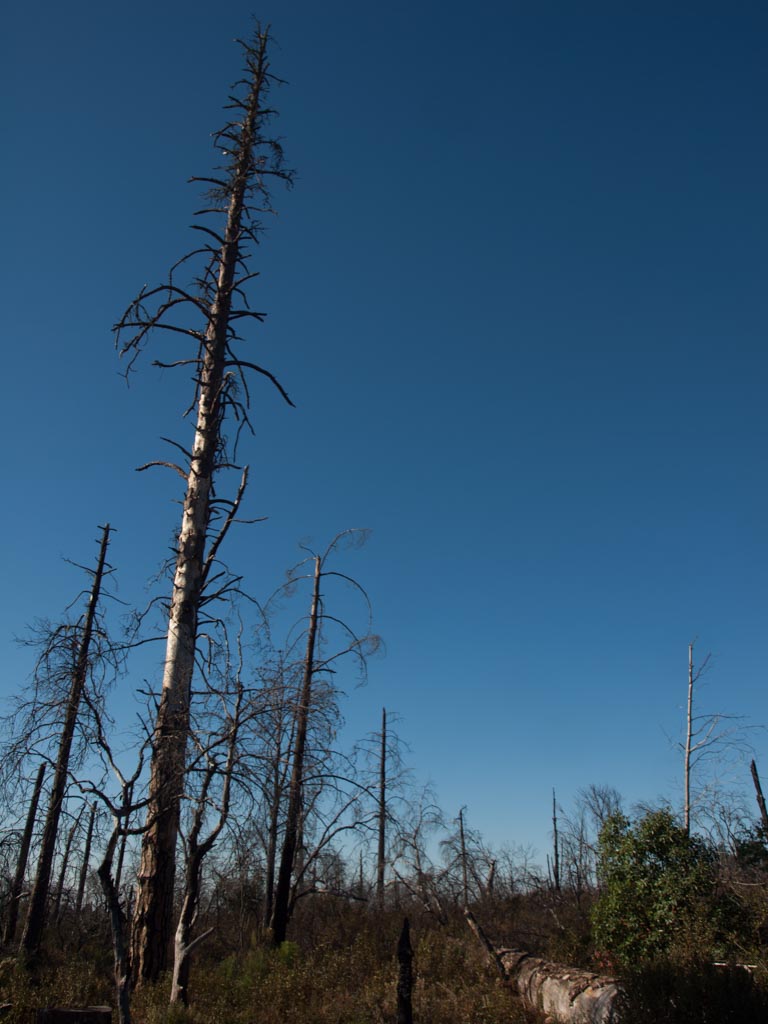
Since the species is so common within its range, only a few choice locales can be mentioned here. It can be seen at low montane elevations in Sequoia and Kings Canyon National Parks, in Yosemite National Park, and in Calaveras Big Trees State Park, all in California. The Calaveras forests are particularly noteworthy because a prescribed fire program has been implemented in the park. Consequently, the stands include examples of open pine forest understory with pine seedling regeneration. Such a sight has not been seen in many American ponderosa stands this past century, due to widespread fire suppression that seems to have doomed many of our finest ponderosa forests to replacement by more shade-tolerant conifers such as Abies grandis.
Remarks
It is the largest and stateliest yellow pine in North America (Kral 1993).
The epithet benthamiana was given to honor botanist George Bentham (Hartweg 1847).
The pine forests of California were eloquently described by John Muir (1894).
Citations
Callaham, R. Z. 2013. Pinus ponderosa: a taxonomic review with five subspecies in the United States. Research Paper PSW-RP-264, USDA Forest Service, Pacific Southwest Research Station, Albany, CA.
Haller and Vivrette. 2011. Ponderosa pine revisited. Aliso 29(1):53-57.
Hartweg, T. 1847. Journal of a mission to California in search of plants. Journal of the Horticultural Society of London 2:187-191. Available at the Biodiversity Heritage Library, accessed 2021.11.27.
Kennedy, Duncan. 2015.11.09. The largest pine in Tehama County: the Collins Pine. sierracountybigtrees.wordpress.com/2015/11/09/the-largest-pine-in-tehama-county-the-collins-pine/, accessed 2016.12.10.
Potter, K.M., V.D. Hipkins, M.F. Mahalovich, and R.E. Means. 2013. Mitochondrial DNA haplotype distribution patterns in Pinus ponderosa (Pinaceae): range-wide evolutionary history and implications for conservation. American Journal of Botany 100(8):1-18.
Silba, J. 2009. Journal of the International Conifer Preservation Society 16(1):30.
Taylor, Michael. 2017.04.29. LiDAR search reveals tallest pine tree on Earth. http://www.ents-bbs.org/viewtopic.php?f=69&t=8002, posting on Native Tree Society BBS, accessed 2017.05.14.
See also
Arno, Stephen F. and Jane Gyer. 1973. Discovering Sierra trees. Yosemite Natural History Association. 89pp.
Hickman (1993).


 Back to top