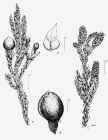
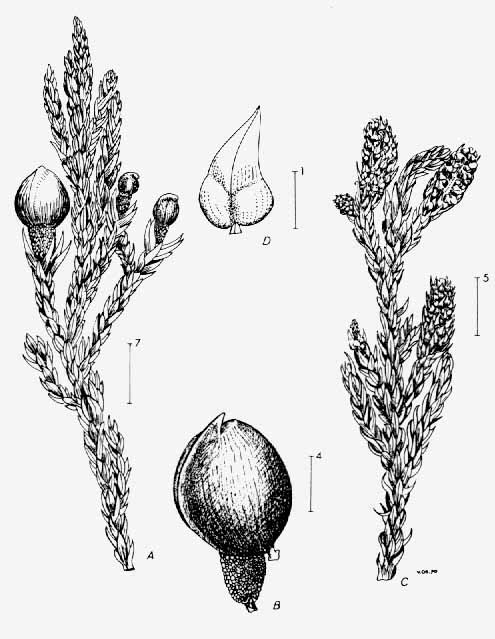
"A. branchlet with ripe fruit, B. ripe fruit, C. branchlet with male cones, D. microsporophyll" (Van Royen 1979).
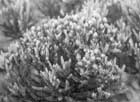
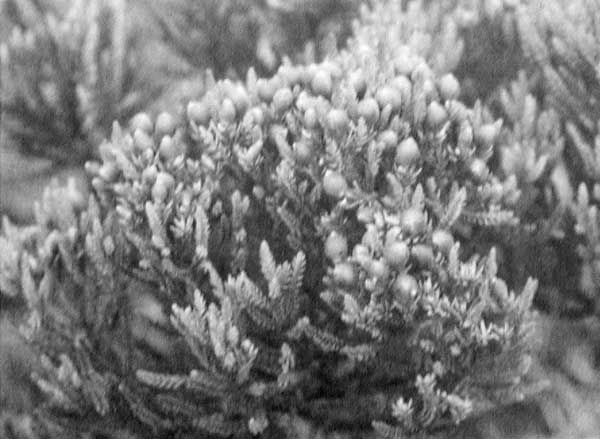
"Detail of female branch with cones. Mt Amungwiwa, New Guinea, 3050 m (Photogr. P. van Royen 11072, June 1976" (de Laubenfels 1988).
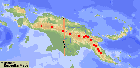
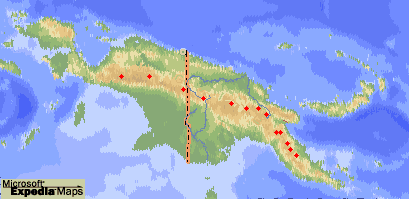
Range of Dacrycarpus compactus (de Laubenfels 1988). Adapted from a map by www.expediamaps.com.
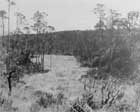
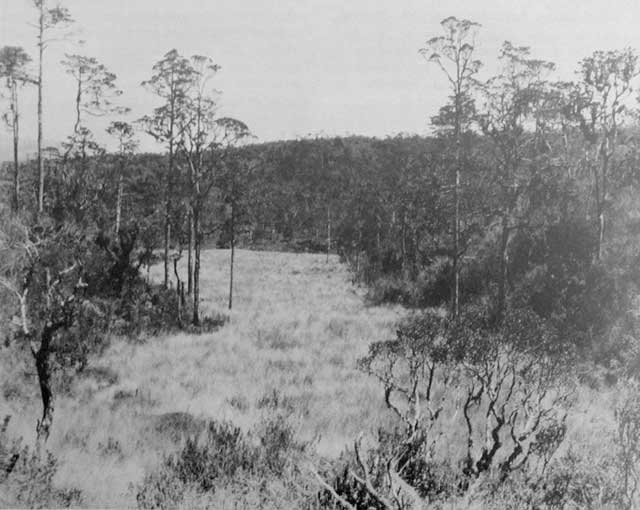
"A boggy hollow, filled with the tall grass Deschampsia klossii Ridley (c. 1 m high) with on the edge tall Dacrycarpus compactus (Wasscher) de Laub. in dense, very mossy shrubberies of mixed composition. About 1 km north of Lake Habbema, West New Guinea, 3300 m (Photogr. L.J. Brass, 1938)" (de Laubenfels 1988).

Dacrycarpus compactus
(Wasscher) de Laub. 1969
Common names
Binban (Oriomo), djasiha (Asaro, Kefamo), kadzinam, kaibigl (Minj), kaipik (Kubur, Minj), man (Kunimaipa), ma-u (Najo), pau (Enga, Kepilam), pawa (Enga, Poio), uba, umba, umbwa (Chimbu, Waimambano) (Van Royen 1979, de Laubenfels 1988).
Taxonomic notes
Syn: Podocarpus compacta Wasscher 1941; P. papuanus (non Ridley) Pilger 1936 (Van Royen 1979, de Laubenfels 1988).
Description
Tree: Height 2-20 m and dbh 25-60 cm, often with 'straggly and twisted' crown (Van Royen 1979, de Laubenfels 1988).
Bark: Outer bark hard, rough, warty, dark gray, cracking into small scales; inner bark reddish straw (Van Royen 1979).
Leaves: Dark green or dark grey green above, glaucous below. On primary shoots spreading slightly, often curved so that the apex is directed inward towards the axis. Leaves of juvenile foliage shoots are not distichous, lanceolate, strongly keeled laterally, 2-2.5 × 0.6 mm. Leaves on older trees not dimorphic, bifacially flattened, slightly spreading, lanceolate, falcate, needle-tipped, strongly keeled on the dorsal side, 1-2.5 × 0.6-1 mm (Van Royen 1979, de Laubenfels 1988).
Cones: Terminal on a 6-17 mm long brachyblast. Involucral leaves robust, 4-5 × 0.8-1.2 mm, clasping the receptacle, strongly keeled on the dorsal side and more or less triangular in cross section, 4-5 by 0.8-1.2 mm. Ripe receptacle purple to black, small, 3-4 mm long, warty (Van Royen 1979, de Laubenfels 1988).
Pollen cones: Lateral on a 3+ mm long shoot or terminal, cylindric, 7-8 × 2-3 mm. Microsporophylls lanceolate, 2 mm long, acute, anther-cells globose-ellipsoid, c. 1 mm long (Van Royen 1979).
Seeds: Dark brown or black, globose, 7-8.5 × 7-8 mm, with a rounded crest (Van Royen 1979, de Laubenfels 1988).
Flowers May to August, but also reported from February (Van Royen 1979).
Distribution and Ecology
New Guinea, at 2800-3950 m elevation (de Laubenfels 1988). Within its range, mean annual temperature is 12.5°C, with an average minimum in the coldest month of 6.3°C, and a mean annual precipitation of 2940 mm (Biffin et al. 2011, Table S5). It is "common on the higher peaks near the tree line, sometimes forming pure stands or emerging above a subalpine shrubbery, or scattered in alpine grassland, often in isolated specimens and obviously fire-resistant, in Podocarpus-Libocedrus forest, rarely on wet peaty soil (Lake Aunde)" (de Laubenfels 1988).
Regionally distributed as follows (Van Royen 1979):
- "WNG. Carstensz Mts, Lake Habbema. Baliem Valley.
- "TNG. Mt Capella, Mt. Scorpio, Yobobos area, Upper Korn valley, Mt Kinkain, Mt Wilhelm and lakes area, Mt Kerigomna, Mt Otto, Mt Piora, Mt Amungwiwa.
- "PAPUA. Mt Dickson, Mt Strong, Mt Albert Edward"
Remarkable Specimens
No data as of 2023.02.21.
Ethnobotany
No data as of 2023.02.21.
Observations
No data as of 2023.02.21.
Remarks
The epithet is Latin, referring to the dense, compact foliage found on older trees.
Citations
Laubenfels, D. J. de. 1969. A revision of the Malesian and Pacific rainforest conifers, I. Podocarpaceae, in part. Journal of the Arnold Arboretum 50:336-337. Available: Biodiversity Heritage Library, accessed 2021.12.24.
See also

 Back to top