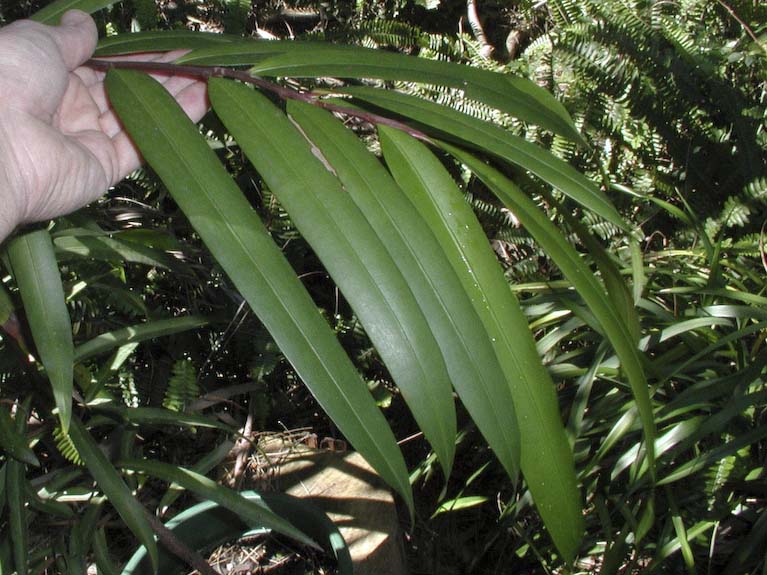
Foliage of an ornamental tree in Sydney [Trevor Hinchliffe, 2006].

Foliage of an ornamental tree in Sydney [Trevor Hinchliffe, 2006].
Podocarpus dispermus
Broad-leaved brown pine.
Type location "Gadgarra Reserve, Atherton Tableland, alt. 800 m., in rain-forest, not plentiful, no. 1192 (type; ripe seeds)" (White 1933). Collected first on 1929.08.10 by S. F. Kajewski (Hill 1998).
Trees up to 20 m tall. Bark thin, smooth to thinly scaly. Foliage buds small, conical, over 3× longer than wide with acicular scales. Adult leaves short-petiolate, 18-30 mm × 10-20 cm, acute(-pungent), glossy, dark green with a prominent midrib and 3 resin ducts below the vascular bundle. Pollen cones axillary in groups of 1-3, sessile, cylindrical, 2-3×10-30 mm. Seed cones axillary on thick peduncles 5-15 mm long with a fleshy red receptacle 5-6 mm long bearing 2 deciduous subtending bracts. Mature seed elliptic, ca. 17×25 mm. Similar species (P. elatus, P. grayae, P. smithii) differ with regard to characters including bud shape and bud scale shape, number of resin ducts, and color of receptacle. P. grayae has globular buds. P. smithii has large buds with obtuse scales, and a solitary resin duct. P. elatus has shorter, blunter buds and receptacles are purple at maturity (Hill 1998).
Australia: Queensland, occurring only on the Atherton Tableland and adjacent ranges, from sea level to 700 m elevation (Hill 1998). You can create a highly detailed map, and access specimen data, using the "search" function at the Australia Virtual Herbarium.
Based on data from 12 collection localities, its climate preferences include a mean annual temperature of 22.5°C, with an average minimum in the coldest month of 13.3°C, and a mean annual precipitation of 2925 mm (Biffin et al. 2011, Table S5). Zone 11 (cold hardiness limit above +4.4°C) (Bannister and Neuner 2001).
The IUCN reports that the population status is stable.
White, C. T. 1933. Ligneous plants collected for the Arnold Arboretum in north Queensland by S. F. Kajewski in 1929. Contributions from the Arnold Arboretum of Harvard University 4 (p. 10). Available: Biodiversity Heritage Library, accessed 2021.12.19.
P. 268 in de Laubenfels (1985).
Gray, Netta E. 1958. A Taxonomic Revision of Podocarpus, XI. The South Pacific Species of Section Podocarpus, Subsection B. Journal of the Arnold Arboretum 39:448. Available: Biodiversity Heritage Library, accessed 2023.01.08.
Last Modified 2023-02-26
 Back to top