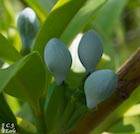
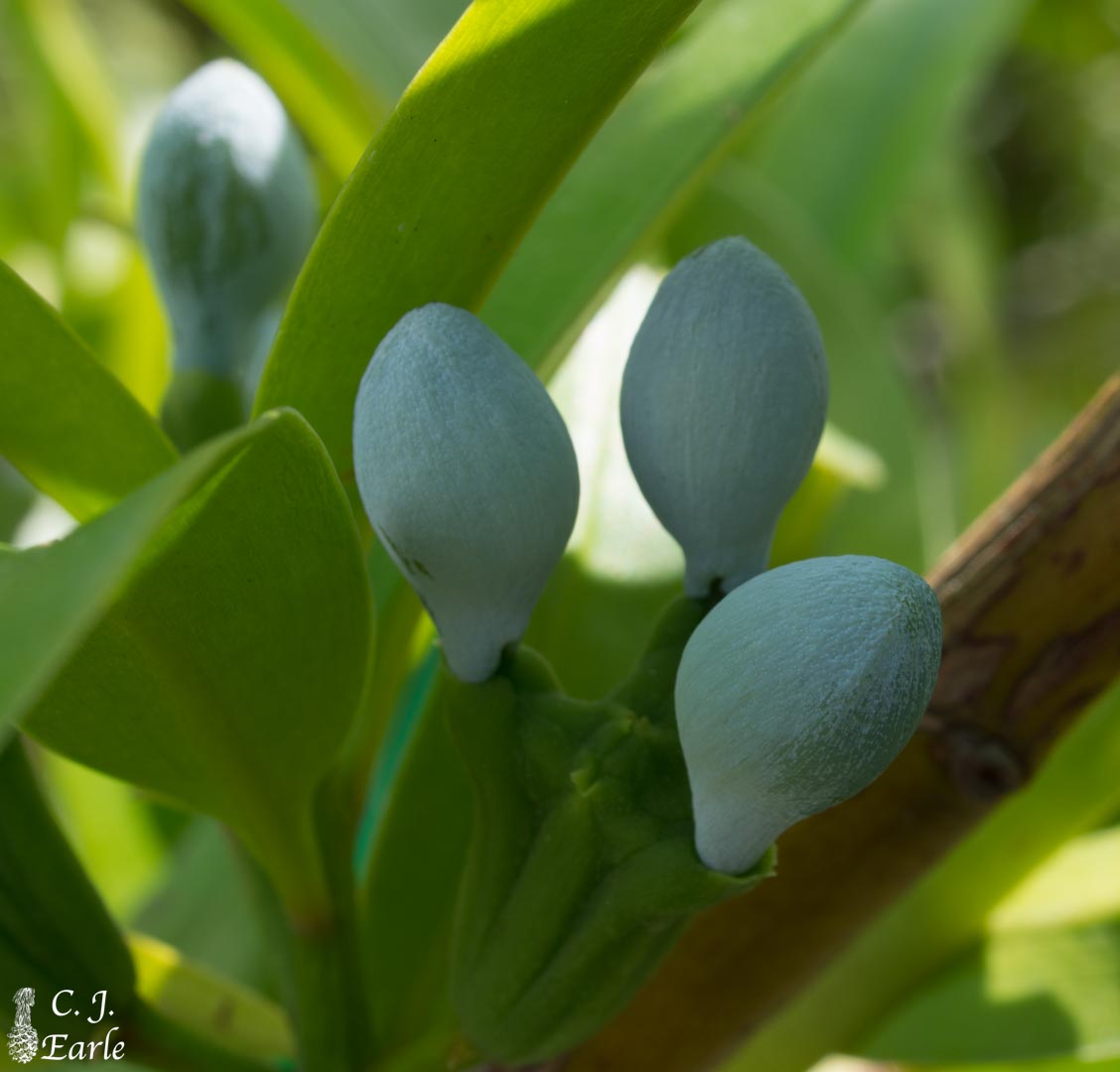
Developing seed cones on a potted plant collected from habitat by Tim Brodribb, at the Royal Tasmanian Botanical Garden [C. J. Earle, 2015.02.25].
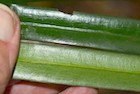
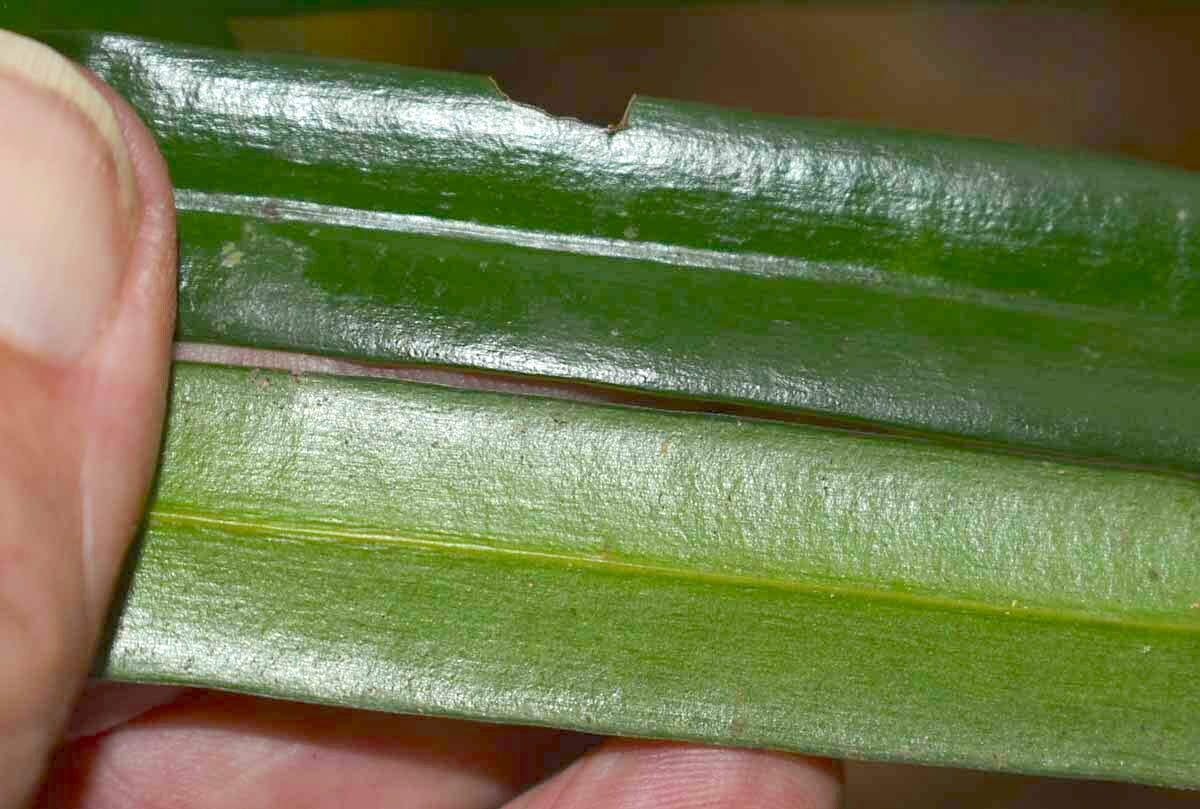
Upper and lower surfaces of a leaf on a plant in habitat, Queensland. iNaturalist observation 146011238 [Russell Cumming, 2022.11.05].
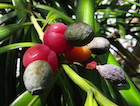
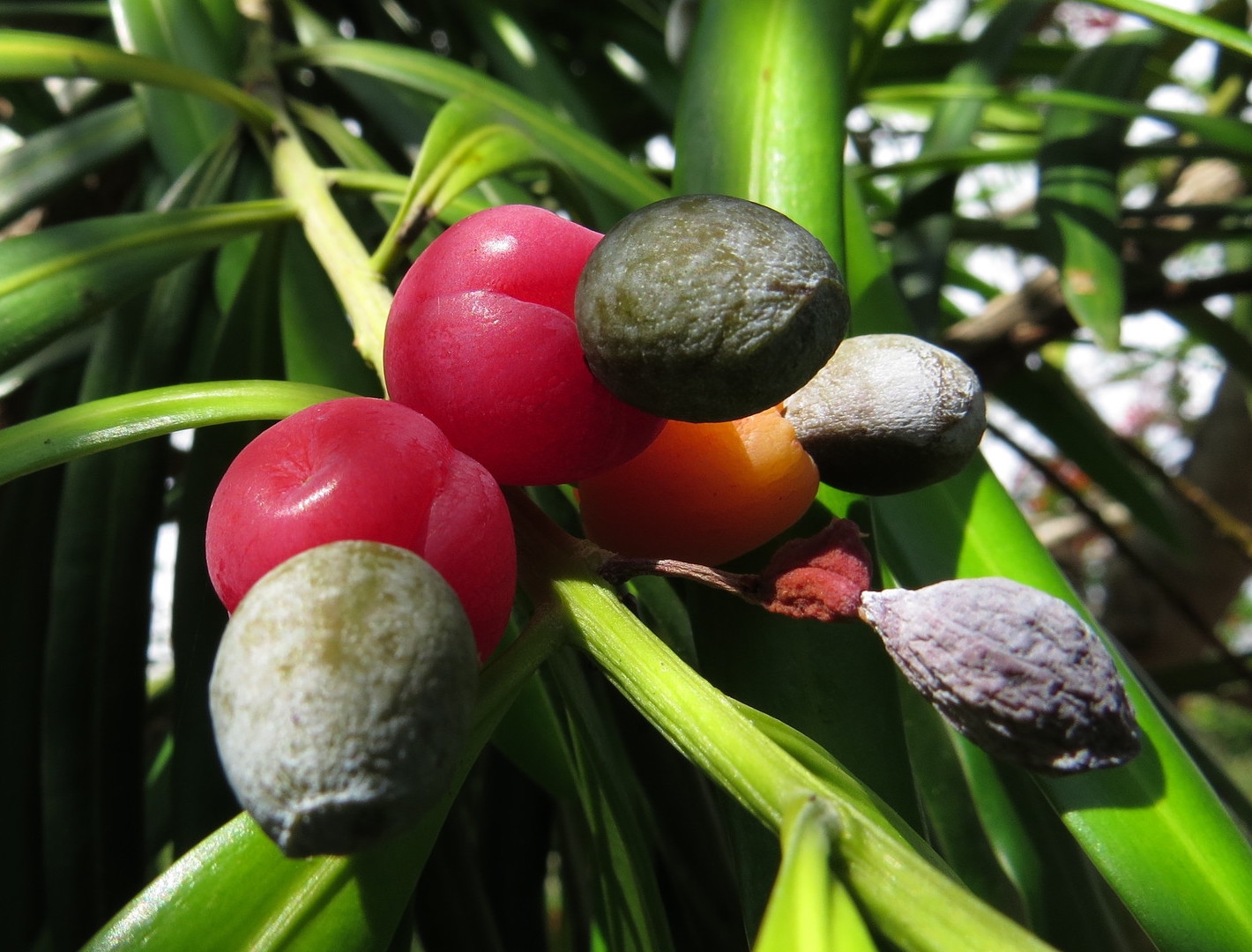
Mature seed cones on a plant in habitat, Queensland. iNaturalist observation 36641453 [kerrycoleman, 2014.12.10].
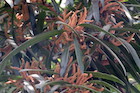
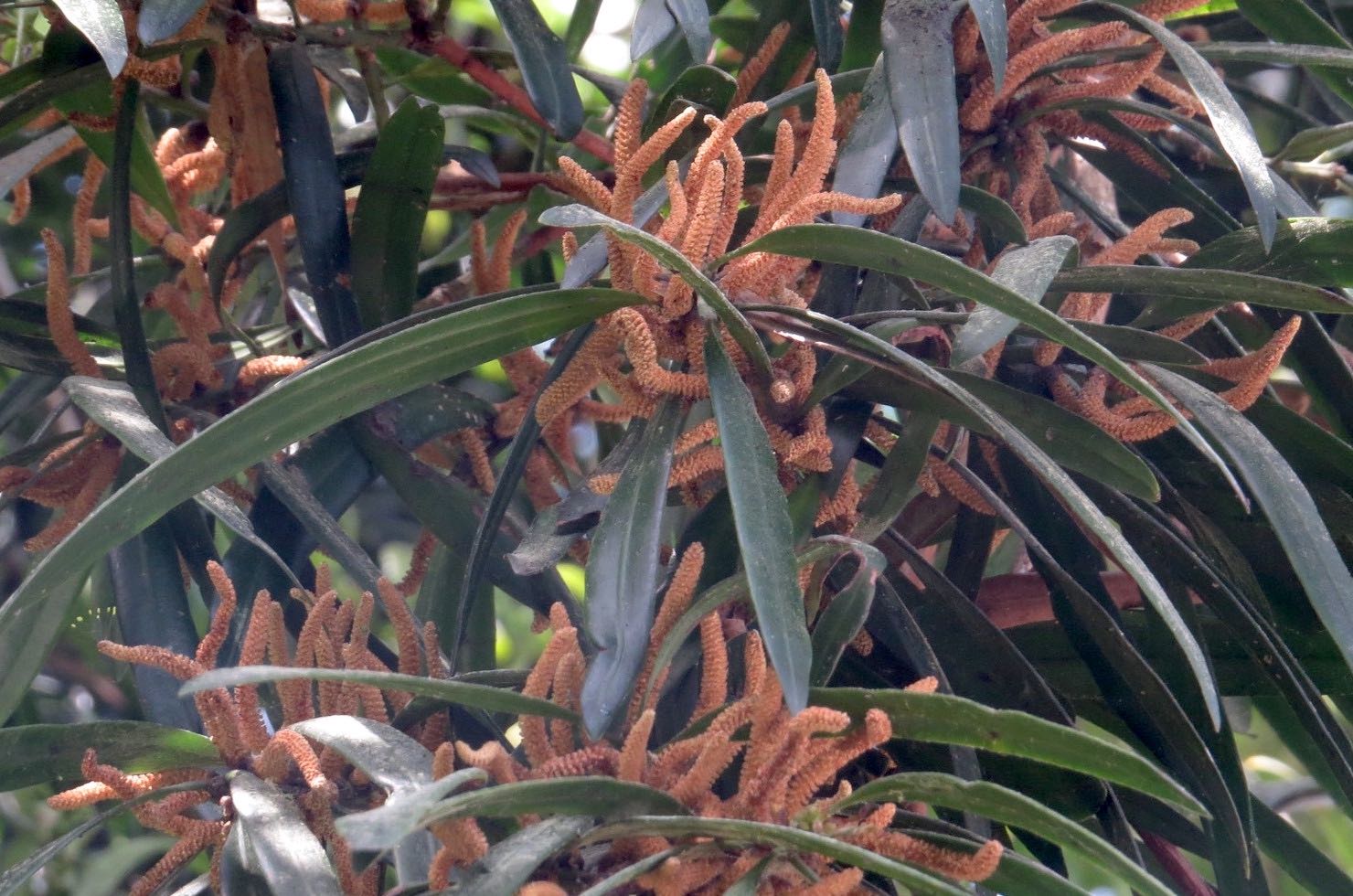
Pollen cones on a plant in habitat, Queensland. iNaturalist observation 36641453 [kerrycoleman, 2014.12.10].

Podocarpus grayae
de Laubenfels 1985
Common names
Brown pine.
Taxonomic notes
The type specimen is from upper Parrot Creek on the Annan River, Cape York Peninsula, Queensland, Australia. It was collected by L. J. Brass (later honored in Podocarpus brassii) on 1948.09.12 (Hill 1998).
Description
Trees up to 30 m tall. Bark thin, dark gray, shortly fibrous. Foliar buds globular with obtuse, imbricate scales. Adult leaves dark green, 7-16 mm × 8-25 cm, on a petiole 4-10 mm long, obtuse, with a slightly raised upper midrib and 3 resin ducts below the vascular bundle. Pollen cones in groups of 1-4, sessile or nearly so, 3-4×20-30 mm. Seed cones solitary, axillary on 6-9 mm peduncles, with a 9-12 mm long fleshy red receptacle subtended by 2 deciduous bracts. Seed 7-9×10-15 mm, dark red (Hill 1998).
Distribution and Ecology
Australia: Queensland: widespread in the coastal rainforests from Cardwell to the outer Cape York Peninsula. Outlier populations occur at Mt. Elliott near Townsville and in western Arnhem Land in the Northern Territory (Hill 1998). You can create a highly detailed map, and access specimen data, using the "search" function at the Australia Virtual Herbarium.
Based on data from 30 collection localities, it grows at elevations of 280 ±220 m. Within its range, mean annual temperature is 24.2°C, with an average minimum in the coldest month of 15.8°C, and a mean annual precipitation of 2010 mm (Biffin et al. 2011, Table S5).
Remarkable Specimens
Ethnobotany
Observations
Remarks
Named for Netta E. Gray (1913-1970), who conducted many in-depth studies of the podocarps (partial Bibliography). Netta was a woman, thus the specific epithet is properly grayae although it was described as P. grayii and it is also sometimes called P. grayi.
Citations
See also
 Back to top