Podocarpus oleifolius
D. Don 1824
Common names
Pino de pasto (in Colombia); pinete (in Venezuela) (Farjon 2010).
Taxonomic notes
Synonymy (Farjon 1998):
- Nageia oleifolia (D. Don) Kuntze 1891;
- Podocarpus macrostachyus Parl. 1868;
- N. macrostachya (Parl.) Kuntze 1891;
- P. oleifolius D. Don var. macrostachyus (Parl.) J. Buchholz et N.E. Gray 1948;
- P. oleifolius D. Don var. costaricensis J. Buchholz et N.E. Gray 1948;
- P. oleifolius D. Don var. trujillensis J. Buchholz et N.E. Gray 1948;
- P. oleifolius D. Don var. equadorensis Silba 1990;
- P. ingensis de Laubenfels 1991;
- P. monteverdeensis de Laubenfels 1991;
- Podocarpus ballivianensis Silba 2008.
Farjon (2010) describes the rationale for synonymizing several names listed above. His basic argument is that P. oleifolius is a widespread taxon with a fairly high level of phenotypic variation, and that each of these taxa, as described and as shown by herbarium collections, overlaps with the characters of P. oleifolius. However, it is noteworthy that a molecular analysis by Nieto-Blázquez et al. (2020) that included most of the New World taxa of Podocarpus (with many outgroup species) found evidence that P. oleifolius is paraphyletic, with the Bolivia/Colombia population sharing a clade with P. ingensis, but the Costa Rican population in a distant clade, and P. ballivianensis placed in a clade with P. matudae. The other findings from this study generally confirm hypotheses about phylogenetic relationships in New World Podocarpus, so it seems likely that P. oleifolius holds multiple discrete taxa, not yet widely accepted. Mill (2015) seems to agree with this assessment and in that paper he recognizes P. oleifolius var. costaricensis as a good taxon, and provides (pp. 250-253) a very detailed recounting of how previous authors have dealt with these taxa; but he reserves a decision for a future publication focused on South American taxa. As of 2023, that future publication has not appeared. Accordingly, this page currently presents information on Podcarpus oleifolius sensu latu.
Description
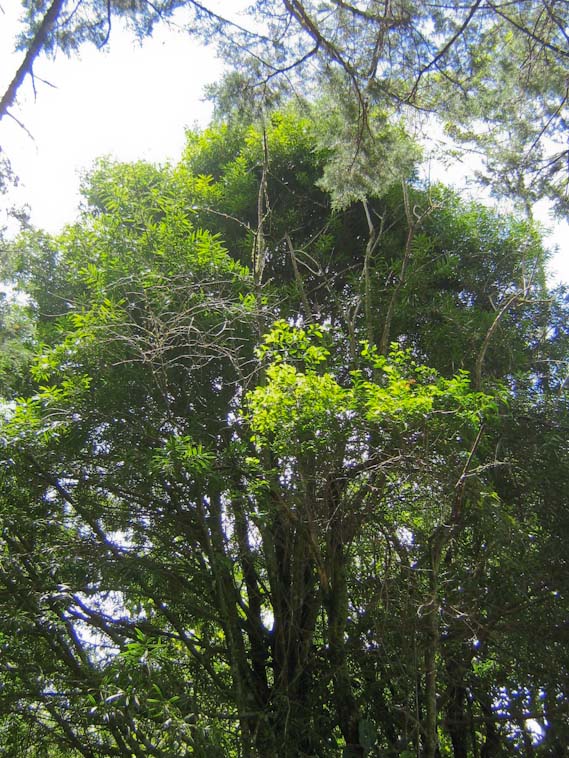
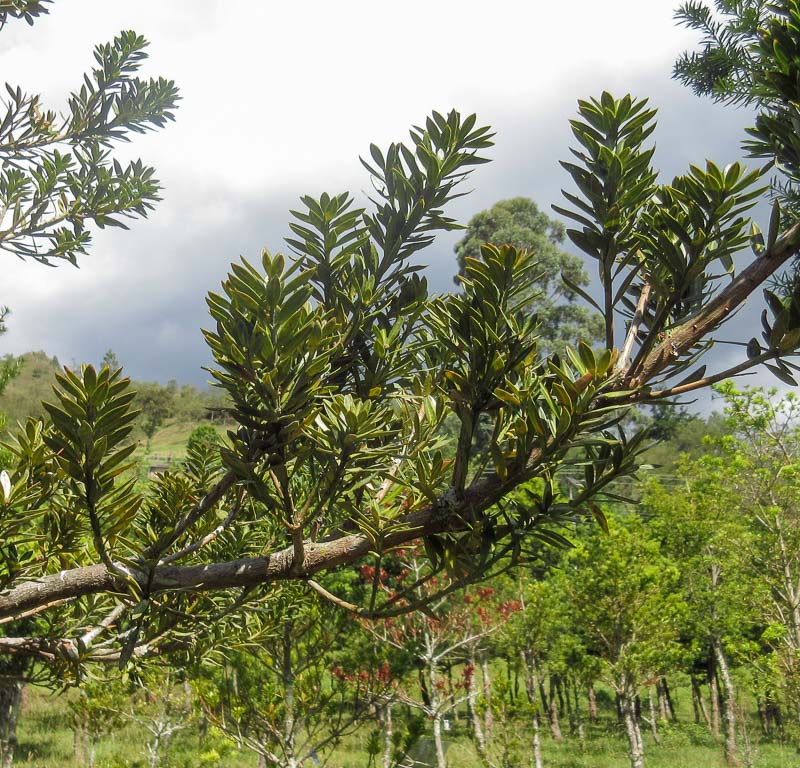
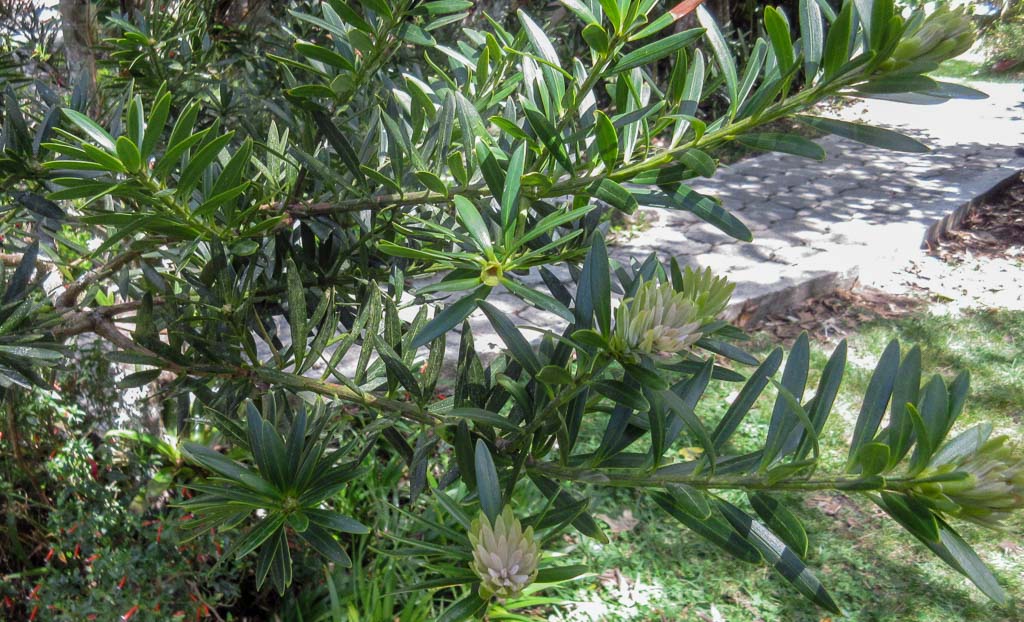
Trees to 30 m tall and 150 cm dbh, erect with a single round trunk, densely branched; at high altitudes may be a shrub or short tree. Bark thin, smooth becoming scaly with age, yellow-brown weathering to a light gray. Foliage branches round, bearing prominent leaf scars and decurrent grooves. Leaves dimorphic. On juvenile trees they are up to 15×2 cm, linear-lanceolate, sometimes curved. On mature trees they are (1.5-)4-9 cm long and (5-)7-12 mm wide, linear-lanceolate, usually straight. Midrib on upper surface in a narrow groove; on lower surface a prominent ridge that may also have a central groove. Pollen cones solitary, axillary, sessile, 25-30×3-4 mm at full expansion; microsporophylls imbricate. Seed cones axillary on short peduncles, with (when fully ripe) succulent red receptacles 6-10 mm long; seeds with epimatium 7-8 mm long, ovoid to globose, olive green (Farjon 2010).
Distribution and Ecology
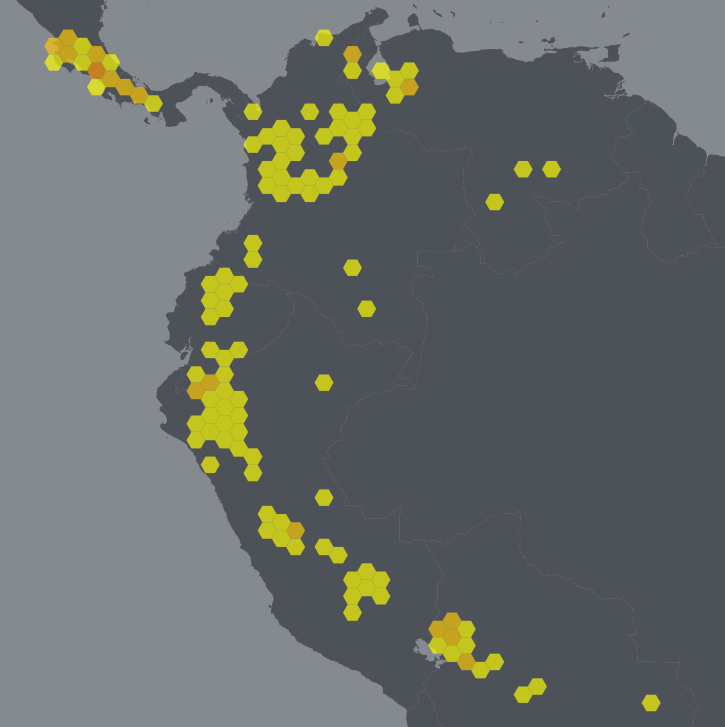
Bolivia; Colombia; Costa Rica; Ecuador; El Salvador; Guatemala; Honduras; Mexico (Guerrero, Chiapas, Michoacán, Oaxaca, Veracruz, Puebla); Panama; Peru; Venezuela. Based on data from 209 collection localities, it grows at elevations of 1,970 ±810 m (full reported range 825-3,300 m; Farjon [2010]). Within its range, mean annual temperature is 16.8°C, with an average minimum in the coldest month of 10.0°C, and a mean annual precipitation of 1,940 mm (Biffin et al. 2011, Table S5). As such, it is an upper montane species of evergreen and semi-deciduous forests, often in cloud forest with abundant epiphytes. Common associates include species of other Podocarpus, Cedrela, Persea, Quercus, Magnolia, Symplocus and various Lauraceae. At the highest elevations it forms a shrub or small tree in a canopy 2-8 m tall. In Venezuela, it is known from the summits of tepuis (Farjon 2010).
Zone 10 (cold hardiness limit between -1°C and +4.4°C) (Bannister and Neuner 2001).
Remarkable Specimens
Vladimir Dinets (e-mail, 2003.12.16) reports: "I found an unusually large specimen of Podocarpus (with a sign saying P. oleifolius) along the main trail at Biotopo Mario Dary Rivera, Guatemala. It was more than 1.5 m in diameter, and probably close to 50 m tall."
Ethnobotany
I have no records of its use by indigenous people. Commercially, large trees are sometimes logged for uses including home construction and furniture making (Farjon 2010). It is not a species of conservation concern, and is reasonably common with an extensive range. It is rarely seen outside of its native range, not being popular as an ornamental, though it is occasionally found in botanical gardens and arboreta.
Observations
In El Salvador, it can be found in habitat only on the highest peaks of Cerro Montecristo, in Quercus-dominated cloud forests (Fernando Tobar email 2008.11.12).
In Peru, it is reported from the National Park Yanachaga Chemillen.
Remarks
The epithet means "with leaves like an olive," which is equally true of many other species in the genus.
Citations
Laubenfels, D. J. de. 1991. Brenesia 33:120.
Laubenfels, D. J. de. 1991. Podocarpaceae Podocarpus ingensis de Laub. Boletin de Lima 13(73): 58.
Mill, R. R. 2015. A monographic revision of the genus Podocarpus (Podocarpaceae): III. The species of the Central America and northern Mexico bioregions. Edinburgh Journal of Botany 72 (2): 243–341. https://doi.org/10.1017/S0960428615000050.
Nieto-Blázquez, María Esther, Lourdes Peña-Castillo, and Julissa Roncal. 2020. Historical biogeography of Caribbean Podocarpus does not support the progression rule. Journal of Biogeography 48. https://doi.org/10.1111/jbi.14034.
See also
de Laubenfels, D. 1994. Las podocarpáceas del Peru. Boletin de Lima 16(91-96): 35-38.

 Back to top