
var. sellowii

var. angustifolius
Podocarpus sellowii
Klotzsch ex Endlicher 1847 (p. 209)
Common names
Taxonomic notes
Syn.: Nageia sellowii (Klotzsch ex Endl.) Kuntze 1891 (Farjon 1998). There are two varieties, the type and P. sellowii Klotzch ex Endl. var. angustifolius Pilger ex Engler 1903, p.88.
Description
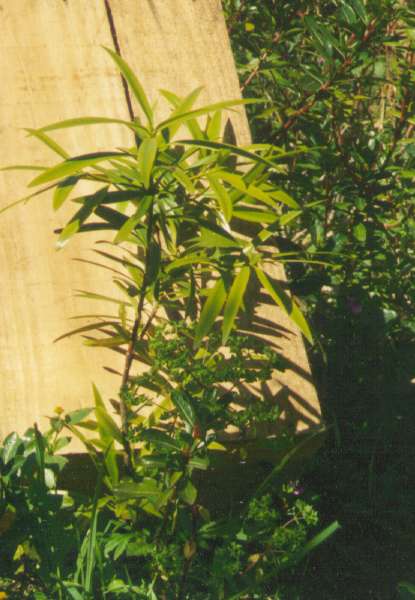
Shrubs or trees to 20 m tall and 100 cm dbh (usually much smaller), with a rounded or irregular crown. Bark red-brown, fibrous. Twigs green, stout, round, prominently grooved between decurrent leaf bases. Buds conical, 3-4 mm wide at base, sometimes clad in leafy scales up to 15 mm long. Leaves densely borne on the twigs, 8-15 cm × 12-20 mm on juveniles, but only about 4-9 cm × 7-11 mm on mature trees; variably shaped, from elliptic to lanceolate to linear, straight or slightly curved, with a wedge-shaped base and 2-3 mm petiole; midrib raised on lower side; shiny dark green, coriaceous, not waxy. Pollen cones axillary in groups of 1-2, 1-3 cm × 2-3 mm, microsporophylls ovate-acuminate. Seed cones axillary, solitary on peduncles to 10 mm long, with a receptacle that turns reddish purple at maturity, 6-8 × 4-6 mm, bearing a seed (including epimatium) 7-9 × 5-8 mm (Eckenwalder 2009, Farjon 2010).
Variety angustifolius differs from the type in having smaller leaves (3-5 cm × 3-8 mm on mature trees, vs. 4-9 cm × 7-11 mm) and smaller pollen cones (ca. 10 × 1 mm, vs. ca. 20 × 2 mm) (Farjon 2010).
Distribution and Ecology
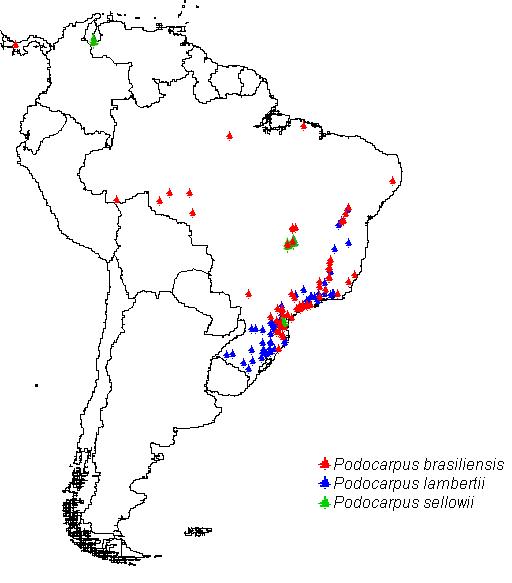
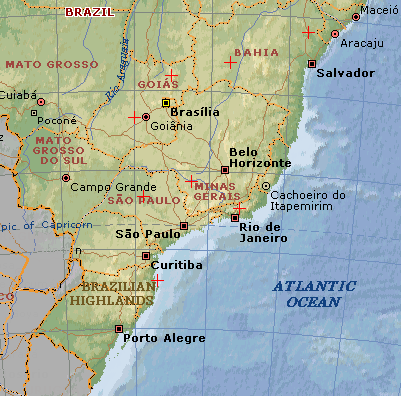
Brazil. The type variety is widespread, occurring in Paraná, Rio Grande do Sul, Rio de Janeiro, Santa Catarina, and Sao Paulo. Variety angustifolius is rare, occurring only in two districts of Rio de Janeiro: Cerro dos Orgaos and Pico do Tingua (Farjon 2010).
According to Carvalho (2003) and Ledru et al. (2001), this species has an extremely broad and scattered range, occurring in montane vegetation, north to Amazonas, Pernambuco and Ceará, south to Rio Grande do Sul; west to Rondonia, Mato Grosso and Mato Grosso do Sul. Márcio Renato Guimarães (e-mail, 2003.07.12) reports that in S. Brazil, it is typical of montane areas in the Tropical Coastal Range Rainforest (Mata Atlántica), and rarely occurs within Araucaria angustifolia forests.
Based on data from 11 collection localities, it grows at elevations of 530 ±510 m. Within its range, mean annual temperature is 20°C, with an average minimum in the coldest month of 11°C, and a mean annual precipitation of 2020 mm (Biffin et al. 2011, Table S5).
Remarkable Specimens
Ethnobotany
Observations
In the granitic peaks of Serra do Mar (as in Anhangava Mount, Paraná, more than 1,200 m), it grows among the rocks, in the Ilex theezans montane forest, where it occurs as dwarf plants less than one meter tall (Márcio Renato Guimarães e-mail 2003.07.12).
It can be found growing with Podocarpus lambertii and Araucaria angustifolia in Campos do Jordão State Park in São Paulo State (22.7333°S, 43.7333°W) at elevations of ca. 1800 meters (Sousa et al. 2004).
Variety angustifolius can most readily be seen in the Reserva Biologica Tingua (Farjon 2010).
Remarks
Named for the German botanist Friedrich Sellow (1789-1831), who collected the type specimen (Eckenwalder 2009).
Citations
Carvalho, P.E.R. 2003. Espécies florestais brasileiras: recomendações silviculturais, potencialidades e uso da madeira. http://www.cnpf.embrapa.br/pauloernani/temp/indek_especies.htm, accessed 2003.07.12, now defunct.
Ceccantini, Gregório, Universidade da São Paulo, Instituto de Biociencias, São Paulo, Brasil. E-mail, 2007.08.02.
Ledru, M.-P., R.C. Cordeiro, J.M.L. Dominguez, L. Martin, P. Mourguiart, A. Sifeddine, and B. Turcq. 2001. Late-Glacial Cooling in Amazonia Inferred from Pollen at Lagoa do Caçó, Northern Brazil. Quaternary Research 55:47-56. ABSTRACT: New pollen data from a core at Lagoa do Caçó, Maranhão state, Brazil (2°58'S 43°25'W; 120 m elevation), show higher frequencies of Podocarpus at the end of the Pleistocene than today. The increase in Podocarpus, which follows the successive increase of various pioneer species such as Didymopanax, Melastomataceae/Combretaceae and Cecropia, implies a progressive late-glacial increase of moist and cool climatic conditions. A comparable increase in Podocarpus is found in other lowland records in Amazonia. A review of published pollen data from Amazonia suggests that the moisture source was from the southeast. By contrast, present day moisture comes from the tropical Atlantic and from the Amazon basin, with its convective precipitation. The likely cause for the southeastern moisture source between ca 15,000 and 14,500 cal yr B.P., was enhanced polar (Antarctic) advection that reached low latitudes and maintained year-round the meteorological equator in its austral winter position or reduced drastically its southern summer displacement. This hypothesis is corroborated by marine and ice core records.
Sousa, V.A., I.P. Robinson and H.H. Hattemer. 2004. Variation and Population Structure at Enzyme Gene Loci in Araucaria angustifolia (Bert.) O. Ktze. Silvae Genetica 53(1):12-19.
See also
The species account at Threatened Conifers of the World.
Angely, J.A. 1965. Flora analitica do Parana. (L Parana)
Laubenfels, D.J. de. 1985. A taxonomic revision of the genus Podocarpus. Blumea 30:259.

 Back to top