Taxaceae
Gray 1821
Common names
The yew family, 红豆杉科 hong dou shan ke [Chinese], Taxacées [French], Eibengewächse [German], イチイ科 [Japanese], Тисовые [Russian], taxáceas [Spanish].
Taxonomic notes
A family of 6 genera and 28 species, mainly in the northern hemisphere:
The taxaceous conifers are generally regarded as being distinct from the other conifers; many authors have assigned them to a distinct Order, Taxales Knobl. 1890, and they have also been placed in a distinct Suborder, Taxineae Luerss. 1879, or have even been segregated at the Subclass rank as Taxidae Ehrend. ex Reveal 1996. The family seems to have arisen via a whole-genome-duplication (polyploidy) event that separated it, in a clade that included the progenitor of both the Cupressaceae and the Taxaceae, from the remaining conifer lineages (a similar event gave rise to the Pinaceae clade, and to the Welwitschiaceae) (Li et al. 2015).
Within the Taxaceae, some authors have assigned Amentotaxus to a separate family (Amentotaxaceae Kud et Yamam. 1931), likewise Austrotaxus (Austrotaxaceae Nakai 1938), Cephalotaxus (Cephalotaxaceae Neger 1907), and Torreya (Torreyaceae Nakai 1938). Relationships within the family were elucidated by Hao et al. (2008), who used both chloroplast and nuclear DNA markers to analyze all generally recognized species in the Taxaceae inclusive of Cephalotaxus. Their analysis confirmed the close relationship between Cephalotaxus and the remaining taxaceous genera, but did not clearly determine whether Taxaceae in monophyletic without Cephalotaxus. Certainly, the group of genera I have here included in the Taxaceae is monophyletic, but it is also reasonable at this time to assign Cephalotaxus to a discrete family (Ji et al. 2020). Hao et al. (2008) also showed that the ancestral distribution of the family is centered in southwest or southeast China.
Description
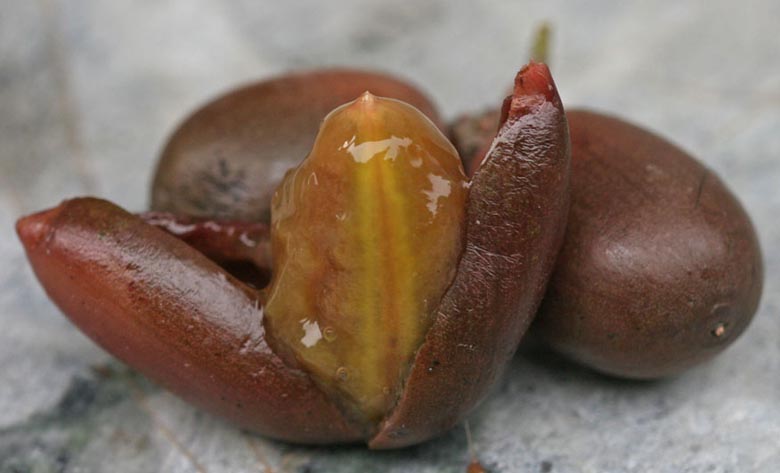
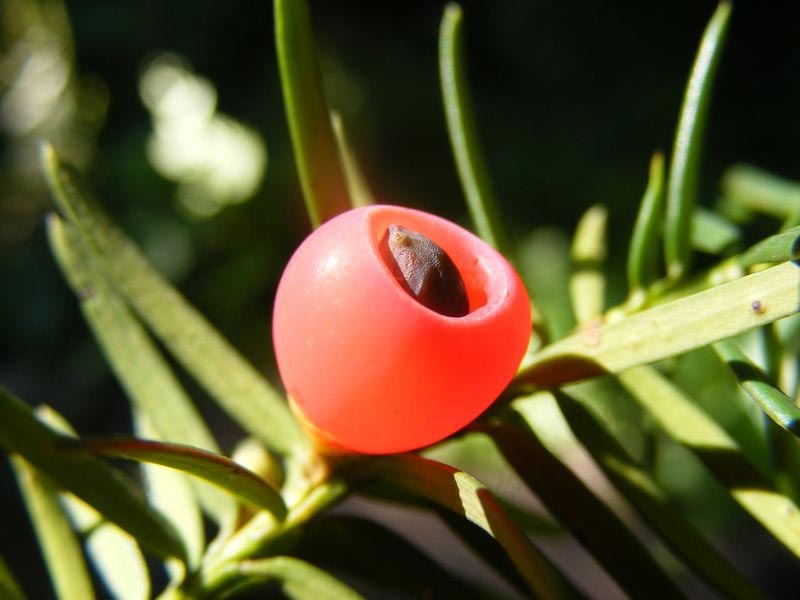
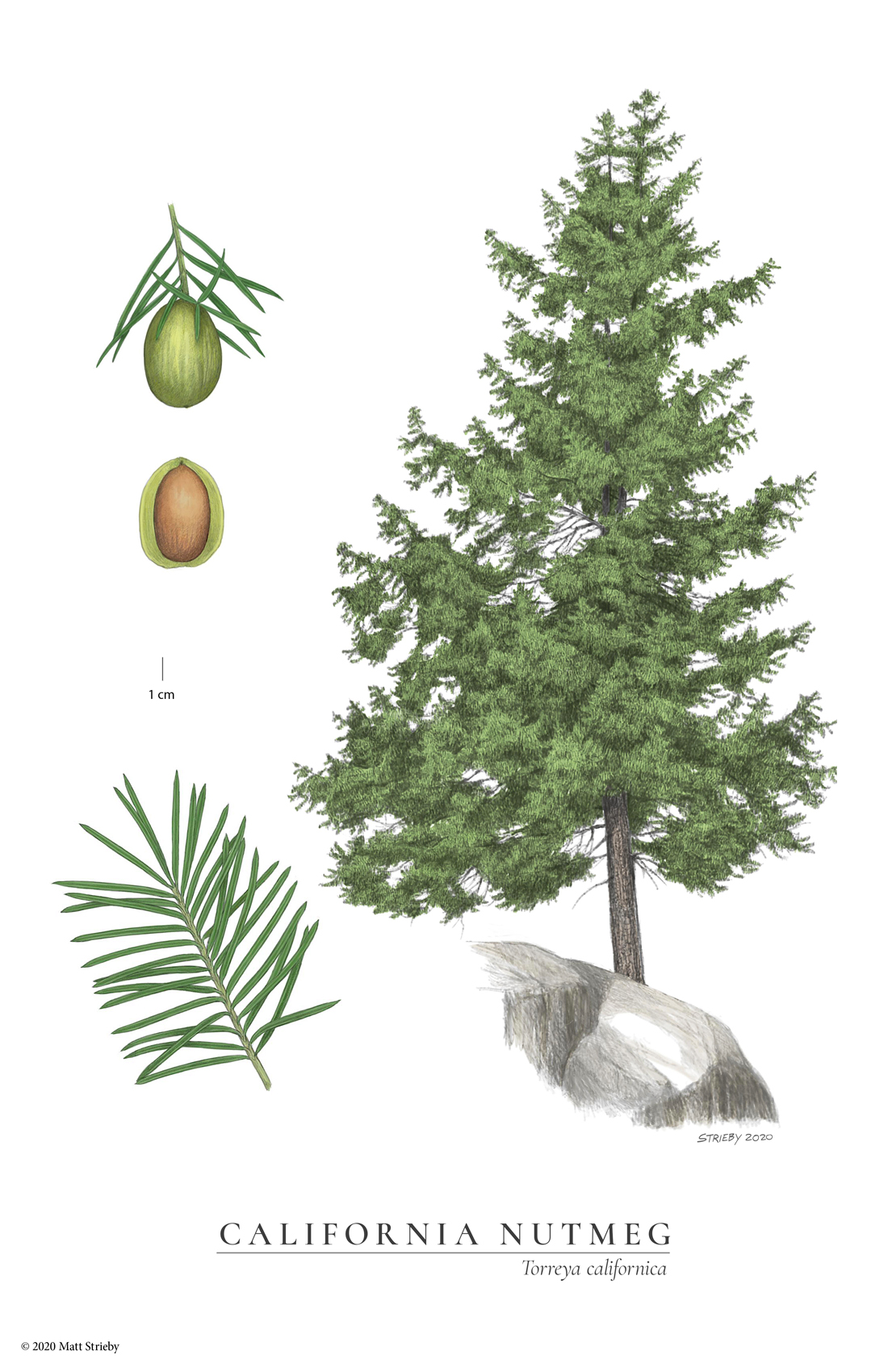
Evergreen trees or shrubs, usually neither resinous nor aromatic (sharp- or foul-odored in Torreya), dioecious or monoecious. Bark scaly or fissured. Lateral branches well developed, similar to leading shoots; twigs terete, not densely clothed by leaves but ± ridged by decurrent leaf bases; longest internodes less than 1 cm; buds ± inconspicuous. Roots fibrous to woody. Leaves (needles) simple, persisting several years, shed singly, alternate [opposite], spirally arranged but often twisted so as to appear 2-ranked, linear to linear-lanceolate, decurrent; resin canals present or absent. Pollen cones maturing and shed annually, solitary or clustered, axillary on year-old branches, globose to ovoid, sporophylls bearing 2 - 16 microsporangia (pollen sacs); pollen ± spheric, not winged. Seed cones reduced to 1 - 2 ovules subtended by inconspicuous, decussate bracts, maturing in 1 - 2 seasons, axillary on year-old branches. Seeds 1 per "cone," erect, not winged, hard seed coat partially or wholly surrounded by a juicy, fleshy or leathery aril; cotyledons 2. Wood without resin ducts (Silba 1986, Hils 1993). All investigated species form a vesicular-arbuscular mycorrhiza (Brundrett 2008 and citations therein).
Distribution and Ecology
Europe: Britain to N Iran. Asia: USSR, Korea, Japan, China, Taiwan, Himal, India, Burma, Vietnam, Philippines. New Caledonia. N America: SE AK to CA, E Canada, E USA, FL, Mexico, Guatemala, El Salvador. S America.
Worldwide distribution of Taxaceae, generalized to 1x1 degree cells; data from the BRAHMS database at Conifers of the World, accessed 2021.11.11.
The Taxaceae are, in general, very much of conservation concern. The IUCN (2020) has identified 2 taxa as critically endangered, 8 as endangered, and 9 as vulnerable, thus 61% of all species in the family are at risk. Principal factors of decline, which typically affect all taxa regardless of their conservation listing status, include habitat conversion through agriculture or development, timber harvest, grazing, and climate change.
Remarkable Specimens
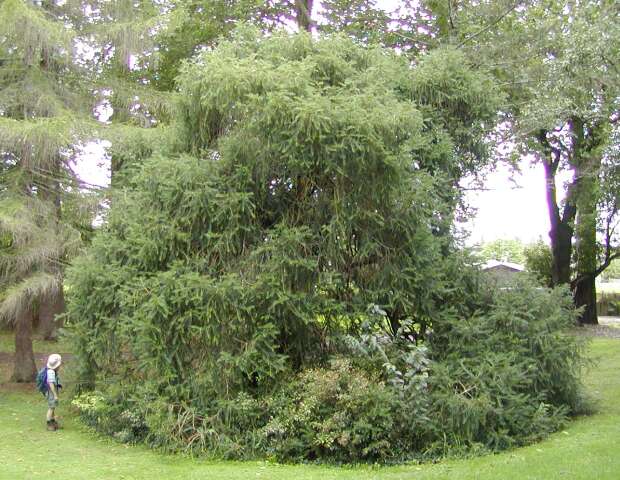
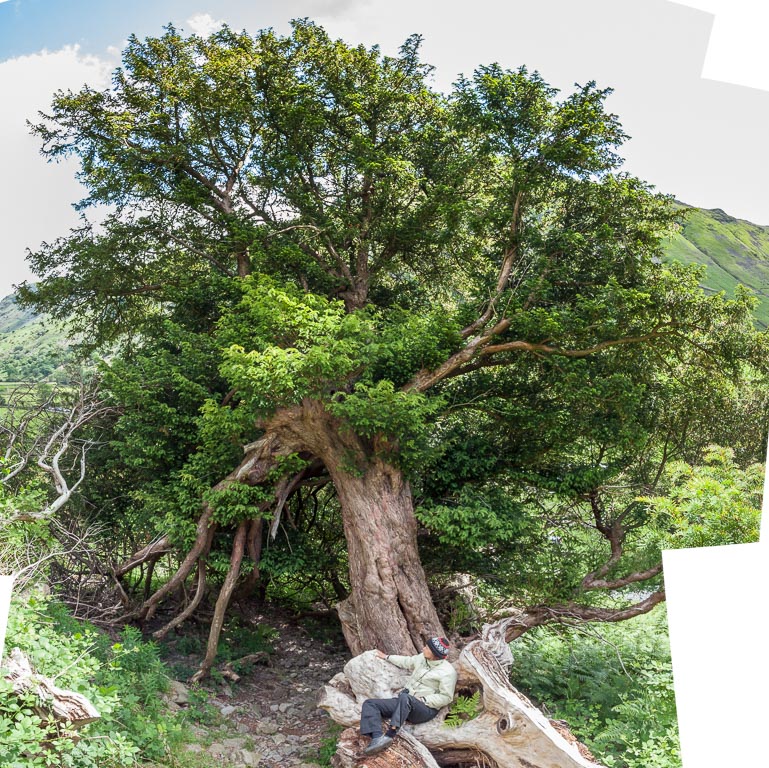
The largest trees, with many examples over 200 cm dbh, are found in Taxus baccata and Torreya nucifera. These are also the oldest, although the data are scanty and not very reliable. There are also some remarkably large Taxus cuspidata, T. brevifolia, Torreya californica, and T. taxifolia. As noted below, several species are spiritually important and exceptional examples can be found at places of worship or other culturally significant sites.
Ethnobotany
The wood, particularly of Taxus but also more generally through the family, tends to be hard and grainy, difficult to work but extremely tough and durable; aboriginal peoples have widely used it for bows and tools. In modern times its use is primarily as craftwood or veneer, since it tends to have an attractive figure. Many species were used in traditional medicine, and not without reason; Taxol, the most effective drug for treatment of ovarian cancer, was first extracted from bark and foliage of several Taxus species. Edible seeds of Torreya grandis and T. nucifera are popular in China and Japan (respectively), although paradoxically the foliage and bark throughout the family are generally toxic to mammals. Several species, particularly of Taxus and Torreya, have also been spiritually important in a variety of traditions around the world, usually as symbols of longevity or timelessness.
Observations
See the species accounts.
Remarks
The family has been around quite a while. It includes at least one extinct genus, Kakahuia, reported from the Eocene and early Miocene of southern New Zealand (Pole 2007).
Citations
Brundrett, Mark. 2008. Mycorrhizal Associations: The Web Resource. mycorrhizas.info, accessed 2009.06.09.
Gray, S.F. 1821. A Natural Arrangement of British Plants. London: Baldwin, Cradock & Joy. Vol. 2, pp.222 & 226.
IUCN. 2020. IUCN Red List version 2020-1: Table 4b: Red List Category summary for all plant classes and families. https://nc.iucnredlist.org/redlist/content/attachment_files/2020_1_RL_Stats_Table_4b.pdf, accessed 2022.09.23.
Yunheng Ji, Changkun Liu, Jacob B. Landis, Min Deng, and Jiahui Chen. 2020. Plastome phylogenomics of Cephalotaxus (Cephalotaxaceae) and allied genera. Annals of Botany mcaa201, https://doi.org/10.1093/aob/mcaa201
Li Zheng, Anthony E. Baniaga, Emily B. Sessa, Moira Scascitelli, Sean W. Graham, Loren H. Rieseberg, and Michael S. Barker. 2015. Early genome duplications in conifers and other seed plants. Science Advances 1(10):e1501084.
See also
Burns and Honkala (1990).
Canadian Forestry Service. 1983. Reproduction of conifers. Forest. Techn. Pub. Canad. Forest. Serv. 31.
Cheng Y., Chaw S., R. Nicholson and K. Tripp. 2000. Phylogeny of Taxaceae and Cephalotaxaceae genera inferred from chloroplast matK gene and nuclear rDNA ITS region. Molecular Phylogenetics and Evolution 14 (3): p. 353-365.
Florin, R. 1948. On the morphology and relationship of the Taxaceae. Botanical Gazette 110:31-39.
Krüssmann, G. 1972. Handbuch der Nadelgehölze. Berlin.
Pilger (1903, 1916 and 1926).
Price (1990).

 Back to top