Welcome to the Gymnosperm Database, the web's premier source of information on conifers and their allies. Since we went online on 1997, the Database has attracted worldwide attention as a readily accessible, scientifically accurate source of information on the classification, description, ecology and uses of this culturally and ecologically important group of plants. This home page gives some hints about how to navigate the Database, as well as providing background information for the curious.
There are three major sections of the site:
| Species |
Descriptions of all the species and higher-rank taxa of gymnosperms. See Example Species for more information on the format of these pages. For each taxon I provide information on classification, description, ecology, ethnobotany, and various other topics of interest. |
| | |
| Topics |
Things that are not strictly tied to a particular species. For instance, pages on the gymnosperms of Australia (and other regions), the largest and oldest trees in the world, why trees have spiral grain, and conifers in musical instruments. |
| | |
| Bookstore |
Most of the books sold here are linked through Amazon, and if you buy them through this site, the price is the same to you but some of the proceeds come to me, to help support the Database. |
| | |
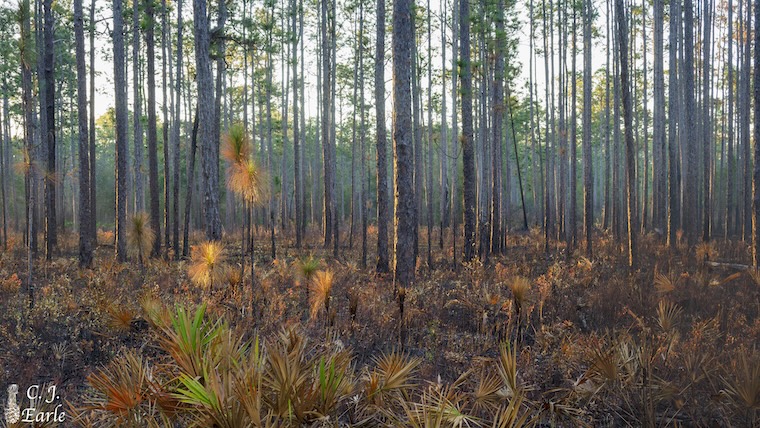
Gray pine woodland in Pinnacles National Park, California.
What's New?
Oct-2026: New Youtube video: The Oldest Trees in the World, based on a talk I gave at the American Conifer Society annual meeting this year. There's also a new page on The Lives of Trees: Human and Tree Biology & Ecology based on a talk I gave to an annual arborist meeting last year. This one provides a fairly deep dive into the relationships between humans and trees, and takes a new approach to this old topic. I've also been doing a lot of varied species rewrites, two major ones are Callitris glaucophylla and Pinus rigida.
Aug-2026: As usual, the summer has been focused on getting out amongst the conifers, this year just in the West. Recently did total revisions of Pinus latteri and P. merkusii, sister species mostly found in Indochina and Indonesia, respectively. Have also been experimenting with AI tools; for example it's quite useful for literature searches across a range of languages (e.g. Thai, Vietnamese), which really helps with database fields like "Ethnobotany" and "Observations". Also did a big push on finding maximum age estimates as follow-up to a paper I coauthored late last year.
Apr-2026: February was spent wandering around California studying the ecology of many conifers (photo above). March and early April involved another "POWO review" to track changes in the conifer world over the past year, turning up many small changes and some new species, notably Xanthocyparis guangxiensis, Ephedra karumanchiana, Ephedra nutans, Picea brachytyla var. argyroderma, Pinus ponderosa var. cunninghamia, Pinus × saportae, and Taxus qinlingensis, as well as some reshuffling of existing taxa, such as giving species rank to former varieties or removing species that have turned out to not be distinct from previously recognized species.
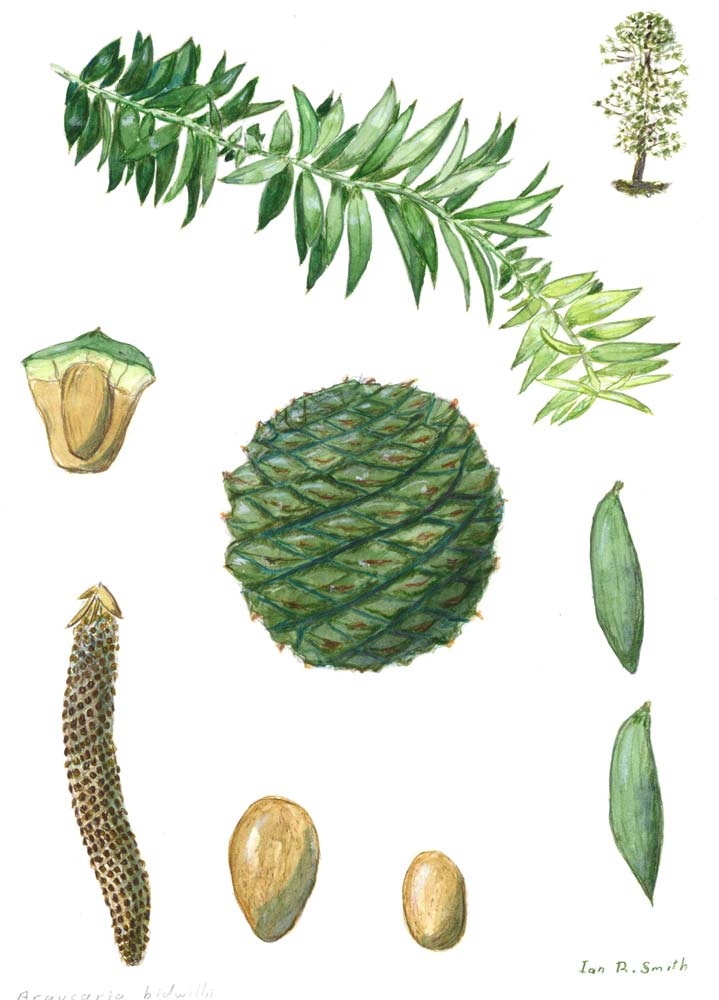
Jan-2026: Very extensive "housekeeping" tasks that involve finding and eliminating code issues, giving all pages a consistent format, finding bad links, correcting scientific author names (yes they change occasionally), and installing trackers so I know more about how people use the site. Stats of interest: currently we're seeing 5-6000 users per week, about 40% each in the U.S. and China and the rest in mostly English-speaking countries. About half come in through search engines and most of the rest come directly to the site. The most popular genus is Pinus (pines) and the most popular species are Sequoia (redwood) and Araucaria bidwillii (bunya-bunya).
Dec-2025: Complete and detailed revision of all taxa in Dacrydium, and a less complete update of all taxa in Taxaceae.
Nov-2025: Complete and detailed revisions of Pinus contorta and P. muricata.
Aug-2025: Revised Cupressus to include the new taxa C. bhutanica and C. corneyana. This gets a lot closer to solving the very long-standing problem of Himalayan cypress classification.
Background on the Site
The Gymnosperm Database was established as an online entity in the summer of 1997 and has since grown steadily, getting its own URL (Conifers.org) in the summer of 1999. The Database provides information for all species and higher-ranked taxa of the gymnosperms, i.e., conifers, cycads, ginkgo, and the gnetophytes. You enter the taxonomic tree at the Family level and then navigate to the Genus and Species. It's sort of like a blog that runs through a tree instead of a straight line.
How to Use This Site
See the Description of Database Fields and the Example Species.
If you have a specific question, use the search box (top of page at right). Otherwise, I suggest you start with the Topics page, or browse the family, genus, and species accounts. The site covers conifers, ginkgo and gnetophytes (Ephedra, Gnetum, and Welwitschia) in detail. Although they are gymnosperms, in recent years I have neglected the cycads because an excellent site, the World List of Cycads, exists to provide the same sort of information that I would otherwise have to collect.
Appeal for volunteer assistance
People sometimes write and say, "Who writes the database?" The answer is, I do. I have assembled most of the database and done essentially all of the computer-based work: typing, scanning images, writing code, etc. Any assistance is welcome! To date I have received helpful advice from a variety of recognized taxonomic authorities, as well as information on individual taxa from persons scattered across the globe. Many visitors have sent photos or even fine art drawings of gymnosperms. In fact, I have to say that running this website has introduced me to new friends, provided opportunities to travel to memorable places, and provided opportunities to share both my writing and photography. The correspondence related to this site provides one of the greatest rewards of maintaining this site. However, if you would like to increase those rewards, you could buy some books (from Amazon.com) via my gateway/bookstore located HERE.


 Back to top