Conservation Status

Pinus apulcensis
Lindl. (1839)
Common names
Pino, ocote (Perry 1991).
Taxonomic notes
Type: In 1838 C. T. Hartweg collected the type in a ravine near Apulco, Hidalgo; it was described the following year by Lindley (1839) and illustrated shortly thereafter by Loudon (1842). Hartweg's type specimen was lost. Farjon (1995) designated a lectotype based on a cone found at W that, he contends, was labeled in Lindley's handwriting. Debreczy and Racz (2011) dispute the validity of this specimen. However, the validity and accuracy of Loudon's illustration have not (yet) been disputed, and the illustration and the lectotype are certainly very similar in appearance (see illustrations at right).
Synonymy:
- Pinus coatepecensis (Martínez) Gaussen (nom. inval.);
- Pinus pseudostrobus var. coatepecensis Martínez;
- Pinus pseudostrobus subsp. coatepecensis (Martínez) Silba;
- Pinus pseudostrobus var. apulcensis (Lindl.) Shaw (pro parte); and
- Pinus pseudostrobus subsp. apulcensis (Lindl.) Stead (pro parte).
There is one subspecies, P. apulcensis subsp. estevezii (Martínez) Earle. Type: Mexico, Nuevo León, Santa Catarina, Cañón de las Mieleras, June 1941, Martínez 3433 (holotype, ME). Synonyms: Pinus pseudostrobus var. estevezii Martínez (1945); Pinus estevezii (Martínez) J.P.Perry (1982).
This species has a fairly complex history, and was generally regarded as a synonym of P. pseudostrobus until phylogenetic work established a division within the Pinus pseudostrobus complex such that P. pseudostrobus is sister to P. hartwegii and P. montezumae, while P. apulcensis is sister to P. oaxacana (Gernandt et al. 2025). For a detailed discussion see Phylogenomics restructure the Pinus pseudostrobus complex.
Description
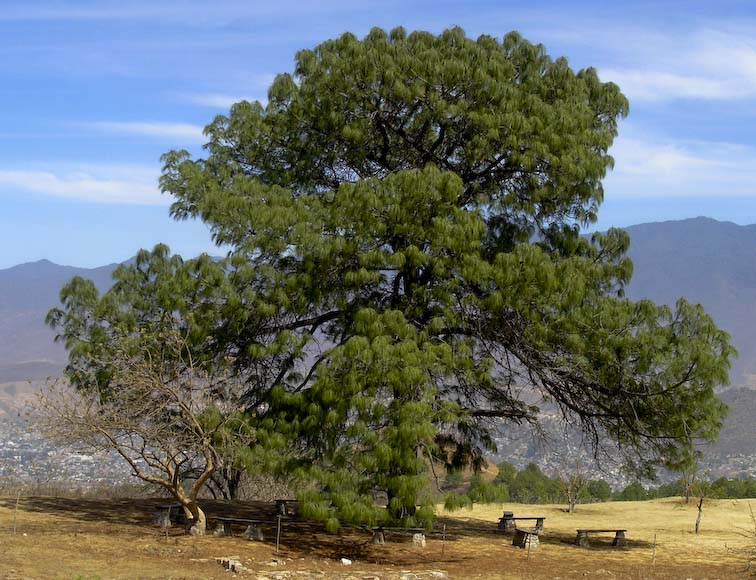
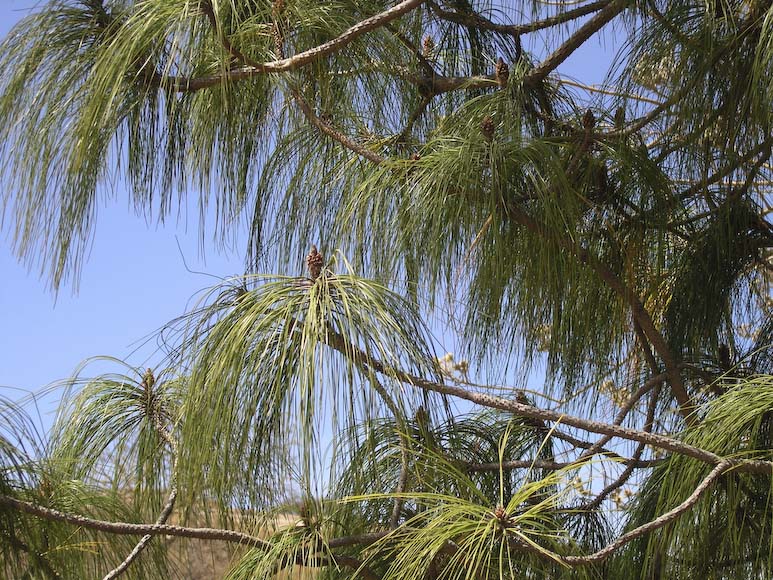
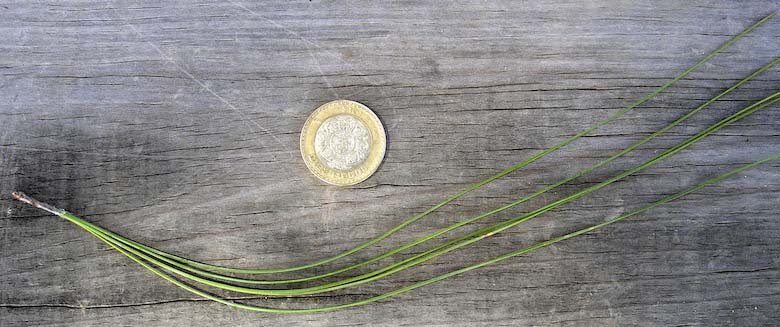
Trees to 30 m tall and 100 cm dbh, typically with a single erect trunk and a dense, rounded crown of large, horizontal to drooping branches. Bark smooth, light brown, with age reddish brown and thick with deep longitudinal fissures. Twigs greenish-brown, glaucous, slender, smooth, leaf bract bases not decurrent. Leaves yellow green, in fascicles of 5 (rarely 6), 15–28 cm long, slender, flexible, drooping, margins serrulate, stomata on all surfaces; resin canals 3(–4), medial, outer wall of endodermal cells thickened, 2 contiguous but distinct fibrovascular bundles, hypoderm dorsally thick, with some irregular intrusions to the chlorenchyma; fascicle sheaths light brown, persistent, 15–20 mm long. First-year seed cones on 10–12 mm long thick, scaly peduncles; brown, subglobose, borne in 2's and 3's, scales thick and pointed with a sharp, stiff prickle. Mature seed cones wide-ovoid to oblong-conical, slightly curved and oblique, 10–15 cm long, lustrous yellowish to reddish brown, resinous, opening at maturity (November-December) and persisting a few months; on falling, leave the peduncle and a few basal scales attached to the branch. Cone scales strong, stiff, hard, 3–4 cm long and up to 2 cm wide, apophyses raised and recurved with a prominent transverse keel; umbo prominent, thick, generally curved towards the cone base and armed with a strong, persistent prickle 1.5 mm long. Seeds dark brown, 6–8 mm long with an articulate seed wing to 30 mm long, pale brown with fine to broad dark lines (Lindley 1839, Martinez 1945, Perry 1991).
Subsp. estevezii differs from the type in the following: it is generally a shorter tree, 15–20 m tall and 75–100 cm dbh, and the young trees especially have a thick, bushy appearance. Leaves are light green, in fascicles of 5 (rarely 4), 20–30 cm long, stiff, not drooping; hypoderm may deeply penetrate the chlorenchyma; fascicle sheaths 15–30 mm long. First-year seed cones pinkish-purple. Mature seed cones 10–13 cm long. Seed scales typically 3 cm long, 1.5 cm wide. Seed wings to 25 mm long (Martinez 1945, Perry 1991).
P. apulcensis is very similar to other, closely-related species, particularly P. oaxacana and P. pseudostrobus. This table provides a comparison between these species. Table 1 in Escobar-Alonso et al. (2023) may also be helpful; it indicates that the taxa can be reliably distinguished according to traits visible in the mature seed cone.
Distribution and Ecology
Mexico: the two subspecies have disjunct distributions and distinct habitats.
For subsp. apulcensis: Hidalgo, México, Puebla, Tlaxcala, and Veracruz. There are very few identified collections and a thorough review of collections identified as Pinus pseudostrobus would likely reveal many more specimens. Habitat is in the mountains at 1800–2200 m elevation; climate is warm-temperate with occasional winter frosts and 1000–1500 mm annual precipitation, predominately in May to October. Commonly associated pines include P. leiophylla, P. montezumae, P. pseudostrobus and P. teocote (Loock 1950, Perry 1991).
For subsp. estevezii: Nuevo León, with a small range in adjacent portions of Coahuila and Tamaulipas; there is also one collection from San Luis Potosí. Habitat is lower slopes and foothills on dry, rocky slopes at 800–1800 m elevation; climate is temperate with fairly common November to January frosts and 300–400 mm annual precipitation, mostly from June to September. Common associated pines include P. cembroides, P. greggii and P. stormiae (Loock 1950, Perry 1991).
Remarkable Specimens
No data as of 2026-01-11.
Ethnobotany
Subsp. apulcensis has a creamy-white, soft, not very resinous wood that Perry (1991) reported was used for timber and firewood. Subsp. estevezii has a moderately resinous, medium-hard wood that is sometimes cut for firewood (Perry 1991).
Observations
I know of no particularly good locations to view either subspecies. Perry (1991) suggests the type locality of subsp. apulcensis, which is in ravines near Apulco, Hidalgo (20.304, -98.345). He also says subsp. estevezii is common in the hills around Iturbide in south-central Nuevo León.
Remarks
The epithet apulcensis is a Latinized version of the type locality, Apulco. Martínez (1945) does not say where the epithet estevezii came from, but Estevez is a fairly common surname in Mexico, and was likely someone Martínez wanted to honor. For instance, he named Juniperus blancoi for a botanist, he named Abies vejarii for the Minister of Public Education, he named Pinus herrerae for his mentor, and he named P. douglasiana and P. stormiae for independent American women.
Citations
Debreczy, Zsolt and Istvan Rácz. 2011. Conifers Around the World. Budapest: Dendropress Ltd. (pp. 1020–1031).
Escobar-Alonso, S., J. J. Vargas-Hernández, J. López-Upton, S. Escobar-Alonso, J. J. Vargas-Hernández, and J. López-Upton. 2023. Ability of morphological traits from needles and cones to identify Pinus pseudostrobus Lindl. varieties. Revista Chapingo serie ciencias forestales y del ambiente 29:99–116. http://dx.doi.org/10.5154/r.rchscfa.2022.05.038.
Farjon, Aljos. 1995. Typification of Pinus apulcensis Lindley (Pinaceae), a misinterpreted name for a Latin American pine. Novon 5:252–256.
Gernandt, D.S., Willyard, A., Vázquez-Lobo, A., Moreno-Letelier, A., Delgado, P., Figueroa, D.S. and González-Elizondo, M.S. 2025. Multilocus phylogenetics of Pinus subsection Ponderosae using the Hyb-Seq method. Botanical Sciences 103:95–112.
Lindley, J. 1839. Edwards's Botanical Register 25:62. Available: Biodiversity Heritage Library, accessed 2025.10.17.
Loock, E. E. M. 1950. The Pines of Mexico and British Honduras. South Africa Department of Forestry Bulletin 35.
Loudon, John C. 1842. An Encyclopaedia of Trees and Shrubs; Being the Arboretum et Fruticetum Abridged. London: Published by the author (pp. 1014–1015). Available: Biodiversity Heritage Library, accessed 2025.10.17.
Martínez, M. 1945. Las Pinaceas Mexicanas. Publ. Biol. Univ. Nac. Mexico 16:177–201. Available: https://anales.ib.unam.mx/index.php/anales/article/view/678/623, accessed 2025.10.17.
Perry, Jesse P. 1982. The taxonomy and chemistry of Pinus estevezii. Journal of the Arnold Arboretum 63:187–198. Available: Biodiversity Heritage Library, accessed 2025.10.17.
Perry, Jesse P. 1991. The Pines of Mexico and Central America. Portland, OR: Timber Press. 231 pp.
See also
Stead, J. W. 1983. A study of variation and taxonomy of the "Pinus pseudostrobus" complex. Commonwealth Forestry Review 62(1):25–35.
Stead, J. W., and B. T. Styles. 1984. Studies of Central American pines: a revision of the ‘pseudostrobus' group (Pinaceae). Botanical Journal of the Linnean Society 89(3):249–275.



 Back to top