Conservation Status

Dacrydium beccarii
Parl. (1868)
Common names
In Malaya it is elfin ru, ru bukit, ekor kuda, or ekor tupai (Corner 1988), or sempilor or milor (Smythies 1965). In New Guinea it is netukuria; in New Britain, mejoop; in the Kebar valley, kawau [Taliabu language]; on the Merurong Plateau, sempilor; in Borneo, kayu embun; in Sarawak, bintulu; in Sumatra, sampinur tali [Tapanuli language] (de Laubenfels 1988).
Taxonomic notes
Type: Malaysia, Sarawak, Gunung Pueh (Mt. Poe), collected ca. 1865-68, O. Beccari 2385 (lectotype FI, isolectotype K000288753). Syn. Nageia beccarii (Parl.) Gordon. Corner described a variety, subelatum, subsequently assigned to Dacrydium elatum by de Laubenfels (1988). See D. elatum for further discussion. The phylogenetic position is uncertain, but it seems to be sister to D. elatum; see Dacrydium for discussion.
Description
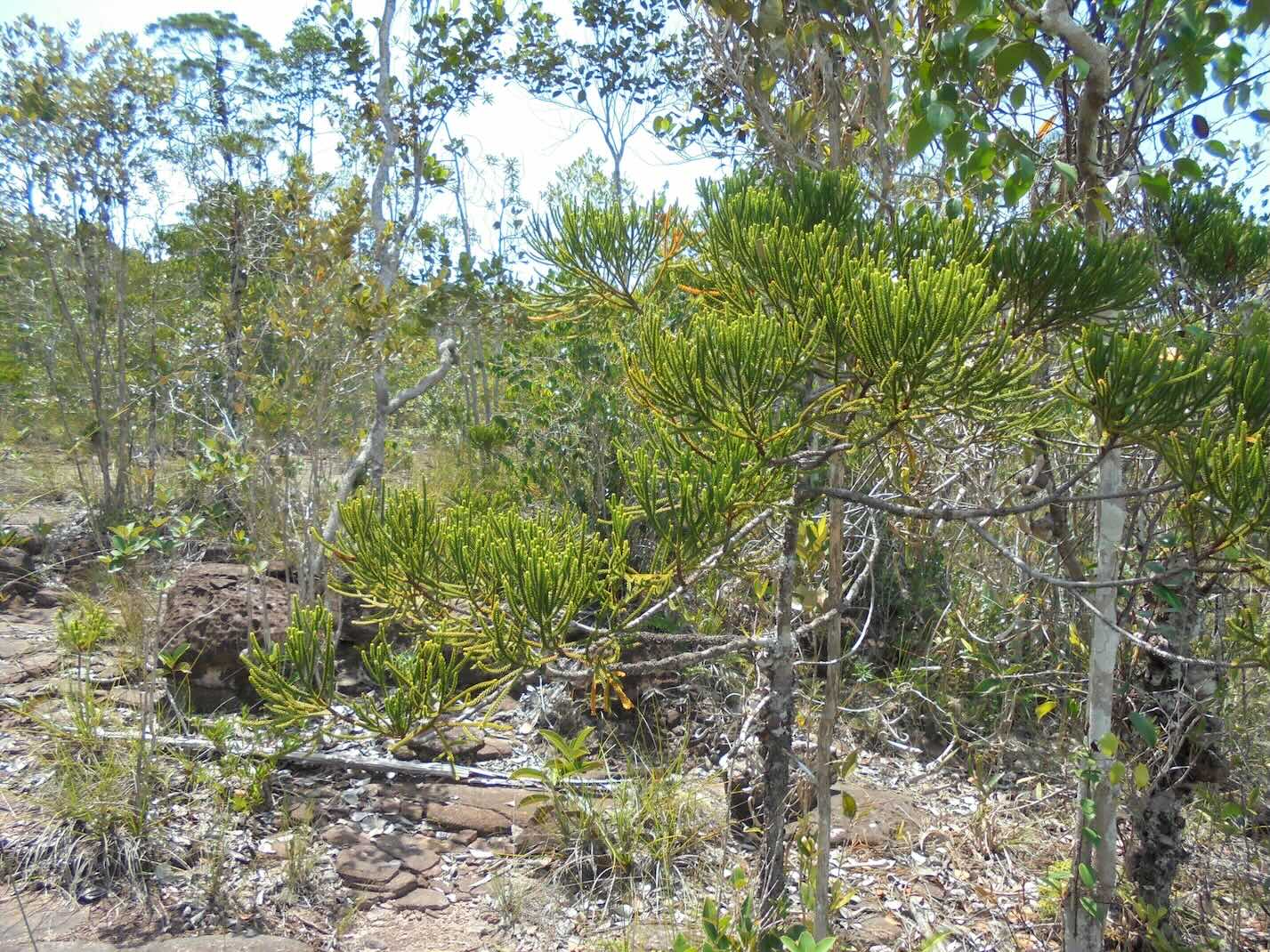
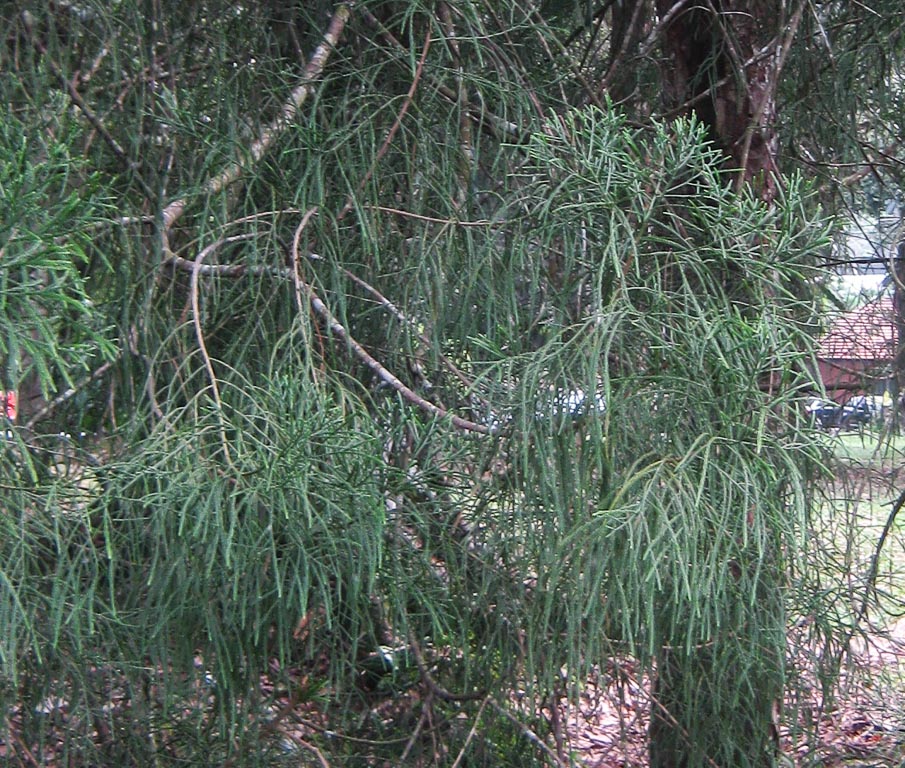
Shrub or small tree 1-20(-35) m tall, profusely branched with the branches turned upward, often forming a dense umbrella- or dome-shaped crown. Leaves are crowded so that shoots resemble a furry animal's tail. Juvenile leaves are nearly straight, linear-lanceolate, becoming gradually curved forward, strongly keeled on three sides, nearly flat on the axial surface, up to 17 mm long, 0.2 mm wide and 0.1 mm thick. Adult leaves are spreading, bent slightly forward but the apiculate tips still directed slightly outward, triangular in cross section, 5-10 mm long, 0.3-0.4 mm wide, 0.2 mm thick, crowded, linear-lanceolate. Cones are both lateral and terminal, subtended by about a dozen reduced leaves c. 1 mm long, the seed cone itself formed of a similar number of bracts up to 2 mm long and not completely covering the epimatium. There are 2(-3) seeds fully exposed at the apex of the structure. Pollen cones are both lateral and terminal, 7-10 × 2.5-3 mm, subtended by a cluster of sterile 1-2 mm long bracts. Apex of the microsporophyll is a lanceolate spur 1 × 0.3 mm. Seeds shiny, dark brown, c. 4 mm long (de Laubenfels 1988).
Distribution and Ecology
Brunei; Indonesia; Malaysia; Papua New Guinea (including Normanby Island and New Britain); Philippines (Mindanao; Negros; Biliran Island); Solomon Islands (Guadalcanal); Viet Nam. Grows at elevations of 600-2500 m (mean 853 m). Within its range, mean annual temperature is 22.5°C, with an average minimum in the coldest month of 18.3°C, and a mean annual precipitation of 3200 mm (Biffin et al. 2011). Recorded substrates include karst limestone, granite, andesite, and wet peaty soil (Farjon 2010).
Distribution data for all species, from GBIF Occurrence Download https://doi.org/10.15468/dl.yvmru2 accessed 2025.12.08. D. beccarii color is dark red. Click on any point for more info.
The usual habitat is as a codominant or dominant tree in low canopy (up to 20 m tall) mossy forest on leached, podzolic sandy soils (kerangas); it is particularly common on mountain ridges. In high, exposed locations it is an emergent low tree above dense scrub. Associated conifers may include Agathis spp., Dacrycarpus spp., Falcatifolium gruezoi (e.g. on Mt. Halcon in the Philippines), Nageia wallichiana, and sometimes Sundacarpus amarus (de Laubenfels 1988, Farjon 2010).
Zone 10 (cold hardiness limit between -1°C and +4.4°C) (Bannister and Neuner 2001).
In a 2011 assessment, the IUCN determined that this species is of "Least Concern" for conservation because of its large extent of occurrence; however, it is locally threatened by logging and land use conversion, particularly the clearing of keranga forest.
Remarkable Specimens
No data as of 2026-01-10.
Ethnobotany
In New Guinea, Dacrydium beccarii is exploited for timber for building houses and making drums. The bark serves as insulation for some houses in the highlands (Farjon 2010).
Observations
Many observations are recorded in Bako National Park, Sarawak; the area appears to offer easy access with a maintained trail system.
Remarks
The epithet honors Italian botanist Odoardo Beccari (1843-1920), who collected the type specimen.
Citations
Biffin, Ed, Timothy J. Brodribb, Robert S. Hill, Philip Thomas and Andrew J. Lowe. 2011. Leaf evolution in Southern Hemisphere conifers tracks the angiosperm ecological radiation. Proceedings of the Royal Society B, doi.org/10.1098/rspb.2011.0559. Data from Table S5.
Corner, E. J. H. 1988. Wayside Trees of Malaya, 3rd ed. Malayan Nature Society.
de Laubenfels, David J. 1988. Coniferales. P. 337-453 in Flora Malesiana, Series I, Vol. 10. Dordrecht: Kluwer Academic. Available: Biodiversity Heritage Library, accessed 2025.12.11.
Parlatore, F. 1868. Coniferae (Ordo CXCIX). Pp. 361-521 in A. P. de Candolle and Alph. de Candolle (eds.), Prodromus systematis naturalis regni vegetabilis, vol. 16, part 2. Paris (p. 494). Available: Biodiversity Heritage Library, accessed 2025.12.11.
Smythies, B. E. 1965. Common Sarawak trees. Borneo Literature Bureau, Kuching, Sarawak.
See also
Dallimore et al. 1967.

 Back to top