Pinus ayacahuite
Ehrenberg ex Schlechtendahl 1838
Common names
Ayacahuite pine, Mexican white pine [English]. Ayacahuite, ayaucuáhuitl [Nahuatl]; a´cxua´t [Totonaca, in Puebla]; acalocote [in Puebla]; acalocahuite [in Veracruz], pino cahuite [in Hidalgo]; ocote blanco, pino real [in Oaxaca]; ocote gretado, pinabete, pino tabla [in Chiapas] (Martínez 1979).
Taxonomic notes
Syn.: Pinus don-pedrii Roezl 1857, Pinus hamata Roezl 1857, Pinus loudoniana Gordon var. don-pedrii (Roezl) Carrière 1867, Pinus ayacahuite Ehrenb. ex Schltdl. var. oaxacana Silba 1990 (Farjon 1998).
Section Strobus. The variety brachyptera recognized by Perry (1991) and certain earlier authors, is here placed in synonymy with P. strobiformis, in accordance with the analysis by Farjon and Styles (1997). The variety veitchii recognized by most authors from 1909 to 2012 is here assigned to Pinus strobiformis Engelmann subsp. veitchii (Roezl) Frankis, for reasons explained under that taxon.
Description
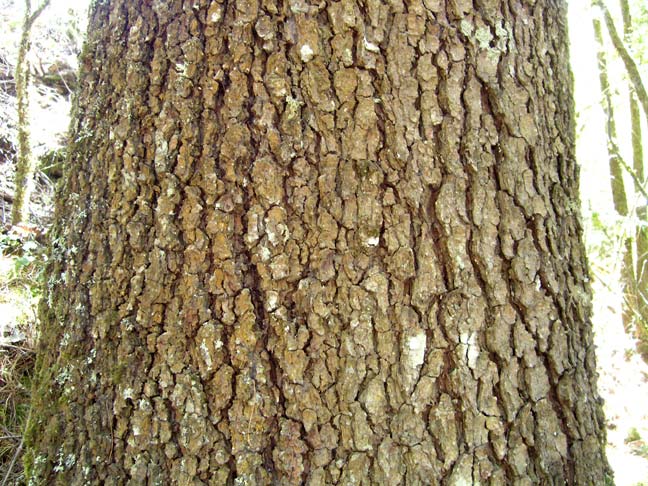
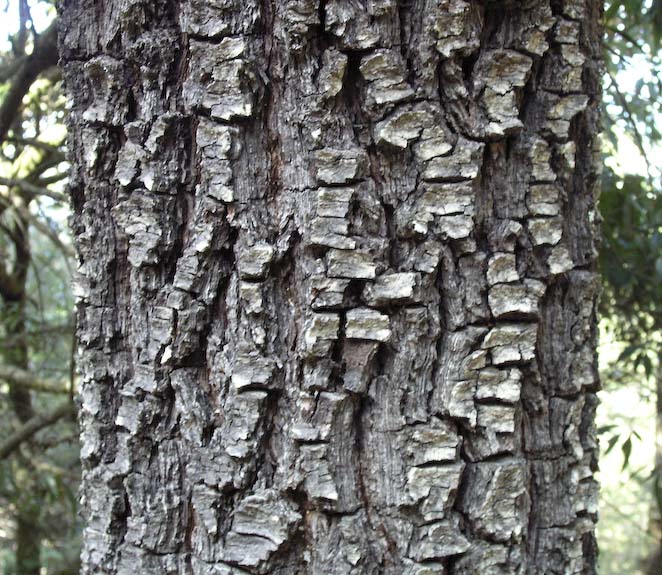
Tree to 45 m tall and 200 cm dbh, with a straight, round trunk and pyramidal to conical crown with regular branch whorls, becoming more irregular and open in old trees. Bark is thin, smooth, and ash-grey on young trees, with age becoming rough, gray-brown, divided into small rectangular plates. Branches long, slender, spreading horizontally, lower branches often drooping. Twigs slender, smooth, light gray with foliage grouped toward the end. Leaves 5 per fascicle (very rarely 6), slender, flexible, (8-)10-15(-18) cm × 0.7-1.0 mm, straight or slightly twisted, flexible but not drooping, abaxial surface bright green, adaxial surfaces glaucous with stomata, margins serrate with minute, widely spaced teeth; stomata only on ventral surfaces; resin canals 2-4(-7), external; fibrovascular bundle single; fascicle sheaths 15-20(-25) mm long, pale brown, early deciduous. Pollen cones crowded at ends of new shoots, ovoid to short cylindrical, 7-10 mm long, yellow, turning orange-brown. Seed cones borne near ends of main branches, usually in whorls of 2-4, with a peduncle to 25 mm long that falls with the cone, pendent, slightly curved, almost cylindrical, tapering toward apex, 15-40 cm × 7-15 cm when mature and open, yellow-brown, resinous; ripening in the fall and soon deciduous. Cone seed scales 100-150, thin, narrow, flexible, 5-7 cm long, apophyses elongate, apex rounded to obtuse, generally reflexed and curled; umbo terminal without a prickle and nearly always resinous. Seeds 2 per scale, light brown with dark spots, 8-10 × 6-8 mm with an adnate 20-35 × 8-12 mm wing. Cotyledons usually 11-13 (7-8 in Guatemalan specimens). Wood soft, cream-white, light, not very resinous. Pollen dispersal, in south-central Mexico, typically in May (Perry 1991, Farjon and Styles 1997).
In habitat, it is difficult to confuse this species with any other. It occupies higher and drier sites, and has much longer cones, than Pinus chiapensis.
Distribution and Ecology
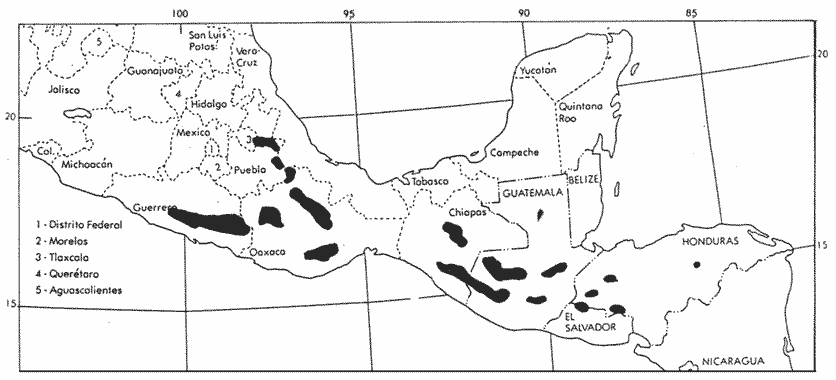
Mexico: Veracruz, Puebla, Hidalgo, Tlaxcala, Guerrero, Oaxaca, and Chiapas; also Guatemala, El Salvador and Honduras (Frankis 2008). Various authors have reported more westerly occurrences, which are here assigned to populations of P. strobiformis. P. ayacahuite typically grows as an emergent tree in mixed stands with other pines, and firs, at altitudes of (1,500-)2,000-3,200(-3,600) m. It grows best on well-drained moist loamy soils on relatively cool, moist sites, such as in riparian areas (Perry 1991, Farjon and Styles 1997). In Los Altos de San Miguel Totonicapán park, Guatemala, it grows with Pinus montezumae, P. pseudostrobus, P. hartwegii, P. oocarpa, Abies guatemalensis, and Hesperocyparis lusitanica (ParksWatch 2004).
Distribution data from USGS (1999) and herbarium data.
Hardy to Zone 7 (cold hardiness limit between -17.7°C and -12.2°C) (Bannister and Neuner 2001). See also Thompson et al. (1999).
Remarkable Specimens
I have no data on trees in habitat. Monumental Trees (accessed 2019.09.25) lists a 140 cm DBH tree, measured in 2016, at Bodnant Garden, UK; this is also the tallest tree listed at 31 m, and the oldest, at 117 years (planted in 1902).
Ethnobotany
This species provides one of the most important and sought-after softwoods of Mexico. Formerly very large trees were common, yielding large volumes of an attractive, easily worked timber that provided the raw material for furniture and finish carpentry throughout the country. Those great stands have been largely depleted now, especially in southern Mexico and Mesoamerica (Perry 1991, Farjon and Styles 1997).
A few dendrochronology studies have considered this species; it is mentioned in Heyerdahl and Alvarado (2003) but I don't know if it proved to be a useful species. One study performed in Oaxaca (Naylor 1971) found generally unsatisfactory results: all sampled trees were young, complacent, and could not be crossdated. This finding was attributed to an insufficiently seasonal climate. It was later used in a fire history study in Chihuahua, a more northerly and more seasonal climate (Fulé et al. 2005).
Observations
I have found it along Highway 175, the highway from Oaxaca city to Tuxtepec, Oaxaca. This is one of the best drives in the world if you like either driving or natural history; I have provided details HERE, and Perry (1991) also describes this route. P. ayacahuite is fairly common above about 2,500 m elevation.
Totonicapán forest in Guatemala harbors the largest and best-conserved stand of Pinus ayacahuite in Guatemala (ParksWatch 2004). Perry (1991) also suggests a visit to the area around kilometer 168 on Highway CA-1 west of Guatemala City, elev. 3,000 m, where trees over 40 m tall occur in an area locally called "Alaska."
In Honduras, it grows on the upper slopes of Cerro Santa Bárbara (2,800 m) and Cerro Celaque (2,900 m); a reliable guide is necessary to locate the trees (Perry 1991).
In El Salvador, it occurs above 2000 m on Cerro el Pital (Fernando Tobar email 2008.11.12).
Remarks
The epithet ayacahuite is a Romanization of the trees' Nahuatl name, ayaucuáhuitl.
The hybrid between P. ayacahuite and P. wallichiana occurred naturally in 1904 at the Westonbirt Arboretum in Gloucestershire, England. This fertile hybrid is called Pinus × holfordiana.
In Oaxaca, Chiapas and Guatemala, this species is a host to the dwarf mistletoe Arceuthobium guatemalense (Hawksworth and Wiens 1996).
Citations
Heyerdahl, E.K. and E. Alvarado. 2003. Influence of climate and land use on historical surface fires in pine-oak forests, Sierra Madre Occidental, Mexico. Pages 198-217 in T.T. Veblen, W.L. Baker, G. Montenegro, and T.W. Swetnam, eds., Fire and Climatic Change in Temperate Ecosystems of the Western Americas. New York: Springer-Verlag.
Martínez, M. 1979. Catálogo de Nombres Vulgares y Científicos de Plantas Mexicanas. Fondo de Cultura Económica. México, D.F. Cited at www.conafor.gob.mx:8080/documentos/docs/13/953Pinus%20ayacahuite.pdf, accessed 2013.12.28.
Naylor, T.H. 1971. Dendrochronology in Oaxaca, Mexico: a preliminary study. Tree-Ring Bulletin 31:25-29.
Schlechtendahl, D.F.L. von. 1838. Vorlaufige Nachricht uber die Mexicanischen Coniferen. Linnea: ein Journal für die Botanik in ihrem ganzen Unfange 12:486-496. Available: www.botanicus.org, accessed 2011.03.20.
See also
Elwes and Henry 1906-1913 at the Biodiversity Heritage Library. This series of volumes, privately printed, provides some of the most engaging descriptions of conifers ever published. Although they only treat species cultivated in the U.K. and Ireland, and the taxonomy is a bit dated, still these accounts are thorough, treating such topics as species description, range, varieties, exceptionally old or tall specimens, remarkable trees, and cultivation. Despite being over a century old, they are generally accurate, and are illustrated with some remarkable photographs and lithographs.
Farjon et al. 1997.
Wright, J.A., A. Marin V., and W.S. Dvorak. 1996. Ex situ gene conservation of Pinus ayacahuite, in Forest Genetic Resources No. 24. www.fao.org/docrep/008/w3354e/W3354E20.htm, accessed 2011.02.25.




 Back to top