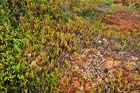
A stand of mature L. fonkii ca. 10 cm tall in habitat, Patagonia [Jeff Bisbee, 2013.02].
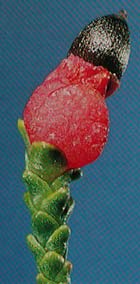
L. intermedius, ripe seed (Webb and Simpson 2001).
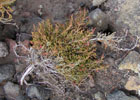
L. laxifolius, 15 cm tall and 20 cm across - old, for this species. On Mangotepopo shrubland, New Zealand [C.J. Earle, 2003.03.07].

Lepidothamnus
Philippi 1860
Common names
None, but the genus name is derived from the Greek and means scale-shrub; all members of the genus are small shrubs (one can be found as a small tree) with scale-like leaves.
Taxonomic notes
A genus of three species:
The genus (nothwithstanding Philippi's description of its South American member) was long included in Dacrydium, but de Laubenfels (1969) segregated the genus Falcatifolium and Quinn (1982) further segregated the genera Halocarpus, Lagarostrobos, and Lepidothamnus, leaving Dacrydium sensu strictu, in its present form. These segregations were made on the basis of differences in female cone morphology, a criterion that has been used as the taxonomic basis for differentiating all genera in the Podocarpaceae (Quinn 1982) (although leaf morphology has since been found to also provide a consistent basis for taxonomic distinctions in Podocarpaceae; cf. Biffin et al. [2011]). Quinn also observes that "the [three] species are united by their distinctive cone morphology with its erect ovule, the absence of resin ducts in the leaves which occur universally elsewhere in the family [cit.] and a large number of cupressoid cross-field pits not found elsewhere in the family. Chemically, these species are also unique in the family, having cupressuflavone as their major biflavenoid constituent (Quinn and Gadek 1981)."
Molecular studies, reviewed in the "Taxonomic notes" section of Podocarpaceae, have so far placed Lepidothamnus with Phyllocladus in a basal clade sister to all the other genera in the Podocarpaceae.
Description
"Trees, shrubs or creepers with narrow, linear spreading juvenile leaves giving way by gradual transition to strongly keeled, subulate, decurrent appressed scales. Plants dioecious or monoecious; male cones solitary, terminal or axillary; sessile. Female cones solitary and terminal, consisting of 3-5 bracts with very elongated bases, of which 1 or 2 are fertile. Each fertile bracts bearing within its axil an erect ovule" ... "that remains erect throughout its development" ... "and has a sharply reflexed micropyle. Seeds maturing in the second year, not compressed, becoming dark-brown to black and surrounded by an asymmetrical, membranous, basal sheath formed by the epimatium that is less than one-quarter the height of the seed. Bracts frequently becoming swollen, fleshy and pink to red at maturity" (Quinn 1982).
Distribution and Ecology
Chile and New Zealand (Quinn 1982) in mesic, lowland to subalpine vegetation associations. Like Pectinopitys, Podocarpus, Prumnopitys and Retrophyllum, the genus has representatives on both east and west sides of the Pacific Ocean. It thus predates the breakup of Gondwana, which happened in late Cretaceous time when South America separated from Antarctica.
Remarkable Specimens
The largest plants (though still not very big) are probably in L. intermedius, which also likely contains the oldest individuals.
Ethnobotany
Uses have been recorded only for L. intermedius.
Observations
See the species accounts.
Remarks
The genus name is from the Greek words for "scale" and "shrub".
Plants of this genus have been found in early Miocene (about 20 million years ago) sediments in southern New Zealand (Pole 2007).
Citations
Bentham, G. and J.D. Hooker. 1880. Coniferae, in Genera Plantarum (3)1:420-442. London. Available: Botanicus.org, accessed 2013.03.24.
Philippi, R.A. 1860. Zwei neue Gattungen der Taxineen aus Chile. Linnea 30: 730-735. Available: Botanicus.org, accessed 2013.03.24.
Quinn, C.J. and P. Gadek. 1981. Biflavones in Dacrydium sensu lato. Phytochemistry 20:677-681.
See also

 Back to top