Conservation Status

Prumnopitys taxifolia
(Banks & Solander) de Laub. 1978
Common names
Matai (Maori), black pine (Salmon 1996).
Taxonomic notes
Syn: Dacrydium taxifolium Banks & Solander ex D. Don 1837; Dacrydium mai A. Cunn. 1838; Podocarpus spicatus R. Br. in Horsfield 1838; Nageia spicata (R. Br.) F. Muell. 1876; Stachycarpus spicatus (R. Br.) Tiegh. 1891 (Farjon 1998).
There is an unsolved mystery of biogeography affecting P. taxifolia. In appearance it very closely resembles P. andina, native to the Andean forests of Argentina and Chile, mainly; morphology and, to a degree, molecular data identify a close relationship between the two taxa. The same issue, close similarity in appearance, habitat, and molecular taxonomy, affects the species pair Podocarpus totara of New Zealand and Podocarpus nubigenus of South America. This evidently attests to a dispersal event in the distant past, but the nature and timing of that event remain unknown. The two areas have not had a land connection since the late Cretaceous, which is a very long time for species pairs to maintain such a close similarity.
Description
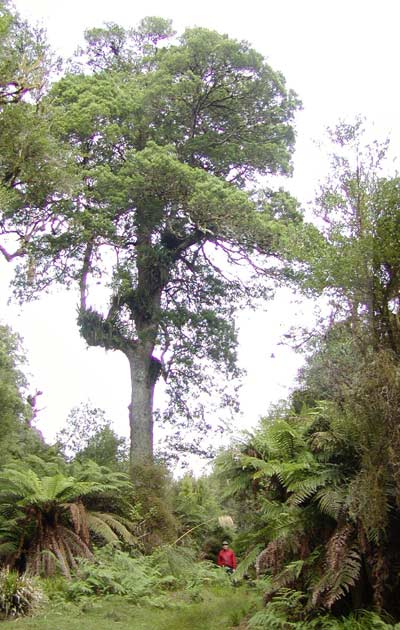
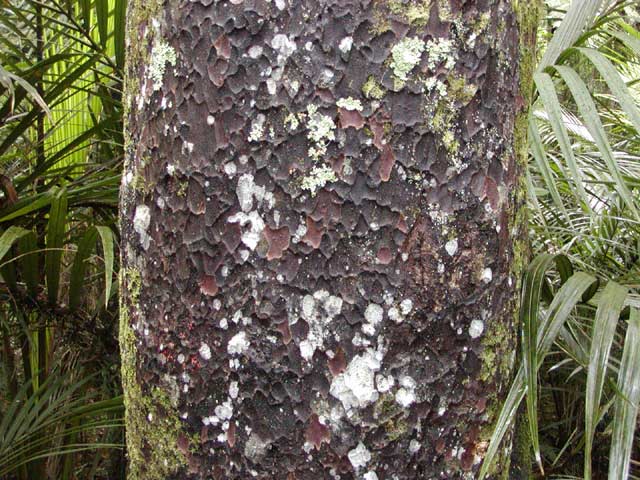
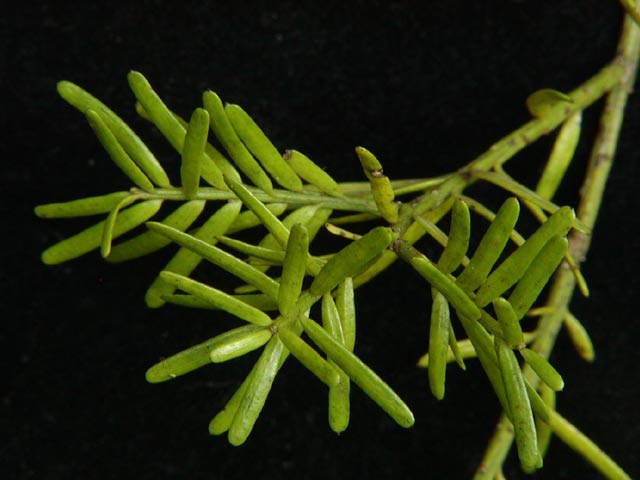
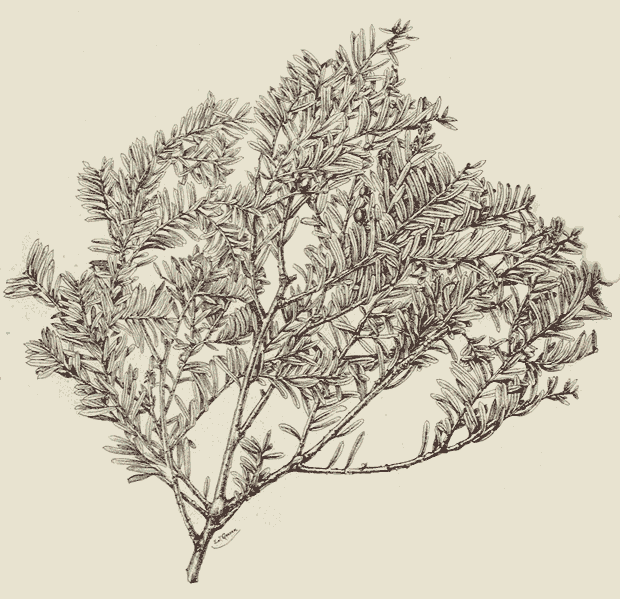
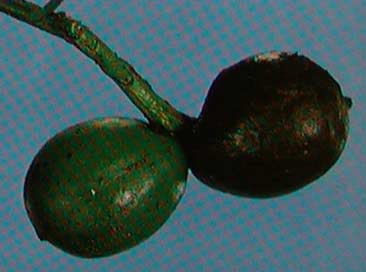
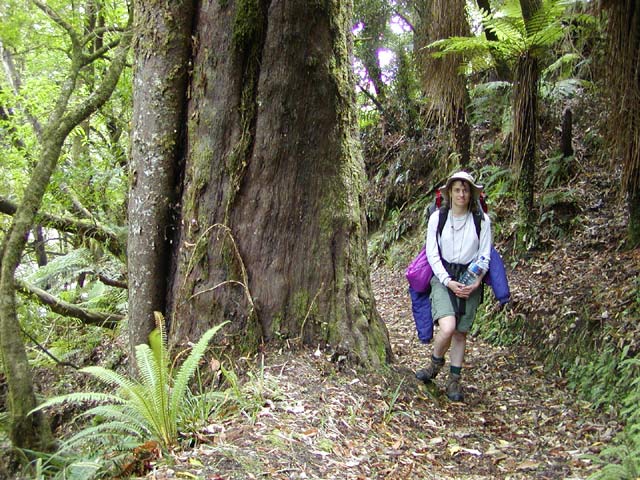
Dioecious tree up to 25 m tall and 125 cm dbh with a broad crown held on stout, erect, spreading branches. It forms a round-headed tree when mature which becomes more open and spreading as it ages. In the forest, matai trees can be recognised most easily from their bark. Grey-brown and punctate, it flakes off in thick rounded or ovoid chunks which leave reddish blotches on the trunk. The bark is commonly described as having a 'hammered' appearance, as if it were beaten brass. On young trees the flakes are larger and more irregular. Juvenile trees have the form of a shrub with slender, flexible, intertwining, drooping branchlets with yellowish or brownish-green leaves 5-10 × 1-2 mm. After a number of years the adult tree grows out from the top of this shrub and then the divaricating branchlets atrophy and fall away. Adults have leaves 1-1.5 cm. × 1-2 mm., linear, straight to subfalcate, obtuse, often apiculate, coriaceous, dark green, the undersurface silvery-blue, becoming darker as the leaves age. Pollen cones are in spikes, 3-5 cm. long, 10-30 per spike, and are often borne in great profusion. Ovules are tiny, 3-10 on a spike c. 4 cm. long, on short axillary branchlets; peduncle not swollen. Most ovules do not develop to seeds. Seeds are 5-9 mm. long, subglobose, apiculus obtuse: black, drupaceous (Allan 1961, Salmon 1996, pers. obs. 2003.03). See García Esteban et al. (2004) for a detailed characterization of the wood anatomy.
Distribution and Ecology
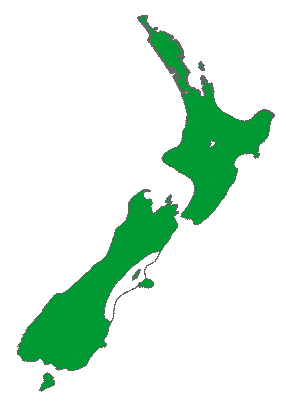
New Zealand: North and South Islands (Allan 1961). Based on data from 209 collection localities, its climate preferences include a mean annual temperature of 12°C, with an average minimum in the coldest month of 3°C, and a mean annual precipitation of 1570 mm (Biffin et al. 2011, Table S5). Zone 9 (cold hardiness limit between -6.6°C and -1.1°C) (Bannister and Neuner 2001).
Remarkable Specimens
The largest specimen ever recorded was discovered in 2019 near near Lake Kaniere; it is 280 cm dbh and 24.7 m tall (photos and details at New Zealand Tree Register 2019.12.21). Both the second and third largest specimens were also discovered in 2019, in the same area, by the same surveyors (Phil and Kevin Barker, Euan Mason), so this must be quite an impressive forest. There's also a historic record of a tree measured to be 23 m tall and 235 cm dbh that grew at Hari Hari, Lake Ianthe, Westland (Burstall and Sale 1984). This tree was damaged and removed in the early 2000's (Brad Cadwallader email 2011.01.01).
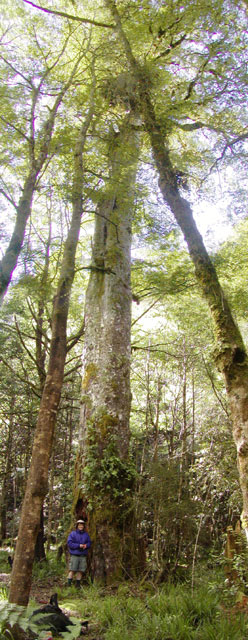
The tallest known tree, in the Pureora Forest, was measured in 2013 by Matt Smillie at 37.3 m tall (photo and details at New Zealand Tree Register 2019.12.21).
Burns et al. (1999) report an age of 1,358 years for a tree at the Paengaroa Scenic Reserve, near Taihape on the North Island. This was based on a ring-counted core with extrapolation to the geometric center of the tree. Due to ring wedging, the reported age based on a core sample is likely an underestimate, whereas ages determined by extrapolation tend to be overestimates. The tree was in an old-growth mixed forest in an area with a relatively dry, cool forest, that also yielded a 716-year-old specimen of Dacrycarpus dacrydioides.
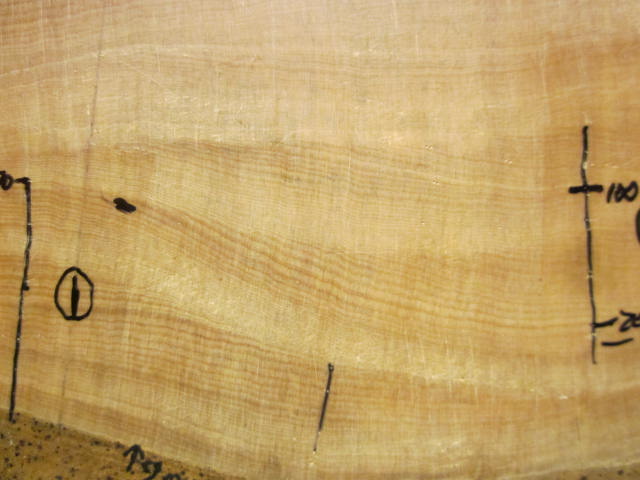
A sample recovered from a tree cleared during highway construction and prepared and counted by Claude Grayson in 2019 (email 2019.03.08) contains 1,185 rings, which is a limiting age. The sample shows severe ring wedging (photo) and thus may be even older.
Sparks et al. (1995) found a subfossil specimen with a 411-year tree-ring record.
Ethnobotany
See Conifers of New Zealand for a review of the historic role of forests in native and European cultures of New Zealand.
The wood is brown, heavy, very hard and brittle with a close, attractive grain. It is exceptionally strong and durable, much used for flooring and weatherboarding. It is also used, to a lesser extent, in the manufacture of furniture (Salmon 1996).
Matai has been explored for use in dendrochronology, but poses problems because is is subject to ring wedging (photo at right). "Ring wedging occurs when rapid radial growth occurs over several years in certain segments of the tree's circumference, while being extremely slow or absent in others... Examination of complete cross sections can help overcome this problem, and for some species accurate age counts must be based on cross sections rather than increment cores" (Norton and Ogden 1990). The species has seen limited use in a radiocarbon calibration study (Sparks et al. 1995).
Observations
Matai is fairly common in native forests of the North Island, at elevations from sea level up to about 500 m. The finest examples I have seen are in Pureora and Whirinaki Forest Parks, where it can be seen along virtually any trail. I particularly recommend the track along the Whirinaki River south of Minginui, and the 'Hunter's Track' in Pureora, where it grows with rimu (Dacrydium cupressinum), kahikatea (Dacrycarpus dacrydioides), totara (Podocarpus totara), and miro (Pectinopitys ferruginea) in a pristine, very old forest with complex structure.
Remarks
"Briggs and Loe (J. Chem. Soc. March 1950, 958-959) examined material of P. spicatus from the centre of North Island and found no kaurene, 'the only diterpene isolated was phyllocladene in very small yield'. Butler and Holloway (J. Soc. Chem. Ind. 58, 1939, 223) from South Island material isolated a diterpene which they suggested was kaurene. Briggs, Cawley, Loe and Taylor (J. Chem. Soc. March 1950, 956) examined a sample of Butler and Holloway's isolation, and 'It proved to be laevo-rotatory whilst the Debye-Scherer diagram indicated that it was mixture of kaurene and isokaurene'. No clear-cut morphological differences between the plants of North and of South Island have been found" (Allan 1961).
Citations
Allan, H. H. 1961. Flora of New Zealand. Volume I, Indigenous Tracheophyta. Wellington: R.E. Owen Government Printer.
Burns, B. R., M. C. Smale, and M. F. Merrett. 1999. Dynamics of kahikatea forest remnants in middle North Island: implications for threatened and local plants. Science for Conservation 113. Wellington, NZ: Department of Conservation. 23 pp. Available: www.doc.govt.nz/documents/science-and-technical/Sfc113.pdf, accessed 2014.08.25.
Laubenfels, David J. d. 1978. The genus Prumnopitys (Podocarpaceae) in Malesia. Blumea 24:189-190.
See also
Conifers of New Zealand.
The New Zealand Plant Conservation Network, accessed 2010.11.22.
Salmon 1996.
Wardle, P. 2001. Holocene forest fires in the upper Clutha district, Otago, New Zealand. New Zealand Journal of Botany 39:523-542.

 Back to top