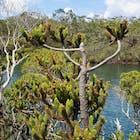
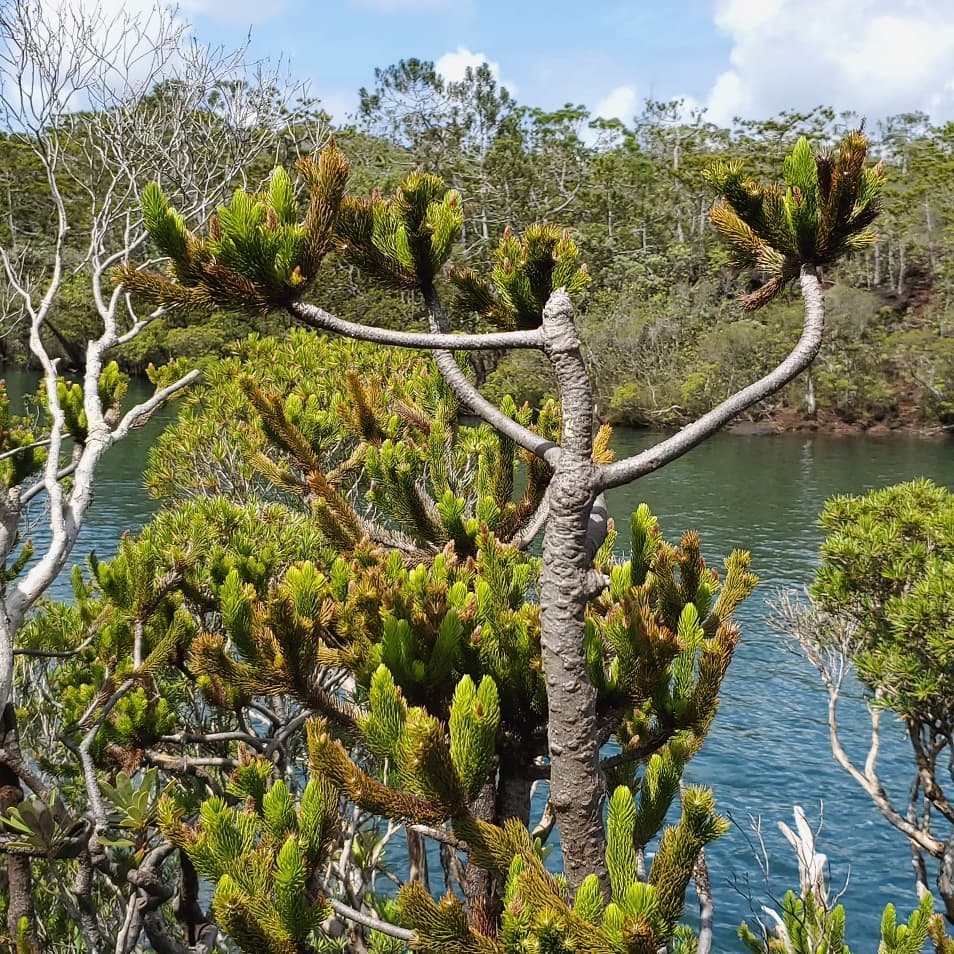
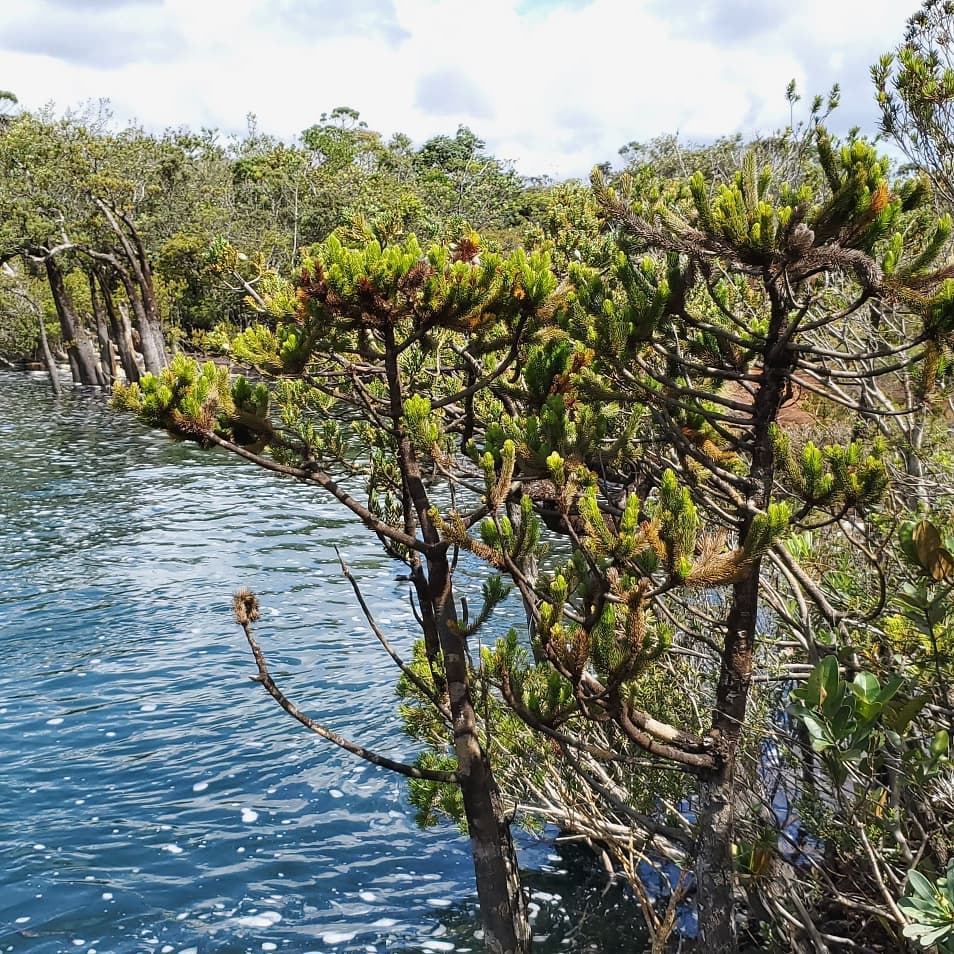
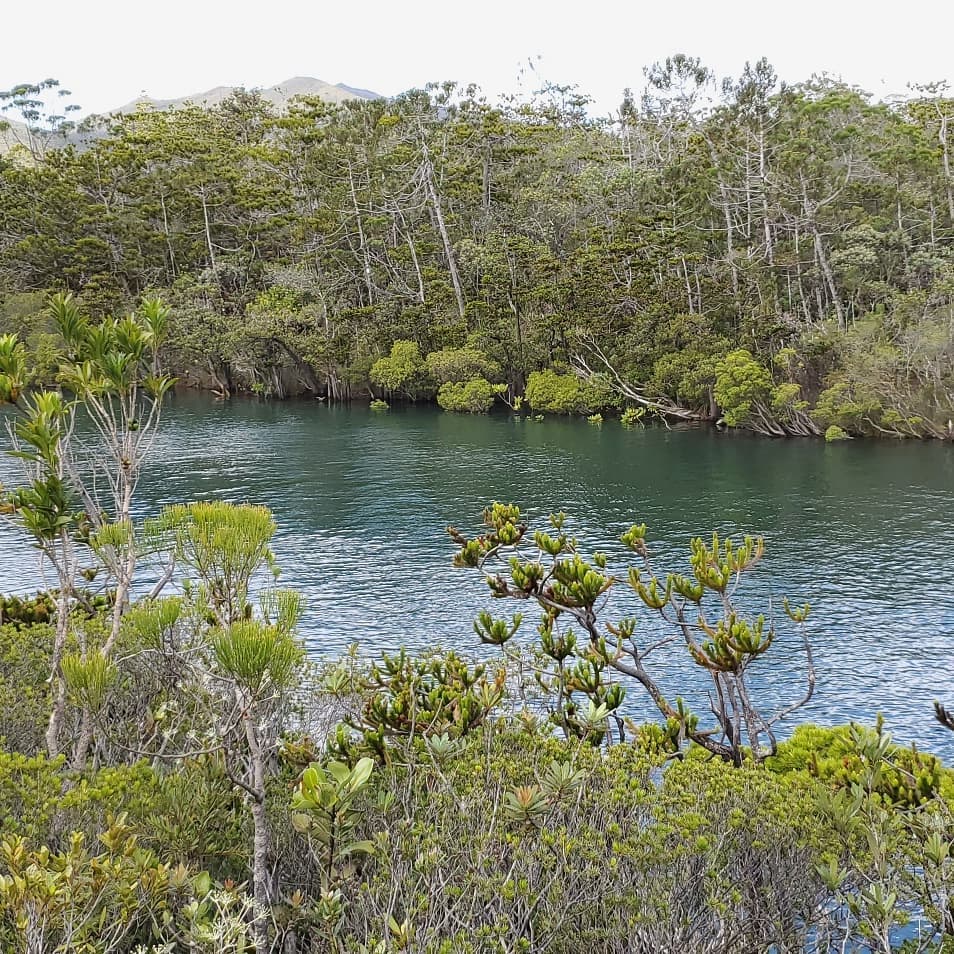
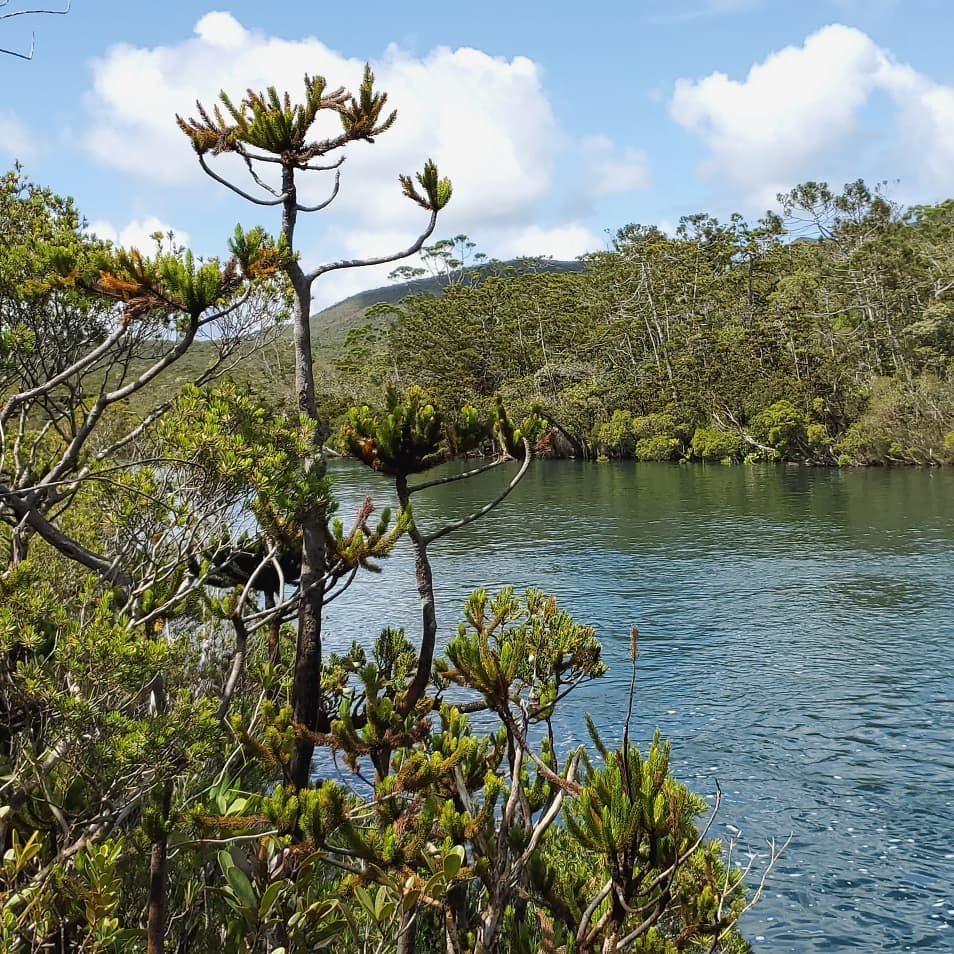
Tree in habitat, riparian/aquatic settings, often with Retrophyllum minus [Adam Black, 2020.02.02, Facebook post].
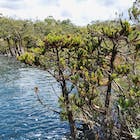
Tree in habitat [Adam Black, 2020.02.02, Facebook post].
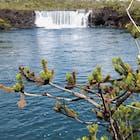
Tree in habitat [Adam Black, 2020.02.02, Facebook post].
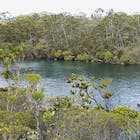
Tree in habitat [Adam Black, 2020.02.02, Facebook post].
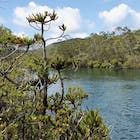
Tree in habitat [Adam Black, 2020.02.02, Facebook post].
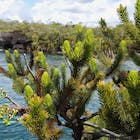
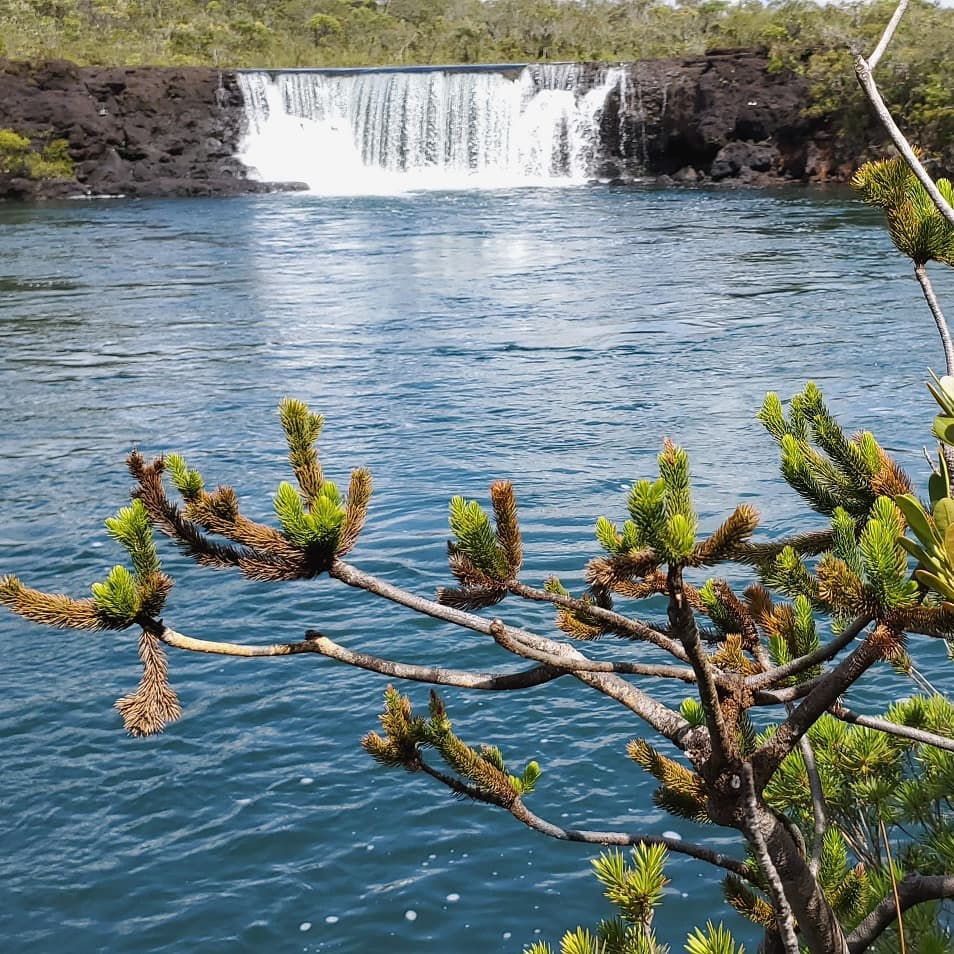
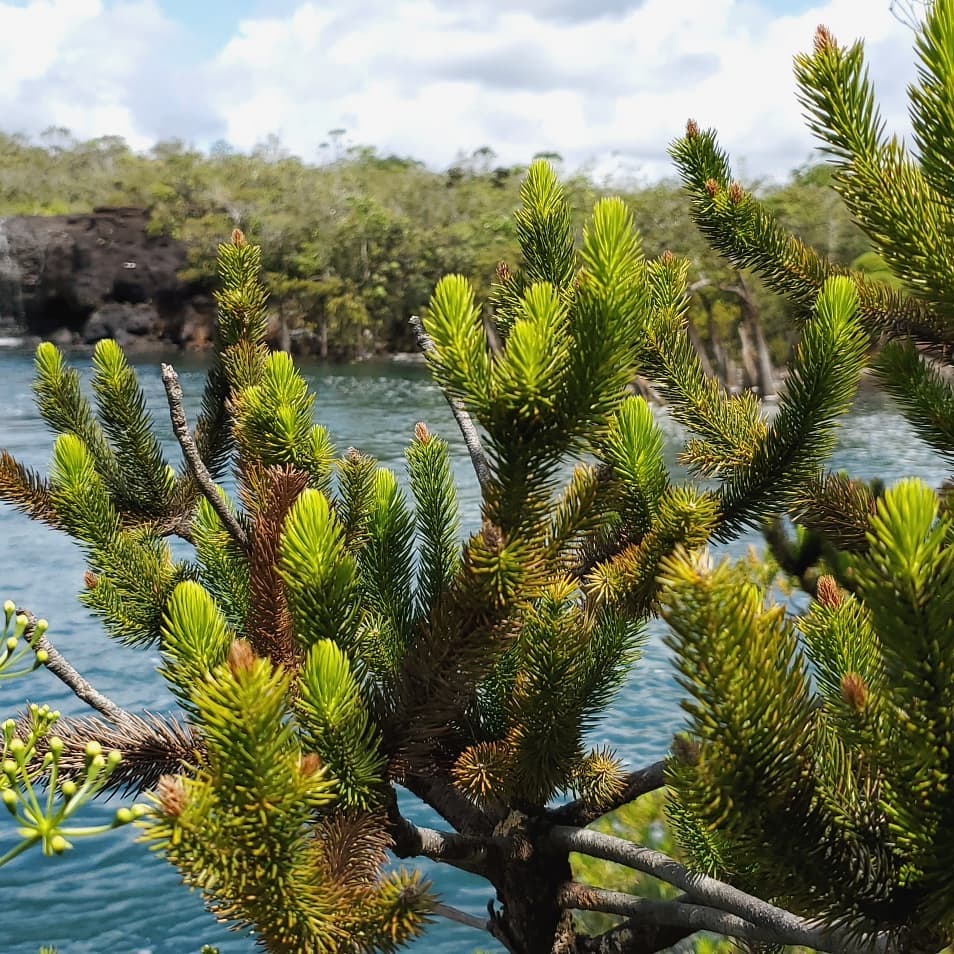
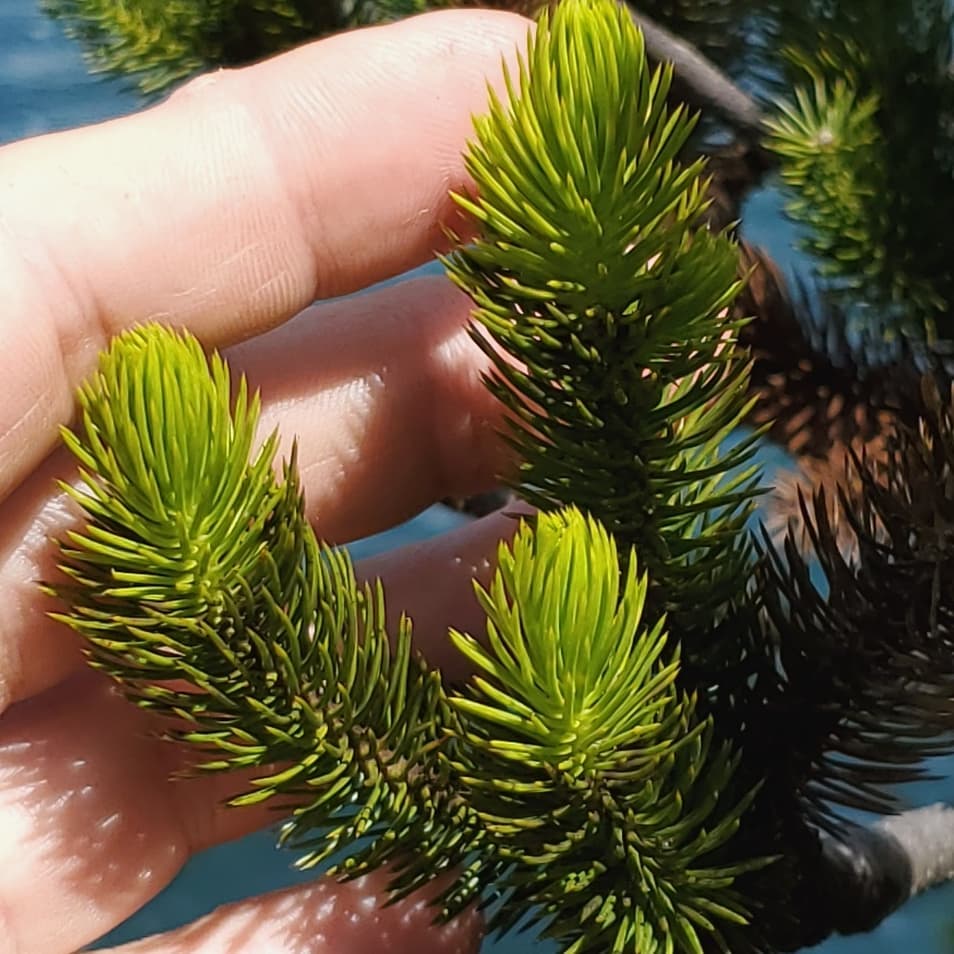
Foliage on tree in habitat [Adam Black, 2020.02.02, Facebook post].
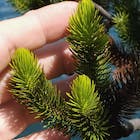
Foliage on tree in habitat Retrophyllum minus [Adam Black, 2020.02.02, Facebook post].
Video on New Caledonia vegetation; D. guillauminii, growing at the Chutes de Madeline, is featured between 24:38 and 26:24 [Crime Pays But Botany Doesn't 2020.02.02].

Conservation Status

Dacrydium guillauminii
J.Buchholz (1949)
Common names
No common names are recorded.
Taxonomic notes
Type: New Caledonia, Grande Terre, Province Sud, Chutes de la Madeleine, 1948.02.22, "Semi-aquatic, banks of River des Lacs at Madeleine Mine", J. T. Buchhholz 1728 (holotype NY00001328). Syn. Gaussenia guillauminii (J.Buchholz) A.V.Bobrov & Melikyan. The phylogenetic position is uncertain; see Dacrydium for discussion.
D. guillauminii is introgressed by D. araucarioides, which is a widespread species that covers the distribution of D. guillauminii. Also, D. guillauminii has lower genetic diversity than other species of Dacrydium studied (Keppel et al. 2011).
Dacrydium × suprinii Nimsch 2007 is a natural hybrid between this species and D. araucarioides.
Description
Shrubs 1-2 m tall, or small trees. Bark with small dark scales, fibrous, brown inside at first, covered with many small lenticels, then develops with age many small crevices. Densely branched. Leaves becoming very dense and less spread out with age but not at all reduced in size, sharp, needle-like, slightly compressed, imbricate, dense, 13-17 × 1 mm. Pollen cones terminal and lateral, the lateral ones are much smaller at the base below the terminal ones, 8-14 mm long, tapering off from the base. Microsporophylls lanceolate, long, pointed, 5 mm wide at the base of the male cone, 2 mm wide at the apex. Seed cones terminal, sometimes on very short lateral shoots, bracts resemble non-modified leaves, slightly reduced. Seeds up to 5 per cone, subterminal, oval, with lateral carina and rounded apex with projecting microsporophylls, 4.5 mm long, becoming almost erect, the bracts are exserted and surround the seeds (de Laubenfels 1972).
Distribution and Ecology
New Caledonia, where it "can only be found within a few kilometers along the river Madeleine (Riviére des Lacs) and along the riverbanks of Lac en Huit in New Caledonia, in which the river flows" (de Laubenfels 1972). Substrates in this area are ultramafic. The streams have a fairly constant water level and Dacrydium guillauminii occupies the streambanks; its roots are probably almost constantly submersed. It grows amidst crowded shrubby vegetation, with the crown of this small tree emergent above the shrubs. This unusual habitat supports the only two rheophytes known in all the gymnosperms, D. guillauminii and Retrophyllum minus. Both species occupy habitats where their roots are typically underwater or in fully saturated soils, and both contain a unique form of aerenchyma, such that air can move through their roots (Carlquist and Nazaire 2016).
This map shows herbarium records of Dacrydium species native to New Caledonia. Blue is D. araucarioides, green is D. balansae, orange is D. guillauminii, and red is D lycopodioides. Click on an icon for further information. Distribution data from GBIF (2020.03.30), edited to remove duplicates.
The IUCN reports that this taxon is critically endangered, facing an extremely high risk of extinction in the wild. It has an extremely restricted range of less than 36 km2 and is known to exist at only a single location. The total population size numbers fewer than 1000 mature individuals and is continuing to decline. The population trend is decreasing and the remaining plants are threatened by fire, tourism, impaired water quality, and reduced water supply.
Remarkable Specimens
No data as of 2026-01-10.
Ethnobotany
No data as of 2026-01-10.
Observations
De Laubenfels (1972) reports collections from the following sites:
- Riviére des Lacs (9 collections, 1 specifying elevation of 146 m).
- Lac en Huit (2 collections)
- Plaine des Lacs
- Mine Madeleine
Carlquist and Nazaire (2016) made their collections at the first of these sites, near the bridge over the Riviére des Lacs.
Remarks
The epithet honors professor A. Guillaumin, who assisted Buchholz (1949) with description of this species.
"Dacrydium guillauminii is clearly a very distinct species and one of the rarest conifers in the world. In general morphological terms, it is related to D. beccarii Parlatore from Malaysia and the Solomon Islands" (de Laubenfels 1972).
Citations
Buchholz, J. T. 1949. Additions to the coniferous flora of New Caledonia. Bull. Mus. Natl. Hist. Nat. (Paris), Sér. 2, 21(2):279–286. Available: Biodiversity Heritage Library, accessed 2020.02.10.
Carlquist, S., and M. Nazaire. 2016. SEM Studies of two riparian New-Caledonian conifers reveal air channels in stem wood; field observations. Aliso: A Journal of Systematic and Floristic Botany 34:1–7.
de Laubenfels, David J. 1972. No. 4, Gymnospermes, in A. Aubréville and Jean-F. Leroy, eds., Flore de la Nouvelle-Calédonie et Dépendances. Paris: Muséum National d'Histoire Naturelle. Available: Biodiversity Heritage Library, accessed 2025.12.12.
Keppel, G., P. Prentis, E. Biffin, et al. 2011. Diversification history and hybridisation of Dacrydium (Podocarpaceae) in remote Oceania. Australian Journal of Botany 59:262-273. doi.org/10.1071/BT10181
Knopf, P., H.Nimsch, and T. Stützel. 2007. Dacrydium × suprinii, sp. nova – a natural hybrid of Dacrydium araucarioides × D. guillauminii. Feddes Repertorium 118(1-2):51-59. Abstract: During excursions in New Caledonia in 1994, a hitherto undescribed natural hybrid between Dacrydium araucarioides Brongn. et Gris. and Dacrydium guillauminii J. Buchholz was found, for which the name Dacrydium × suprinii Nimsch sp. nova in honor of Bernard Suprin, Noumea, New Caledonia, is proposed. Morphological and site characteristics are presented.
Special thanks to Ferenc Kiss for providing the translation of de Laubenfels' text (2004.01).
See also
Association Endemia, a site devoted to New Caledonian species. Has excellent photos, a range map, and other information. In French.
The species account at Threatened Conifers of the World.
Dallimore et al. (1967).
de Laubenfels, D. J. 1969. A revision of the Malesian and Pacific rainforest conifers, I. Podocarpaceae, in part. Journal of the Arnold Arboretum 50:292-295. Available: Biodiversity Heritage Library, accessed 2025.12.14.
Sarlin. 1954. Bois et Forêts de Nouvelle Calédonie : 92 et pl. 21.
 Back to top