Pinus arizonica
Engelmann ex Rothrock 1878
Common names
Arizona pine; pino de Arizona [Spanish].
Taxonomic notes
Formerly, there were thought to be three varieties: arizonica, cooperi, and stormiae. Increasingly, though, both morphological and molecular evidence have accumulated to indicate that the named varieties are not only quite distinct taxa, but are also not particularly similar to typical P. arizonica, so that the species so arranged is paraphyletic. Accordingly, P. cooperi is here treated at species rank. P. arizonica var. stormiae, though, has not yet been described at species rank and so for now retains its misleading name. Nuclear and plastid DNA evidence are ambiguous with regard to the type variety of P. arizonica, with plastid evidence placing it sister to P. brachyptera but nuclear evidence placing it sister to P. engelmannii. Both lines of evidence place P. cooperi sister to P. durangensis, and var. stormiae sister to P. brachyptera, with high confidence (Willyard et al. 2021a). See the "Taxonomic notes" for Pinus ponderosa for further discussion.
For the type variety, synonyms include Pinus ponderosa Dougl. ex Laws. var. arizonica (Engelmann) Shaw 1909; and P. ponderosa Dougl. ex Laws. ssp. arizonica (Engelmann) Murray 1982. Type specimen collected in 1874 by J.T. Rothrock in the Santa Rita Mountains of Arizona (Farjon and Styles 1997).
Hybridization or introgression with P. scopulorum has been described for the population in the Santa Catalina Mountains of Arizona; P. scopulorum occurs at higher elevations and P. arizonica lower, with introgression occurring in the zone of overlap (Epperson et al. 2001).
Description
This describes the type variety; see P. arizonica var. stormiae for the description of that taxon.
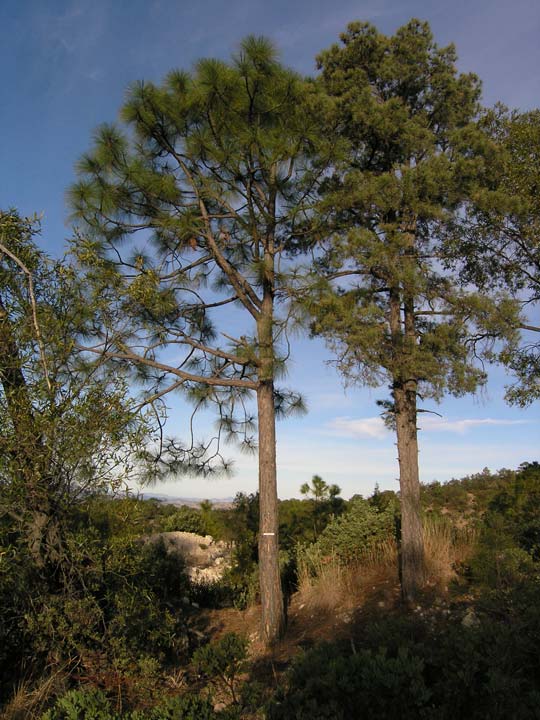
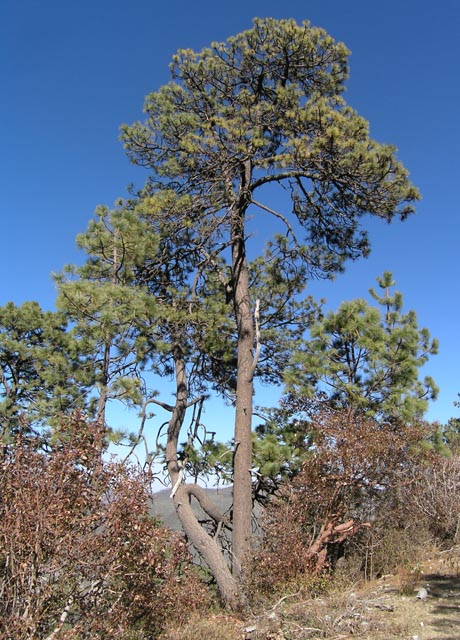
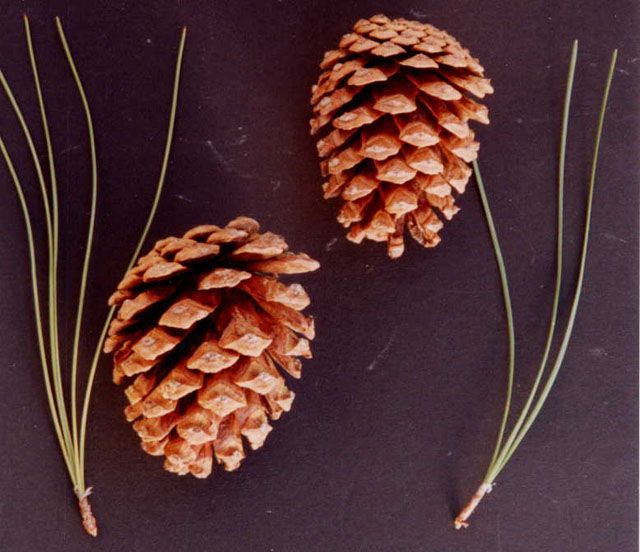
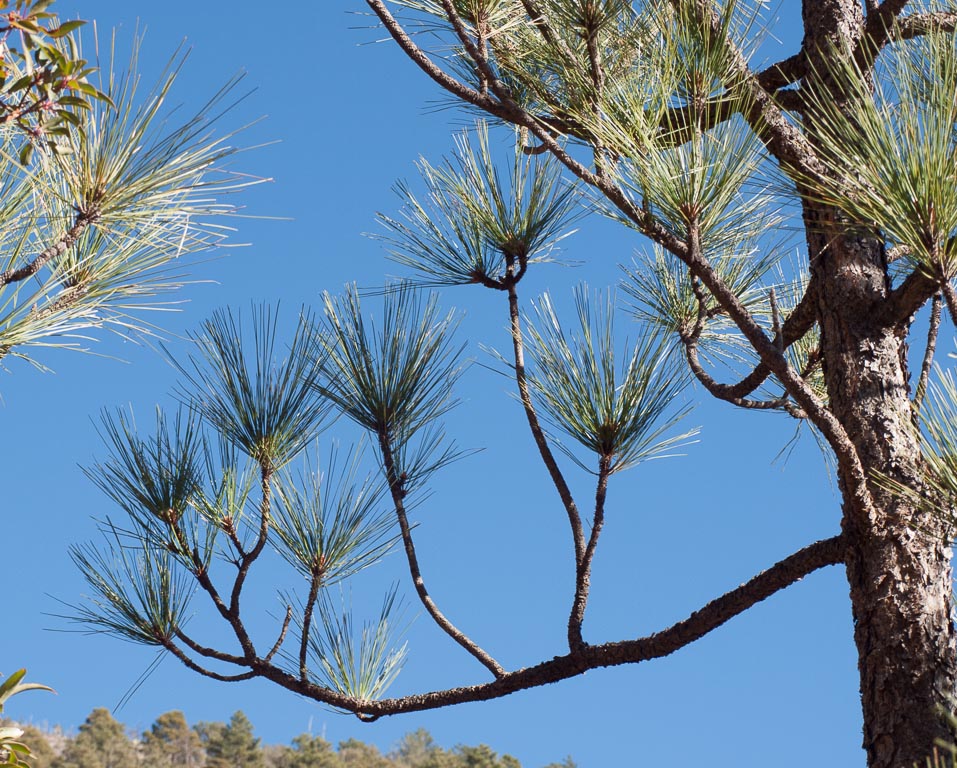
Monoecious evergreen trees to 35(-39) m tall and 70(-125) cm DBH. Leaves in fascicles of 3-4(-5), rigid to slightly lax, straight or slightly curved and twisted, (8-)10-20(-23) cm × 0.9-1.4(-1.6) mm. Stomata on all faces of leaves, in (3-)4-8 lines on the convex abaxial face and in (3-)4(-5) lines on each adaxial face (the abaxial number of lines proportional to width of leaf). Seed cones ovoid, often slightly curved, (4.5-)5-7 × 3.5-6 cm when open. Seeds obliquely ovoid, slightly flattened, 4-6 × 3-3.5 mm. Seed wings obliquely ovate, 12-15 × 4-6 mm. Pollen is dispersed in springtime, dependent on altitude and latitude (Farjon and Styles 1997).
There seems to be a cline in the number of leaves per fascicle, with trees having predominantly 3 leaves in Sonora, Chihuahua, and Coahuila, but 5 leaves in Durango. However, a number of exceptions have been collected (Farjon and Styles 1997).
P. arizonica is often confused with P. brachyptera in Arizona south of the Mogollon Rim, where the two species occur together and some introgression has been observed. Distinguishing characters include leaf number (3 in P. brachyptera, mostly 4-5 in P. arizonica), number of resin canals (2-6 in P. brachyptera and 6-10 in P. arizonica), and cone scales (large strong erect prickles in P. brachyptera and small incurved prickles in P. arizonica) (Perry 1991, Howard 2003).
Distribution and Ecology
This describes the type variety; see P. arizonica var. stormiae for the distribution of that taxon.
United States: Arizona and New Mexico; Mexico: Chihuahua, Coahuila, Durango, Nuevo León, Sinaloa, Sonora, and Zacatecas. Primarily found in the Sierra Madre Occidental at (1300-)2000-2700(-3000) m elevation on various substrates, but grows best in valleys and on mesas with deep soil, in moderately dry to mesic forest. Annual precipitation is low to moderate, 700-900 mm, mostly falling during the winter months, with occasional light winter frosts or snowfall. The trees may form pure stands, but more often are dominant in mixed Pinus-Quercus communities; it is also dominant or codominant in higher-elevation, montane mixed-conifer forests. Conifer associates include P. engelmannii, P. strobiformis), Pinus ayacahuite, Abies concolor, Pseudotsuga menziesii subsp. glauca, and occasionally Juniperus flaccida at lower or J. deppeana at higher elevations (Farjon and Styles 1997, Howard 2003).
Distribution data. Pinus arizonica (undifferentiated) shown in red, var. arizonica shown in orange, var. stormiae shown in blue, and P. cooperi shown in yellow. Data sources (click on data points to view) include my observations, Farjon & Styles (1997), and downloads from GBIF (2014) and SEINet (2014).
Like most pines, P. arizonica is wind-pollinated with wind-dispersed seeds that are primarily produced during mast years occurring every 2-3 years. Seeds germinate in summer, which is the rainy season within this species' range. Also like most pines, it is fire-adapted. Adaptations include high survivorship after low- and moderate-intensity fire, seeds that germinate best on a mineral substrate, and a generally low tolerance for shade. The Sky Islands habitats of southern Arizona are optimum range for this species, and have some of the highest lighting strike frequencies in the U.S.; those lighting strikes also tend to occur in association with summer storms, thus, fire at these times leaves both suitable soils and suitable moisture conditions for seedling germination and growth (Howard 2003).
As in most dry forests of the western U.S., fire frequencies in Pinus arizonica habitat have declined greatly in response to management that includes fire suppression and grazing (which removes fine fuels in the form of dried grasses); these changes have in turn led to accumulation of heavy fuel loads, and that has resulted in high-severity fires that eradicate pine forest over large areas. This pattern is especially apparent when the southern Arizona ranges are compared to ranges across the border in northern Mexico that have not experienced fire suppression; the Mexican ranges have a mean fire return interval of less than 5 years, and high-severity fires are rare (Howard 2003). However, the formerly extensive Mexican forests have been much reduced by logging, leaving a highly fragmented distribution (Perry 1991).
Climate change predictions for southern Arizona within the range of P. arizonica identify substantial warming and drying during the remainder of the 21st century, with periods of extended drought and peak summer temperatures 2.5 to 3°C warmer than currently; compared to historical norms, temperatures have already risen ca. 1.2°C. Snow cover is expected to decrease and fire frequency to increase, although summer rains may also intensify. Mountain-associated species (such as P. arizonica) are likely to respond through migration to higher elevations, which necessarily entails a reduced distribution; thus a declining area of occupancy and a declining population trend are both likely as a result of climate change, apart from other stressors such as development, fire suppression, and possible increases in pests, pathogens, and invasive species (USFS 2018). Although the IUCN has determined this species is not at risk, that assessment treats both cooperi and stormiae as infraspecific taxa of P. arizonica and is thus overestimating the species' extent; in view of the climate change impacts just discussed, this species may become threatened within the foreseeable future.
Remarkable Specimens
In 2021, the national champion tree in Arizona and measured 33 m tall and 121 cm dbh. This is substantially smaller than the tree that was champion in 2004, which was 38.7 m tall and 124 cm dbh (Robert Van Pelt e-mail 2004.02.04).
There are few age data. Work by Barton et al. (2001), presumably using living trees, has identified fire events going back to 1610. Thus trees 400 years or older probably occur.
Ethnobotany
The trees are harvested with associated pine species for construction lumber (Perry 1991). The species has seen some use in dendrochronology, including some stable isotope work and a stand dynamics study by Barton et al. (2001), done in the Chiricahua Mountains of Arizona.
Observations
This species is fairly common along Mex-16 in the vicinity of Parque Nacional Cascada de Basaseachic, as fine a place to visit as you are likely to find. It is also reasonably common in the higher mountain ranges of southern Arizona, such as the Santa Catalina, Santa Rita, and Chiricahua Mountains, where it grows with other species of subsection Ponderosae including P. brachyptera and P. engelmannii.
Remarks
In Mexico, this species is one of many principal hosts for the dwarf mistletoe Arceuthobium vaginatum subsp. vaginatum and, in Durango, A. verticilliflorum; in Arizona, New Mexico, Chihuahua, and Sonora it is also a principal host of A. vaginatum subsp. cryptopodum (Hawksworth and Wiens 1996).
Citations
Barton, A.M., T.W. Swetnam, and C.H. Baisan. 2001. Arizona pine (Pinus arizonica) stand dynamics: local and regional factors in a fire-prone madrean gallery forest of Southeast Arizona, USA. Landscape Ecology 16(4): 351-369.
Epperson, B.K., F.W. Telewski, A.E. Plovanich-Jones, and J.E. Grimes. 2001. Clinal differentiation and putative hybridization in a contact zone of Pinus ponderosa and P. arizonica (Pinaceae). American Journal of Botany 88: 1052-1057. Available: http://www.amjbot.org/cgi/content/full/88/6/1052, accessed 2007.11.19.
Howard, Janet L. 2003. Pinus arizonica. In: Fire Effects Information System, [Online]. U.S. Department of Agriculture, Forest Service, Rocky Mountain Research Station, Fire Sciences Laboratory (Producer). Available: https://www.fs.fed.us /database/feis/plant/tree/pinarz, accessed 2021.11.27.
Rothrock, J.T. 1878. Reports upon the botanical collections made in portions of Nevada, Utah, California, Colorado, New Mexico and Arizona during the years 1871, 1872, 1873, 1874, and 1875 (Washington: Government Printing Office), Vol. 6, Botany: p. 260. Available at the Biodiversity Heritage Library, accessed 2011.03.20.
Southwest Environmental Information Network (SEINet). 2014. http://swbiodiversity.org/portal/index.php, accessed 2014.03.01, now defunct.
USFS (United States Forest Service). 2018. Coronado National Forest Land and Resource Management Plan, Appendix A. Climate Change Trends and Coronado National Forest Land Management Planning. Available, accessed 2021.11.27.
See also


 Back to top